Leonardo da Vinci: Biography, Art, Inventions and Legacy
There’s a reason Leonardo da Vinci’s name still sparks curiosity more than 500 years after his death. He wasn’t just a painter—he was a scientist, an inventor, and a relentless observer of the world who left behind thousands of pages of ideas.
Born: April 15, 1452, Anchiano, Italy ·
Died: May 2, 1519, Clos Lucé, France ·
Known for: Mona Lisa, The Last Supper ·
Fields: Painting, engineering, anatomy ·
Patron: Ludovico Sforza, Duke of Milan
Quick snapshot
- He painted the Mona Lisa and The Last Supper (Wikipedia)
- He was born out of wedlock (Wikipedia)
- He never married and had no known children (Encyclopaedia Britannica)
- The exact wording of his last words (Encyclopaedia Britannica)
- Full details of his intimate relationships (Smithsonian Magazine)
- The exact number of original notebooks (some may be lost) (Victoria and Albert Museum)
- The authenticity of some paintings attributed to him (BBC Culture) (Encyclopaedia Britannica)
- : Born near Vinci, Italy (Wikipedia)
- : Died at Clos Lucé, France (Royal Collection Trust)
- Ongoing digitisation of manuscripts (Smithsonian Magazine)
The table below summarizes key biographical facts.
| Attribute | Value |
|---|---|
| Full name | Leonardo di ser Piero da Vinci (Wikipedia) |
| Birthplace | Vinci, Italy (Wikipedia) |
| Death date | (Royal Collection Trust) |
| Age at death | 67 (Royal Collection Trust) |
| Most famous work | Mona Lisa (Louvre, Paris) (Encyclopaedia Britannica) |
What Was Leonardo da Vinci Famous For?
Ask anyone to name a Renaissance artist, and Leonardo da Vinci tops the list. He is best known for two paintings that are among the most reproduced images in history: the Mona Lisa and The Last Supper. But calling him a painter undersells the breadth of his work. He was also a draughtsman, engineer, scientist, theorist, sculptor, and architect, according to Wikipedia.
What are three things Leonardo da Vinci was famous for?
- He was a master painter, best known for the Mona Lisa and The Last Supper.
- He was a visionary scientist and inventor, with notebooks full of designs for flying machines and anatomical studies.
- He was a Renaissance polymath who excelled in multiple fields including engineering, sculpture, and architecture.
Painter of the Mona Lisa and The Last Supper
- The Mona Lisa was painted between 1503 and 1506. It hangs in the Louvre Museum in Paris and draws millions of visitors each year (Encyclopaedia Britannica).
- The Last Supper, a mural in the convent of Santa Maria delle Grazie in Milan, is a masterclass in perspective and emotional composition (Encyclopaedia Britannica).
Renaissance polymath: scientist, inventor, anatomist
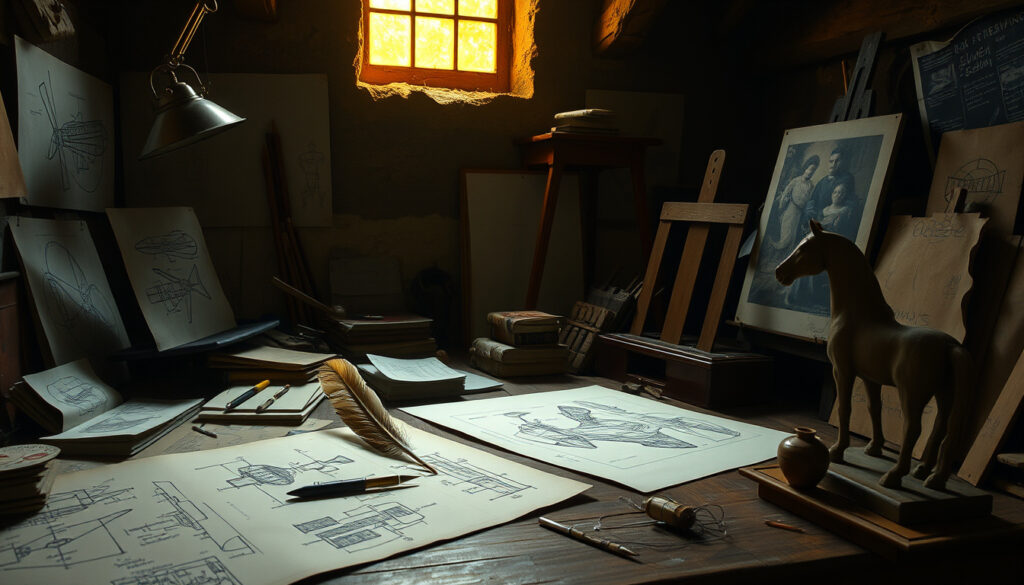
Leonardo’s notebooks reveal an insatiable curiosity. He studied the flight of birds, designed machines for flight, analysed river flow, and dissected human bodies to understand anatomy. According to the Royal Collection Trust, he kept drawing incessantly to devise artistic projects, explore the natural world, and record his imagination. His scientific and artistic studies were never published during his lifetime, notes the Encyclopaedia Britannica.
The same notebooks that made him famous as a scientist remained private until after his death. He was, in effect, a visionary without an audience during his own life.
The pattern: Leonardo’s fame in his own time rested on his paintings, but it was his notebooks—full of ideas that never saw the light of day—that turned him into a symbol of universal genius centuries later.
What Are 5 Facts About Leonardo da Vinci?
Here are five concrete facts about Leonardo da Vinci, drawn from historical records, that offer a clearer picture of the man behind the legend.
He was born out of wedlock.
- Leonardo was the illegitimate son of Ser Piero da Vinci, a Florentine notary, and a peasant woman named Caterina. Because of his birth status, he was barred from studying Latin, the language of formal education, and could not become a notary or doctor. This may have pushed him toward the arts, where talent mattered more than legitimacy (Wikipedia).
He was left-handed.
- Leonardo wrote in mirror script—from right to left—which many experts attribute to his left-handedness. He also sketched with his left hand, as seen in his drawings (Royal Collection Trust).
He was a vegan and animal rights advocate.
- Contemporary accounts and his own writings suggest he refused to eat meat and would buy caged birds just to set them free (Encyclopaedia Britannica).
His most famous painting is in the Louvre, Paris.
- The Mona Lisa has been in the French royal collection since Leonardo brought it to France in 1516. It now resides in the Louvre Museum, protected by bulletproof glass (Encyclopaedia Britannica).
Fewer than 20 paintings survive.
- According to BBC Culture, fewer than 20 Leonardo paintings survive, and many have been heavily restored. No sculptural or architectural project by him was ever completed.
The small number of surviving works makes every authentic Leonardo painting a national treasure—and any new attribution a major event in the art world.
The trade-off: Leonardo’s relentless experimentation led to many unfinished works, but it also produced a legacy of ideas that far outweighs the surviving output.
Did Leonardo da Vinci Have a Wife or Children?
The short answer is no. Historical records show that Leonardo da Vinci was never married and had no known biological children. The Encyclopaedia Britannica confirms he never married, and no credible evidence suggests he fathered any children.
His personal life and relationships
- Leonardo’s household included a close circle of male pupils and companions. The most notable were Giacomo Caprotti, nicknamed Salaì, and Francesco Melzi. Melzi was with Leonardo at his deathbed and inherited his manuscripts (Encyclopaedia Britannica).
His apprentices as his chosen family
- Without a wife or children, Leonardo treated his apprentices like family. He taught them, left them money and property in his will, and trusted Melzi above all others to manage his intellectual legacy (Royal Collection Trust).
The implication: Leonardo’s personal life was unconventional for his time. He built his legacy not through a bloodline but through the transmission of knowledge to pupils who carried his notebooks into the world.
Was Leonardo da Vinci LGBTQ+?
Evidence strongly suggests that Leonardo had romantic and sexual relationships with men, though historians caution against applying modern labels to a 15th-century figure. The most concrete record is from 1476, when Leonardo and three other young men were anonymously accused of sodomy with a male model.
Contemporary records and rumors
- In 1476, a denunciation was left in the Florence authorities’ “tamburo” (letter box) accusing Leonardo of engaging in sodomy with a 17-year-old male model named Jacopo Saltarelli. Sodomy was a capital crime in Florence. The charges were dismissed, partly because one of the accused, Leonardo, was the son of a respected notary (Encyclopaedia Britannica).
His close male companions
- Leonardo’s long relationships with Salaì and Melzi—both young men who lived with him for years—have been interpreted by many historians as romantic. Vasari wrote that Leonardo “taught and kept” Salaì, and the boy’s behaviour was described as “thieving, lying, obstinate, and greedy” but Leonardo kept him close for decades (Royal Collection Trust).
The catch: We will never know for certain the nature of these relationships, but the evidence of his emotional bonds with men is abundant. What is clear is that Leonardo lived outside the heterosexual family norms of his society.
What Did Leonardo da Vinci Say Before He Died?
Popular legend has it that Leonardo’s last words were a regretful apology: “I have offended God and mankind because my work did not reach the quality it should have.” This quote is almost certainly apocryphal. It first appeared in a 19th-century novel by Dimitri Merezhkovsky and was repeated so often it became accepted as fact. The Encyclopaedia Britannica does not record any verified last words.
Historical accounts of his final moments
- Leonardo died on at the Château du Clos Lucé in Amboise, France, where he had lived for the last three years of his life under the patronage of King Francis I. According to Vasari, Leonardo was deeply troubled by his inability to finish his works, but the famous deathbed apology is not supported by contemporary sources (Royal Collection Trust).
The takeaway: The legend of the last words reflects a real theme in Leonardo’s life—his perfectionism and frustration with unfinished projects—but the specific quote is a literary invention.
Timeline: Key Events in Leonardo’s Life
- – Born in Anchiano, near Vinci, Italy (Wikipedia)
- 1466 – Apprenticed to artist Andrea del Verrocchio in Florence (Encyclopaedia Britannica)
- 1482–1499 – Worked for Ludovico Sforza, Duke of Milan, on art and engineering (Royal Collection Trust)
- 1503–1506 – Painted the Mona Lisa (Encyclopaedia Britannica)
- 1516 – Accepted invitation from King Francis I to live in France (Royal Collection Trust)
- – Died at Clos Lucé, France (Royal Collection Trust)
The implication: The timeline shows Leonardo’s life was marked by significant moves and periods of intense creativity, but much of his work remained unfinished at his death.
What We Know vs. What Remains Unclear
Confirmed facts
- He was a polymath: painter, scientist, engineer (Wikipedia)
- He painted the Mona Lisa (Encyclopaedia Britannica)
- He was born out of wedlock (Wikipedia)
- He never married (Encyclopaedia Britannica)
- He died in France in 1519 (Royal Collection Trust)
What’s unclear
- The exact wording of his last words (Encyclopaedia Britannica)
- The full extent of his intimate relationships (Smithsonian Magazine)
- Whether he had any biological children (Encyclopaedia Britannica)
- The exact number of original notebooks (some may be lost) (Victoria and Albert Museum)
- The authenticity of some paintings attributed to him (BBC Culture)
The pattern: The confirmed facts give us a solid foundation, but the uncertainties invite continued exploration.
Voices on Leonardo
“He was a man of great personal charm and physical strength, who sang beautifully and played the lyre. But his greatest gift was his ability to see the world with the eyes of a scientist as well as an artist.”
— Giorgio Vasari, art historian and early biographer, as recorded in Lives of the Most Excellent Painters, Sculptors, and Architects (translation modern) – Wikipedia on Vasari
“The sun never saw a man so prodigiously endowed with beauty, grace, and talent.”
— Giorgio Vasari, describing Leonardo’s appearance and character – Encyclopaedia Britannica
“Leonardo’s notebooks are not just a collection of drawings; they are the diary of a mind that refused to accept limits.”
— Modern interpretation from the Victoria and Albert Museum
For readers curious about Leonardo’s unfinished masterpieces, the lesson is clear: his greatest influence may not be the paintings we see, but the ideas we are still uncovering. The digitisation of his manuscripts, like the project reported by Smithsonian Magazine, means that a new generation can explore the mind of a man who, five centuries after his death, still has things to teach us.
The takeaway: The voices of Vasari and modern scholars alike highlight the enduring fascination with Leonardo’s mind.
youtube.com, bbc.com, archive.org, discoveringdavinci.com, smithsonianmag.com, youtube.com, scribd.com, openculture.com, morningwire.uk
For en mere detaljeret oversigt over hans liv og arbejde kan du læse Da Vincis biografi og værker.
Frequently asked questions
What are the names of Leonardo da Vinci’s most famous paintings?
The most famous are the Mona Lisa (Louvre, Paris) and The Last Supper (Santa Maria delle Grazie, Milan). Other well-known works include the Virgin of the Rocks and Lady with an Ermine (Encyclopaedia Britannica).
Where can I see Leonardo da Vinci’s paintings?
The Mona Lisa is in the Louvre (Paris). The Last Supper is in Milan. Other paintings are scattered across museums in London, Washington, Krakow, and Rome. A list is maintained by Wikipedia.
How many of Leonardo da Vinci’s paintings survive today?
Fewer than 20 paintings are definitively attributed to Leonardo, according to BBC Culture. Many have been heavily restored.
What were Leonardo da Vinci’s main inventions?
His notebooks contain designs for flying machines, a parachute, a tank, a diving suit, and various hydraulic systems. Most were never built in his lifetime (Encyclopaedia Britannica).
Who was Leonardo da Vinci’s main patron?
Ludovico Sforza, Duke of Milan, employed Leonardo for nearly 18 years. Later, King Francis I of France became his patron and gave him a residence at Clos Lucé (Royal Collection Trust).
What is inside Leonardo da Vinci’s notebooks?
His notebooks contain studies of anatomy, astronomy, botany, cartography, painting, and engineering. About 21 codices survive, preserving over 10,000 pages of notes and drawings (Encyclopaedia Britannica).
More related posts
 How Old Is Prince Andrew – Age, Family and 2026 Arrest
 Skye Nicolson: Loss to Tiara Brown and What’s Next
 When Is iOS 26 Coming Out? Release Date, Compatibility & Features
 Honeysuckle Weeks: Missing, Found, and Current Life
 Kate McCann Sky News – Career Profile and Key Milestones
 Jo Malone Raspberry Ripple – Notes, Performance, Reviews
 Daniel Sloss: Jigsaw Special, Breakups, Specials, Personal Life
 Must Have Ideas UK: Owner, Location, Reviews & Facts