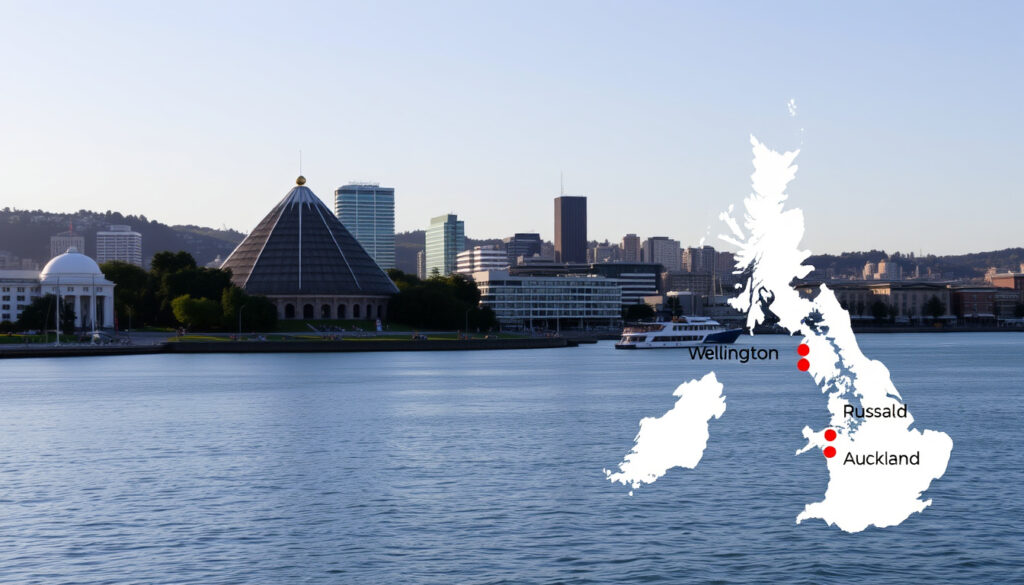
Capital of New Zealand: Three Capital and Why Wellington
If someone asks for New Zealand’s capital, most people say Wellington — and that’s correct. But the answer hasn’t always been that simple. New Zealand has cycled through three different capital cities in less than 30 years, starting with a tiny Bay of Islands settlement, shifting north to the booming port of Auckland, and finally settling on the harbor city at the bottom of the North Island.
Current capital since: 1865 ·
First capital: Old Russell (Okiato), 1840–1841 ·
Number of historical capitals: 3 ·
Largest city: Auckland ·
Capital population (approx.): 215,000 (Wellington city)
Quick snapshot
- Capital from 1840 to 1841. Located in the Bay of Islands. Chosen by Governor Hobson near the Treaty grounds. (Wikipedia – Capital of New Zealand)
- Capital from 1841 to 1865. On land offered by Ngāti Whātua. Remains the largest urban area. (Wikipedia – Auckland)
- Capital since 1865. Southern tip of North Island. World’s southernmost capital city. (Wikipedia – Wellington)
- Wellington is the current capital, not Auckland or Christchurch. Constitutional convention, not statute, cements Wellington’s status. Three capitals in 25 years — a rapid pace by global standards. (Waitangi Treaty Grounds)
What are the three capitals of New Zealand?
New Zealand had three distinct capital sites in just 25 years: Okiato (Old Russell), Auckland, and Wellington. Each relocation reflected a shift in political power, population centers, and colonial priorities. Here’s how the story unfolded.
The first capital: Old Russell (Okiato)
Okiato — also called Old Russell — was the first capital of New Zealand, designated by Governor William Hobson in 1840. Hobson chose the site in the Bay of Islands because it was close to the signing grounds of the Treaty of Waitangi (Waitangi Treaty Grounds). But the arrangement was short-lived. Hobson himself decided Okiato was unsuitable within the first year, and by 1841 the capital had already moved.
Why so fast? The site lacked deep-water access for larger ships, and the growing volume of European settlers and administrative traffic overwhelmed the small settlement. Hobson recommended a new location further south, and the government relocated to Auckland.
The second capital: Auckland
Auckland became New Zealand’s capital in 1841 after Hobson accepted an offer of land from the local iwi (tribe) Ngāti Whātua (Waitangi Treaty Grounds). The new site offered a large natural harbor on the Waitematā Harbour and better access to the expanding European settlements in the northern North Island. For the next 24 years, Auckland served as the seat of government.
But as New Zealand’s European population grew, a new problem emerged: Auckland sat too far north for representatives from the South Island, which was booming after the Otago gold rushes of the 1860s. The legislative commute from Dunedin or Christchurch to Auckland was long, expensive, and deeply unpopular.
The third capital: Wellington
Wellington became the capital in 1865 after a decade of political wrangling. Parliament first met there on a temporary basis in 1862 (Waitangi Treaty Grounds), and the official transfer happened when the fifth session of the 3rd Parliament opened in Wellington on 26 July 1865 (Wikipedia – Capital of New Zealand). Three Australian commissioners — brought in as neutral arbiters — evaluated multiple contenders including Wellington, Whanganui, Picton, Havelock, Port Underwood, and Nelson (Waitangi Treaty Grounds). They selected Wellington for its central location between the North and South Islands and its natural harbor (Waitangi Treaty Grounds).
New Zealand’s three-capital story is unusually compressed. Most countries take centuries to move a single capital; New Zealand did it twice within a generation, each time reacting to the loudest political pressure — first Māori land access, then South Island gold wealth.
Why is Auckland no longer the capital of New Zealand?
Auckland lost its capital status because it was too far north for the growing population and political power of the South Island. The gold rushes of the 1860s had shifted New Zealand’s economic center of gravity southward, and South Island MPs demanded a capital that didn’t require a week-long voyage just to attend parliament.
Geographic centralization was the core concern. South Island representatives argued that the seat of government should sit somewhere near the middle of the country. A parliamentary committee recommended Wellington for its central location (Wikipedia – Capital of New Zealand). The decision played out over roughly a decade, and the Australian commissioners’ endorsement of Wellington sealed the deal.
The catch: Auckland remains New Zealand’s largest city and economic engine. Its population of roughly 1.7 million dwarfs Wellington’s metro area of about 433,900 (Wikipedia – Wellington), but that economic weight hasn’t reversed the 1865 decision. Wellington’s capital status is now cemented by constitutional convention — no single piece of legislation declares it the capital, but every branch of government sits there (Wikipedia – Wellington).
The implication: Auckland’s economic dominance does not override Wellington’s political centralization, which is now a stable convention.
South Island political pressure
South Island voters and MPs were the loudest force for moving the capital. The Otago gold rush of the 1860s brought immense wealth and population to the South Island — Dunedin briefly became New Zealand’s largest city. Those representatives saw no reason to travel hundreds of kilometers north for every parliamentary session.
Three Australian commissioners visited Wellington, Whanganui, Picton, Havelock, Port Underwood, and Nelson before selecting Wellington (Waitangi Treaty Grounds). Their decision was final. The new site satisfied both islands: it was at the bottom of the North Island, directly across Cook Strait from the South Island, making it the most accessible meeting point.
Governor Grey’s relocation decision
Governor George Grey played a role in the transition. Parliament first met in Wellington on a temporary basis in 1862, and Grey supported making the arrangement permanent (Waitangi Treaty Grounds). The fifth session of the 3rd Parliament opened in Wellington on 26 July 1865, a date now regarded as the official transfer of the capital function (Wikipedia – Capital of New Zealand).
The pattern: Governor Grey’s support helped finalize the move that Auckland’s northern location had made inevitable.
Auckland’s 50 percent share of the national economy still creates a tension: the commercial capital and the political capital are split. That split is rare among OECD countries and means Auckland’s business interests must travel south to influence Wellington’s policy decisions.
What was the first capital of New Zealand?
The first capital of New Zealand was Okiato, also called Old Russell, located in the Bay of Islands. It served as capital from 1840 to 1841 (Wikipedia – Capital of New Zealand).
Russell vs Okiato distinction
A common confusion: the modern town of Russell (now a tourist destination in the Bay of Islands) is not the first capital. Okiato — about five kilometers south of present-day Russell — was the original settlement chosen by Governor William Hobson. Hobson purchased land from local Māori and named the settlement Russell. But the name and the location are separate from the current Russell township.
When the capital moved to Auckland in 1841, Okiato was quickly abandoned. The initial government buildings there fell into disrepair. Today, little remains at the site except a historical marker, but the Waitangi Treaty Grounds nearby serve as a major heritage center (Waitangi Treaty Grounds).
Treaty of Waitangi context
Hobson chose Okiato because it was close to the signing of the Treaty of Waitangi in February 1840. The treaty — New Zealand’s founding document — established British sovereignty, and Hobson needed a capital within easy reach of the treaty grounds to manage the transition from Māori to Crown governance. But the convenience didn’t outweigh the site’s practical limitations, and within a year he was pushing for a better location.
The pattern: New Zealand’s first two capitals were chosen for proximity to treaty and Māori land negotiations, not for long-term administrative viability.
Why is Wellington the capital of New Zealand?
Wellington became and remains the capital because of its central location between the North and South Islands, its natural harbor, and the 1865 decision by Australian commissioners that resolved a decade-long parliamentary deadlock.
Central location between North and South Islands
Wellington sits at the southwestern tip of the North Island, directly across Cook Strait from the South Island (Wikipedia – Wellington). That position makes it the most practical meeting point for representatives from both main islands. Before air travel, sea travel was the primary route, and Wellington’s harbor was the natural arrival point for South Island delegates.
Wellington’s central location was the deciding factor that satisfied both islands.
Natural harbor and defensibility
Wellington Harbour — known as Whanganui-a-Tara in Māori — is a deep natural harbor protected by the surrounding hills. The Australian commissioners noted the quality of the harbor as a key advantage over contenders like Picton and Nelson (Waitangi Treaty Grounds). Defensibility also mattered: Wellington’s steep hills offered natural protection against potential attack, though in practice the city is more famous for earthquake risk than military defense.
Official status since 1865
Wellington has been New Zealand’s capital since 1865 — a span of 160 years as of 2025. The seat of government is at the Beehive (the executive wing of the Parliament Buildings). Wellington is also home to the Supreme Court, the Reserve Bank of New Zealand, and most government ministries (Wikipedia – Wellington). It’s the world’s southernmost capital of a sovereign state (EBSCO Research Starters).
Notably, Wellington’s capital status is not enshrined in a single law — it’s a constitutional convention reinforced by 160 years of continuous government operation (Wikipedia – Wellington). No New Zealand government has seriously proposed moving the capital again since 1865.
“Wellington is often called New Zealand’s ‘culture capital’ and ‘creative capital’ because of its arts community and film industry.”
The takeaway: Wellington’s capital status is now so deeply embedded that moving it would require a constitutional crisis, which no major party has pursued.
How many capitals has New Zealand had?
New Zealand has had three capital cities: Okiato (Old Russell), Auckland, and Wellington. That’s an unusually high number for a single country — most nations change capitals once or never.
Timeline of capital shifts
Here’s the sequence at a glance:
| Period | Capital | Key Driver of Move |
|---|---|---|
| 1840–1841 | Okiato (Old Russell) | Proximity to Treaty of Waitangi grounds |
| 1841–1865 | Auckland | Better harbor, larger settlement, Māori land offer |
| 1865–present | Wellington | Central location, South Island political pressure, harbor |
The pattern: each move was driven by a different pressure — first proximity to Māori treaty negotiations, then colonial expansion, then South Island gold-rush power. Wellington’s 160-year tenure suggests the process has finally settled.
Why three capitals instead of one
New Zealand’s three-capital history reflects the country’s rapid early growth and its two-island geography. Within 25 years of becoming a British colony, the population shifted from the far north (Bay of Islands) to the upper North Island (Auckland) and then demanded a center between the two main islands. The result is a capital history that’s more complex than most — but also more grounded in practical compromise.
Clarity section
Confirmed facts
- Wellington is the capital of New Zealand since 1865 (Wikipedia – Capital of New Zealand)
- New Zealand has had three capitals (Wikipedia – Wellington)
- Auckland was capital from 1841 to 1865 (Wikipedia – Auckland)
- Wellington is the world’s southernmost capital (EBSCO Research Starters)
- Parliament opened in Wellington for the first time on 26 July 1865 (Waitangi Treaty Grounds)
What’s unclear
- Why exactly Okiato was abandoned so quickly — limited historical records survive about the conditions (Waitangi Treaty Grounds)
- Whether any New Zealand government in the future might consider relocating the capital again — no formal proposal exists
- The official population figure for Wellington city (215,000) is an estimate and may vary by source (Wikipedia – Wellington)
- The exact number of years Wellington has been capital (160 as of 2025) depends on counting from 1865 (Wikipedia – Capital of New Zealand)
- The role of the Australian commissioners is sometimes described as mediation rather than arbitration (Waitangi Treaty Grounds)
Timeline signal
Three quick shifts within 25 years, then stability for 160 years — the timeline tells a story of early instability that resolved into durable consensus.
- 1840–1841: First capital at Okiato (Old Russell) (Wikipedia – Capital of New Zealand)
- 1841–1865: Capital moves to Auckland (Wikipedia – Auckland)
- 1865–present: Wellington designated the capital city (Wikipedia – Wellington)
The pattern: New Zealand’s first 25 years as a colony saw two relocations. Once Wellington was chosen, no serious movement to change it emerged — unlike some nations that debate capital moves for generations.
What’s next
Wellington’s capital status is secure through constitutional convention and institutional inertia. No political party or region has mounted a credible campaign to move the capital elsewhere — not even Auckland, despite its economic dominance. The shift from a raw colonial outpost to a stable two-island democracy is now complete, and the capital sits exactly where the 1865 commissioners placed it.
The trade-off: Wellington’s small size (215,000 city proper) means it lacks the scale of other national capitals like Canberra, Ottawa, or Brasília. But that’s part of its character — a compact government town at the bottom of the world.
Expert perspectives
“I shall lose no time in fixing the seat of Government at the Bay of Islands… I have chosen Okiato.”
— Governor William Hobson, 1840, on selecting the first capital (Waitangi Treaty Grounds)
“The offer of land by Ngāti Whātua was crucial in establishing Auckland as the capital. It was a generous gift that shaped the country’s future.”
— Waitangi Treaty Grounds historical notes (Waitangi Treaty Grounds)
“Wellington is the world’s southernmost capital city, situated at the southwestern tip of the North Island.”
— Wellington City Council (via Wikipedia – Wellington)
For New Zealanders and travelers, the capital question has a clear answer — Wellington — but the history behind it is richer than most people realize. Three capitals in 25 years reflects a country that grew faster than its institutions could keep up. For anyone planning a visit or researching New Zealand’s government, the key takeaway is this: Wellington earned its seat through geography and compromise, and 160 years of continuous government have made that convention unshakeable.
Visitors to New Zealand’s capital will find plenty to do, from sampling coffee to enjoying dramatic coastline, as explored in a guide to exploring Wellingtons attractions.
Frequently asked questions
What is the capital of New Zealand?
Wellington is the capital of New Zealand. It became the capital in 1865 and is located at the southern tip of the North Island (Wikipedia – Capital of New Zealand).
Is Auckland still the capital of New Zealand?
No, Auckland was the capital from 1841 to 1865. It ceased being the capital when the seat of government moved to Wellington in 1865 (Wikipedia – Capital of New Zealand).
Why was Wellington chosen as capital?
Wellington was chosen for its central location between the North and South Islands, its natural harbor, and the recommendation of Australian commissioners who evaluated multiple candidate sites in 1865 (Waitangi Treaty Grounds).
When did Wellington become the capital?
Wellington became the capital on 26 July 1865, when the fifth session of the 3rd Parliament opened there (Wikipedia – Capital of New Zealand).
Is Christchurch the capital of New Zealand?
No, Christchurch is not the capital. Christchurch is the largest city in the South Island, but the capital is Wellington (Wikipedia – Capital of New Zealand).
What is the capital of New Zealand South Island?
No city in the South Island is the capital of New Zealand. The capital, Wellington, is located at the southern tip of the North Island (Wikipedia – Wellington).
More related posts
 Holiday World Polynesia Hotel – Reviews, Booking and Family Guide
 Smriti Mandhana: Personal Life, Marriage, and Net Worth Rumors
 PSG vs Aston Villa – Preview, Team News, Predictions
 Jill Wagner: Actress Biography, Husband, Children, and Hair Change
 Newcastle United F.C. vs Everton F.C. Standings – Current Table, H2H and Form Stats
 Tanya Roberts: Cause of Death, Sepsis, Will, and More
 Leylah Fernandez: Age, Ranking, Net Worth, and Career Stats (2025)
 Alain Delon: Biography, Love Life, Movies, and Legacy