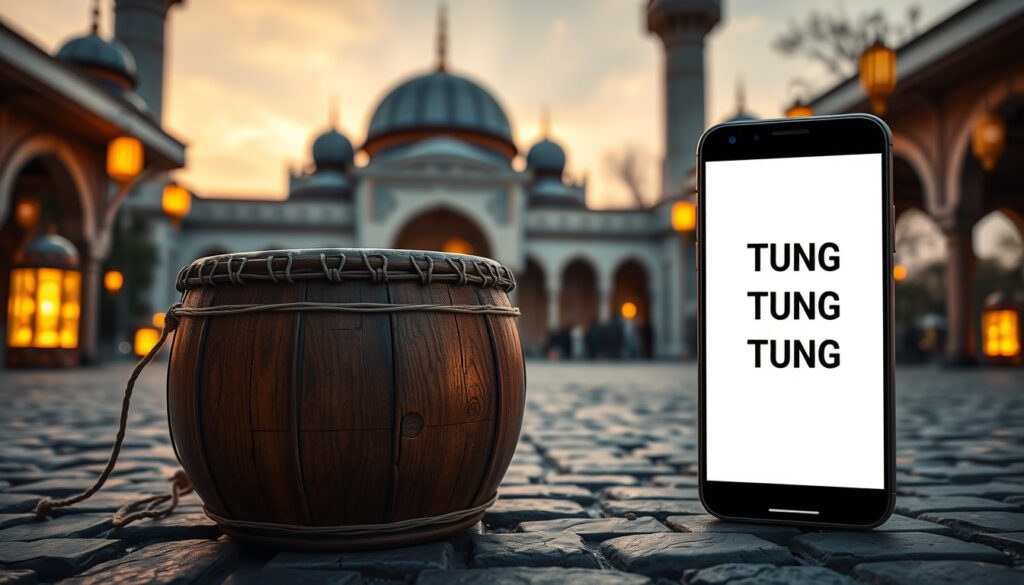
Tung Tung Tung Sahur Meaning – From Ramadan Tradition to Viral Meme
The phrase “tung tung tung sahur” has travelled from the streets of Indonesia to screens across the world, becoming one of the most recognisable sounds in online culture during 2025. While millions encounter it daily in memes and viral videos, the meaning behind the chant runs deeper than its absurdist internet persona suggests.
At its core, “tung tung tung sahur” is a reference to a centuries-old Islamic tradition: the pre-dawn drumming that signals the last meal before a day of fasting during Ramadan. The phrase blends onomatopoeia for a drumbeat with the name of that meal, creating a bridge between cultural practice and internet comedy.
What is the Meaning of Tung Tung Tung Sahur in English?
Breaking the phrase into its components reveals its literal meaning. “Tung tung tung” mimics the sound of a drum being struck repeatedly, while “sahur” refers to the pre-dawn meal eaten before fasting begins during Ramadan. Together, the expression roughly translates to “drum drum drum, time for sahur” — a wake-up call spoken in sound rather than words.
The Indonesian phrasing carries cultural weight that a direct English translation cannot fully capture. “Sahur” itself derives from Arabic (سحور), meaning the meal consumed before dawn, and is known as suhoor in other regions. The drum sound adds an auditory dimension rooted in local tradition, distinguishing the phrase from a simple verbal announcement.
The phrase has two layers: “tung tung tung” is Indonesian onomatopoeia for drumming, and “sahur” is the pre-dawn meal eaten before Ramadan fasting. Combined, it functions as a rhythmic wake-up signal rooted in cultural practice.
Four-Item Overview
Key Insights on Tung Tung Tung Sahur
- The phrase references the bedug, a large double-headed drum used in Indonesian mosques and communities to signal prayer times and, specifically during Ramadan, to call people to sahur.
- Community members historically patrol neighbourhoods chanting “tung tung tung sahur” while beating the drum, a tradition serving both a practical and communal purpose.
- Early traces of the phrase online date to at least 2013, when a tweet referenced “Sahur sahur tung tung tung,” marking the beginning of its digital presence.
- The meme surged in February 2025 when a TikTok user posted an AI-generated video of an anthropomorphic log character wielding a baseball bat, set to the chant.
- Scholars and cultural commentators classify it as a brainrot meme — content designed to provoke laughter through repetition, absurdity, and low-context humor rather than narrative depth.
- Its cultural resonance remains strongest in Indonesia, though global spread through TikTok, Reddit, and YouTube has introduced it to audiences far removed from Ramadan traditions.
- The meme has spawned variations, powerscaling jokes, and crossover content with other brainrot figures such as Brr Brr Patapim and Hotspot Bro.
Tung Tung Tung Sahur Facts at a Glance
| Aspect | Details |
|---|---|
| Literal Meaning | Drum sound (“tung tung tung”) + pre-dawn meal (“sahur”) |
| Cultural Context | Ramadan wake-up practice in Indonesia and Malaysia |
| Meme Form | AI-anthropomorphic log character holding a baseball bat |
| Viral Surge Date | February–March 2025 |
| Arabic Equivalent of Sahur | Suhoor (سحور) |
| Meme Classification | Brainrot / absurdist internet humor |
| Earliest Online Mention | 2013 tweet referencing the phrase |
| Primary Platforms | TikTok, Reddit, YouTube |
What Does Tung Tung Tung Sahur Mean in Islam?
Within Islamic tradition, sahur holds significant spiritual and practical importance. The pre-dawn meal before Ramadan fasting is considered sunnah — practice encouraged by the Prophet Muhammad — and is observed by Muslims worldwide. The timing and the act of waking for sahur are seen as spiritually meritorious, reinforcing discipline and mindfulness at the start of a day of worship.
In Indonesia and Malaysia, the practical challenge of waking families in time for sahur gave rise to communal traditions. The bedug drum — a large double-headed instrument found in mosques and community centres — served as a natural alarm system. Its deep, resonant sound carries across neighbourhoods effectively, making it ideal for pre-dawn announcements. Community members would beat the drum and chant the phrase while patrolling streets, ensuring that even those in the deepest sleep received the call.
The Role of Drumming in Ramadan Culture
The use of drums during Ramadan is not unique to Southeast Asia, but the specific practice of chanting “tung tung tung sahur” while drumming is distinctive to the Indonesian cultural context. The rhythm serves multiple purposes: it is a practical tool for timekeeping, a cultural expression of community solidarity, and a playful tradition that adds texture to the spiritual discipline of fasting.
The chanting element introduces a vocal component that distinguishes this from a simple alarm. The repeated syllables create a mnemonic device — something easy to remember, pass on, and reproduce. Children learn the chant from an early age, and the tradition perpetuates itself through oral and now digital transmission.
The bedug drum signals not only sahur but also prayer times in many Indonesian communities. Its role extends beyond Ramadan, making it a familiar and respected cultural symbol. The adaptation of this sound into an internet meme represents a notable shift from sacred to secular usage, though within Indonesia the cultural memory remains largely intact.
Is Tung Tung Tung Sahur Mocking God?
One question that surfaces frequently in online discussions is whether the meme constitutes mockery of Islamic practice or, more specifically, of God. Reporting from outlets covering the meme’s spread consistently addresses this concern, and the available evidence points in a clear direction.
Multiple sources explicitly state that the meme does not contain content intended as religious mockery or blasphemy. Analysis from The Impact Lawyers describes the meme as a playful parody of the sahur tradition rather than an attack on religious belief. The humour operates through absurdity — the juxtaposition of an AI-generated wooden log wielding a bat with a culturally significant chant — rather than through sacrilege.
Understanding the Intent Behind the Meme
Brainrot memes, by their nature, derive humour from decontextualisation. A phrase or image is stripped of its original meaning and repurposed for chaotic, often nonsensical comedic effect. “Tung tung tung sahur” follows this pattern: the phrase is removed from its religious and cultural setting and placed into surreal, high-energy video edits featuring flashing lights, text-to-speech narration, and AI-generated imagery.
The character is portrayed as a “scary anomaly” that visits homes of those who ignore sahur calls three times — a playful narrative that nods to the tradition without directly imitating or degrading it. Viewers familiar with the Ramadan practice recognise the reference; those who are not find the meme funny for entirely different reasons. This dual audience is a hallmark of brainrot humour, which thrives on accessibility without requiring deep cultural literacy.
Available sources from 2025 do not document any religious authority, scholar, or mainstream Indonesian community group formally condemning the meme as blasphemous. The meme is widely understood by its primary audiences as absurdist entertainment rather than religious critique.
Tung Tung Tung Sahur Meaning in Arabic
The Arabic component of the phrase, “sahur,” has a clear and well-established translation. In Arabic, the pre-dawn Ramadan meal is called suhoor (سحور). The term appears in Islamic scripture; the Quran references eating and drinking during the night until “the white thread of dawn becomes distinct from the dark thread,” establishing the boundary between the pre-dawn meal and the beginning of the daily fast.
The full phrase “tung tung tung sahur” does not have a standard Arabic equivalent because “tung tung tung” is Indonesian onomatopoeia, not a word with meaning in Arabic or any other language outside the Indonesian cultural context. When the meme circulates in Arabic-speaking communities, the original phrase is typically retained intact. Keeping “tung tung tung sahur” untranslated contributes to the meme’s absurdist identity, as the nonsensical drum sound becomes part of its universal comedic signature.
Spread Across the Arabic-Speaking World
The meme gained notable traction in countries with large Muslim populations where Ramadan observance is widespread. Indonesia remains the cultural epicentre, but reports indicate that the meme circulated in Saudi Arabia, Egypt, and other Arab nations through TikTok and social media platforms. The use of the original Indonesian phrase, rather than an Arabic translation, has become a defining feature of how the meme is shared and understood globally.
For those using translation tools, “sahur” typically resolves to “suhoor” or “pre-dawn meal,” while “tung tung tung” registers as an unknown term or is omitted entirely. This gap in machine translation reflects the onomatopoeic nature of the sound — it is meant to be heard and felt, not read and decoded.
Timeline of the Tung Tung Tung Sahur Meme
The journey from cultural tradition to global internet phenomenon spans more than a decade, with the most dramatic developments occurring in 2025. Understanding the progression helps contextualise why the meme resonates with such a wide audience.
- Pre-2013: The phrase “tung tung tung sahur” exists as an oral tradition in Indonesian communities, used by individuals patrolling neighbourhoods during Ramadan to wake families for the pre-dawn meal.
- 2013: An early digital trace appears in the form of a tweet: “Sahur sahur tung tung tung.” This marks the first known online reference to the phrase, predating the meme’s viral explosion by more than a decade.
- February 2025: TikTok user @noxaasht posts an AI-generated video featuring an anthropomorphic cylindrical wooden log with arms, holding a baseball bat. The video incorporates the “tung tung tung sahur” chant and text-to-speech narration. The post sparks rapid sharing and remixing across TikTok and other platforms.
- March 2025: Ramadan reaches its final days. A video by @sebuahvideorandom2 featuring the meme character “returning home” after frightening people into sahur accumulates over 800,000 plays by March 22. The meme reaches peak cultural visibility during this period.
- Late March–April 2025: Coverage expands to international media outlets. Economic Times publishes an explainer, describing the meme’s cultural roots and 2025 surge. The article establishes the Indonesian origin and clarifies the phrase’s connection to Ramadan traditions.
- Post-Ramadan 2025: The meme evolves into a global “brainrot” phenomenon. References to it appear on Reddit, YouTube, and in group chats worldwide. It is frequently compared to other brainrot memes such as “Tralalero Tralala” and “Brr Brr Patapim.” Users remix, mashup, and reinterpret the content across diverse formats.
- Late 2025: The meme becomes a cultural shorthand for chaotic, low-context humour. Fan wikis emerge, documenting the expanding lore of the log character. Know Your Meme and similar databases include dedicated entries tracking its evolution and variations.
Cultural Fact vs. Meme Fiction
The narrative of “tung tung tung sahur” contains layers that do not always align cleanly. Separating what is firmly established from what remains open to interpretation helps frame the meme accurately.
Established Information
- The bedug drum tradition in Indonesia uses rhythmic drumming to signal sahur during Ramadan.
- “Tung tung tung” is Indonesian onomatopoeia mimicking this drum sound.
- “Sahur” refers to the pre-dawn meal before fasting during Ramadan.
- The meme character is an AI-generated anthropomorphic wooden log holding a baseball bat.
- The meme surged in February–March 2025, coinciding with Ramadan.
- Online sources from 2025 describe the meme as playful parody rather than religious mockery.
Information That Remains Unclear
- The precise regional origin within Indonesia of the specific “tung tung tung” phrasing is not documented in available sources.
- The identity of the original creator of the AI log character has not been definitively confirmed.
- The long-term cultural impact on the actual Ramadan drumming tradition in Indonesia is not yet assessed.
- Whether religious scholars in Indonesia have formally responded to the meme remains undocumented in available English-language sources.
- The total volume of meme iterations and variations is unknown.
Cultural and Viral Context
The success of “tung tung tung sahur” as a meme cannot be understood without examining two distinct cultural phenomena that converged in 2025: the continued practice of Ramadan in Muslim-majority countries, and the global explosion of brainrot internet culture.
Ramadan traditions vary significantly across the Muslim world, and the use of drums to signal sahur is particularly associated with Southeast Asia. In Indonesia — home to the largest Muslim population of any country — the practice serves a genuine practical function in communities where clocks and phones are not always sufficient to wake everyone in time. The bedug’s deep resonance travels further than a voice call, and the chant provides a rhythmic cue that is difficult to ignore.
Brainrot memes, by contrast, represent a distinctly internet-native genre of humour. Characterised by repetitive phrases, AI-generated visuals, and intentionally low-context content, brainrot memes spread through platforms like TikTok and Reddit with remarkable speed. The style has been documented across multiple languages and regions, with “Italian brainrot” — memes featuring surreal characters like the Tralalero Tralala shark — gaining particular prominence alongside Indonesian-influenced variants. You can explore the broader brainrot phenomenon through our Steal a Brainrot Game – Complete Online Play Guide, which documents how these memes are shaping online gaming culture.
The Role of AI in the Meme’s Identity
The AI-generated nature of the log character is central to the meme’s appeal. The visual aesthetic — a cylindrical wooden object with arms, swinging a bat in chaotic, flashing environments — communicates intentional absurdity. The imagery does not attempt realism or cultural accuracy; it deliberately rejects both, creating a surreal counterpoint to the traditional phrase it accompanies.
This interplay between the culturally meaningful and the visually chaotic is a defining feature of how the meme operates. Viewers familiar with the Ramadan tradition recognize the reference in the audio; those drawn to absurdist visuals engage with the character itself. The resulting meme functions on multiple levels simultaneously, which partly explains its broad appeal.
Sources and Key Quotes
“The phrase references a longstanding Islamic custom in Indonesia and Malaysia, where a large double-headed drum called a bedug signals prayer times and, during Ramadan, alerts people to sahur.”
— Know Your Meme, entry on Tung Tung Tung Sahur
“The meme peaked during Ramadan end, with users joking about the character ‘returning home’ after scaring people into sahur.”
— Economic Times, April 2025
“Sources emphasize playful parody of the tradition, not religious mockery, succeeding via absurdity and rhythm.”
— The Impact Lawyers, analysis of brainrot meme virality
What’s Next for the Meme?
Predicting the lifespan of a brainrot meme is inherently uncertain. These content forms often surge rapidly and fade just as quickly, replaced by the next wave of absurdist internet culture. However, the cultural roots of “tung tung tung sahur” give it a foundation that purely internet-born memes may lack. As Ramadan returns each year, the phrase regains cultural relevance in Indonesia, potentially sustaining the meme’s connection to its original meaning alongside its global absurdist identity.
Whether the meme undergoes further remixing, spawns additional character variations, or settles into a steady presence in internet culture remains to be seen. What is clear is that by the end of 2025, “tung tung tung sahur” had become a notable case study in how traditional cultural practices interact with digital humour, and how meaning can be simultaneously preserved and subverted through the mechanics of meme culture. Those interested in how brainrot memes are shaping online gaming and community experiences can find additional context in our Steal a Brainrot Game – Roblox Guide and Wiki.
Frequently Asked Questions
What does “tung tung tung sahur” literally mean?
“Tung tung tung” is Indonesian onomatopoeia for a drum sound, and “sahur” is the pre-dawn meal before Ramadan fasting. Combined, it roughly translates to a drum-call for the sahur meal.
Where does the “tung tung tung sahur” tradition come from?
The practice originates in Indonesia and Malaysia, where community members use a bedug drum to wake neighbourhoods for sahur during Ramadan. The phrase has been part of this tradition for generations.
Is the meme considered offensive to Muslims?
Available reporting from 2025 does not document formal condemnation from religious authorities or mainstream Muslim communities. Sources describe the meme as absurdist parody rather than intentional religious mockery.
What is the “log character” in the meme?
The meme features an AI-generated anthropomorphic wooden log, resembling a cylindrical object with arms, depicted wielding a baseball bat in chaotic, high-energy video edits.
When did the meme go viral?
The meme surged in February 2025 when a TikTok user posted the original AI log video. It peaked during the final days of Ramadan in late March 2025.
What is a brainrot meme?
Brainrot refers to a genre of internet meme characterised by repetitive phrases, AI-generated visuals, and intentionally absurd, low-context humour designed to provoke automatic laughter without requiring deep understanding.
Is there an Arabic translation for “tung tung tung sahur”?
“Sahur” translates to “suhoor” (سحور) in Arabic, referring to the pre-dawn Ramadan meal. The full phrase retains no standard Arabic equivalent, as “tung tung tung” is Indonesian onomatopoeia.
More related posts
 Boo Baskets: Irish Halloween Gift Idea & How-To Guide
 Turkish Lira to Pound: Exchange Rates & Travel Guide
 Thomas Skinner: Apprentice, Strictly Lawsuit, Net Worth
 Andy Robertson: Transfer, Religion, Net Worth & Career Facts
 Keith Haring: The Artist Who Redefined Pop Art and Activism
 Solo Leveling Season 3 Release Date: Expected in 2027
 Marcus Rashford: Career, Activism, and Transfer Outlook
 Belal Muhammad: Ethnicity, Record, and Family