Mount Kilimanjaro: Location, Height, Difficulty and Safety
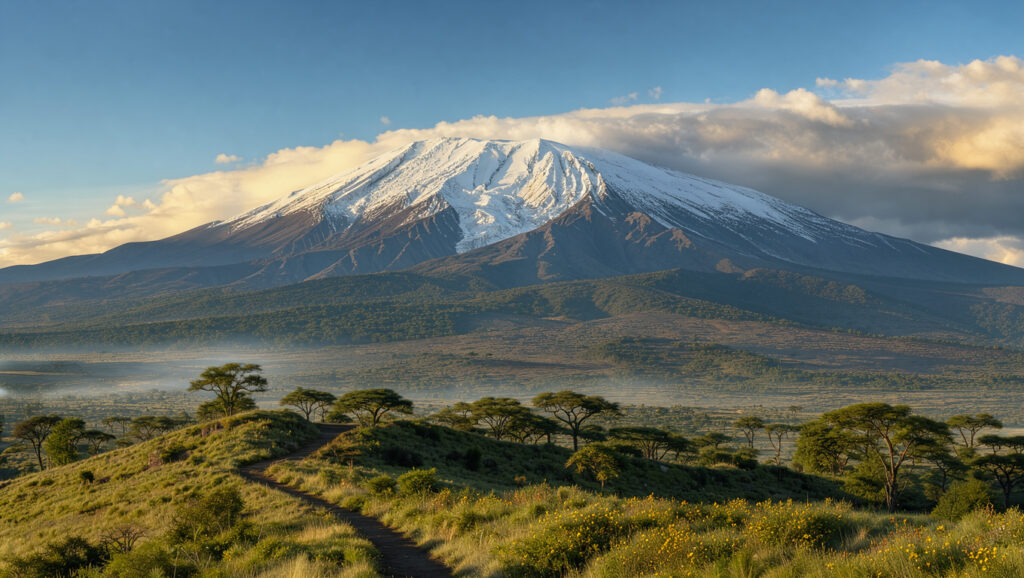
Most people picture Kilimanjaro as a dramatic rock climb, but the real test is the air, not the rock. Uhuru Peak rises to 5,895 m (19,341 ft) above sea level, according to African Scenic Safaris (tour operator guide), and that height shapes nearly every decision a non-technical hiker has to make.
Location: Tanzania, Africa · Summit elevation: 5,895 m (19,341 ft) · Summit name: Uhuru Point · Africa rank: Highest mountain in Africa
Quick snapshot
- Uhuru Peak sits at 5,895 m (19,341 ft), the highest point in Africa (African Scenic Safaris (tour operator guide))
- Standard routes need no ropes or crampons (Global Summit Guide (climbing guide directory))
- Tanzanian rules require a licensed guide for every climber (Newsmatter.uk (UK travel blog))
- Mortality estimates differ widely; Likizo Travel Blog gives about 13.6 per 100,000 climbers (Likizo Travel Blog (travel blog))
- Summit success rates conflict; Olympus Adventure puts 5-day climbs under 50% (Olympus Adventure (trek operator blog))
- Park fees for 7- to 9-day routes are given as $992 to $1,283 (African Scenic Safaris (tour operator guide)), while other sources give different totals
- A wildfire closed the Lemosho and Londorossi routes on (Volcano Guide (climbing operator guide))
- A TANAPA notice on reopened those routes (Volcano Guide (climbing operator guide))
- The park was reported open as of (Volcano Guide (climbing operator guide))
- Operators commonly recommend at least seven days on the mountain for first-time climbers (Global Summit Guide (climbing guide directory))
- Check your government’s current travel advice for Tanzania before you pay any deposit (Global Summit Guide (climbing guide directory))
The key facts below separate the points that sources agree on from the ones they dispute.
| Fact | Value |
|---|---|
| Location | Tanzania, East Africa |
| Summit | Uhuru Peak |
| Elevation | 5,895 m (19,341 ft) |
| Africa rank | Highest mountain in Africa |
| Technical climbing on standard routes | Not required |
| Typical days on the mountain | 5 to 9 days |
| Guide requirement | Licensed guide mandatory; solo unguided climbing not permitted |
| Park fees (7- to 9-day routes) | About $992 to $1,283, with conflicting totals across sources |
| Mid-range guided price | About $2,200 to $3,500 per person |
| Summit night | 12 to 16 hours, including the return to camp |
Ten data points, one pattern: the altitude and guide rules agree across sources, while costs and success rates do not.
Is Mount Kilimanjaro hard?
The walking is the easy part, and the altitude is the hard part. Standard routes need no ropes or crampons, and Global Summit Guide (climbing guide directory) describes the gradient as manageable on well-established trails. Altitude sets the pace for every day on the mountain.
Can a beginner climb Kilimanjaro?
- Beginners who can hike 6 to 8 hours a day for 6 to 8 consecutive days meet the fitness standard, according to Global Summit Guide (climbing guide directory).
- Training on hills with sustained elevation gain matters more than technical skill.
- Operators commonly point beginners to 8- to 9-day itineraries on Lemosho or the Northern Circuit, per the same guide.
How long does it take to climb Mount Kilimanjaro?
- Most climbs take 5 to 9 days on the mountain, depending on route (Paramount Gorilla (trekking operator journal)).
- The summit push typically starts around midnight and takes 12 to 16 hours including the walk back to camp, according to Volcano Guide (climbing operator guide).
Seven days is the number to plan around, not the cheapest package. A shorter trip saves money but cuts the acclimatization time that the altitude demands.
The catch: A trip that looks easy on paper can still fail on summit day if the itinerary gives the body too little time to adjust.
Is it safe to travel to Kilimanjaro now?
Safety comes down to two checks you can make yourself: the current park status and the altitude risk on your chosen route. Park status reportedly changed during 2026, and the sources disagree on the figures that matter most.
How risky is Kilimanjaro?
- Altitude is the main risk, not terrain alone, and it is the factor that stops most climbers before the summit.
- A study of 28 climbers on a six-day schedule reported 86% with altitude sickness on summit day, according to Volcano Guide (climbing operator guide), which cites a 2012 study by Meyer.
- The Western Breach variant involves scrambling and rockfall, and a 2006 rockfall is reported to have killed three climbers, according to Paramount Gorilla (trekking operator journal).
How many climbers died in Kilimanjaro?
No official death toll from a park authority was among the sources retrieved for this article. The one published rate, from Likizo Travel Blog (travel blog), is about 13.6 per 100,000 climbers, with most fatalities attributed to altitude sickness.
A separate estimate puts the Kilimanjaro mortality rate near 0.01% per climber, a figure Outbackbrief.com (travel blog) attributes to other sources. The two estimates are close, but neither comes from a park statistic, so treat both as rough.
What this means: Count altitude as the real risk when you compare operators, and ask each one how many acclimatization days are built into the price.
Where do you sleep when you climb Kilimanjaro?
Sleeping arrangements depend on the route, and the difference is bigger than most planners expect. Only one standard route offers huts.
Do you need a pee bottle for Kilimanjaro?
- Marangu is the only standard route with sleeping huts; the other main routes use tent camping, according to Newsmatter.uk (UK travel blog).
- The recommended sleeping bag rating is -10°C or colder, and some sources suggest -15°C, according to Olympus Adventure (trek operator blog).
- Toilet facilities vary by camp and route, and the sources retrieved do not describe them in enough detail to compare routes.
Night-time toilet access is the detail most planners forget. Packing a wide-mouth bottle is a cheap precaution when facilities are limited.
The implication: On a tented route, the sleeping bag and the camp toilet arrangements matter more than the brochure photo of the tent.
In which country is Mount Kilimanjaro located?
Kilimanjaro sits in Tanzania, in East Africa, and Uhuru Peak is the highest point in Africa, according to African Scenic Safaris (tour operator guide).
Which continent is Mount Kilimanjaro located in?
- The mountain is in Africa, inside Tanzania’s borders.
- Tanzanian rules require a licensed guide or licensed operator for every climber, according to Newsmatter.uk (UK travel blog).
Which is bigger, Everest or Kilimanjaro?
- Everest has the higher summit elevation, so it is the taller mountain, according to Outbackbrief.com (travel blog).
- Everest requires technical climbing and supplemental oxygen above 7,000 m, with expeditions lasting about two months, according to the same source.
- Kilimanjaro needs no technical climbing on its standard routes, so the difference that matters to a hiker is the technical demand, not the height gap.
The trade-off: Kilimanjaro gives you a high-altitude summit without the technical and oxygen demands, but it asks for patience instead.
Why is Kilimanjaro so famous?
Its reputation rests on three things: its height, its status as Africa’s highest peak, and the fact that it can be climbed without technical skills, according to African Scenic Safaris (tour operator guide). Reputation alone proves little, and the sources retrieved do not confirm many named visitors.
Which celebrity climbed Kilimanjaro?
- No named celebrity ascent was confirmed by a published source in the material used for this article.
- A name should be added only once a named, published source confirms the climb.
- Searches for celebrity climbs tend to surface anecdotes that cannot be checked, which is why this section leaves out a list.
Why this matters: Fame sells trips, so treat any celebrity claim in a sales page as a prompt to check, not as evidence.
How the main routes compare
Five routes, one pattern: the longer the itinerary, the more time the body has to adjust to altitude, and the higher the reported summit success.
| Route | Days (as reported) | What the sources say |
|---|---|---|
| Marangu | 5 to 6 | The only hut route and the shortest option, with lower reported success |
| Machame | 6 to 7 | Tented, with the Barranco Wall scramble; success figures conflict between 75–85% and 85–90% for 7 days |
| Lemosho | 7 to 8 | Gradual altitude profile, among the best reported success rates |
| Northern Circuit | 8 to 9 | The longest standard route, with the most gradual acclimatization (TanzaLux (safari operator)) |
| Umbwe | Not stated in sources | Generally considered the steepest standard route, with little time to acclimatize |
The trade-off: The shortest route is the cheapest and the least forgiving, and the sources agree on that much even where their percentages do not.
Steps before you book
- Choose a route of seven days or more, which the sources treat as the safer default for first-time climbers.
- Book a licensed guide or licensed operator, because Tanzanian rules require one for every climber.
- Check the current park status and route notices before you pay a deposit, since closures reported in 2026 changed which routes were open.
- Check your government’s current travel advice for Tanzania.
- Train on hills for 6 to 8 hours a day across several consecutive days.
- Ask each operator to itemize park fees, camp fees and tax, then compare the totals line by line.
What does a Kilimanjaro climb cost?
- Park fees for 7- to 9-day routes are given as about $992 to $1,283 (African Scenic Safaris (tour operator guide)).
- Volcano Guide (climbing operator guide) puts the park fee for a 7-day climb at about $956, a figure below the range above.
- One operator lists a $70 daily conservation fee, a $50 to $60 nightly camping or hut fee, a $20 rescue fee and 18% VAT (Africa Paradise Adventures (tour operator guide)).
- Mid-range guided climbs cost about $2,200 to $3,500 per person, with roughly $950 to $1,100 going to mandatory park fees, according to Paramount Gorilla (trekking operator journal).
- Quotes range from about $1,500 to over $8,000 per person, and sources disagree on both ends (Explorers Passage (travel chronicle)).
The catch: The park-fee figures do not line up across sources, so a low quote may simply leave out fees that a higher quote includes.
What is confirmed and what is still unclear
Confirmed facts
- Uhuru Peak is 5,895 m (19,341 ft) above sea level (African Scenic Safaris (tour operator guide))
- No ropes or technical climbing are needed on standard routes (Global Summit Guide (climbing guide directory))
- A licensed guide is required for every climber (Newsmatter.uk (UK travel blog))
What’s unclear
- Current travel safety status, which changes over time
- The total number of climbers who have died on the mountain
- Summit success rates, which differ by route and by source
- The exact cost of a climb, which varies by operator and route
- Names of celebrities who have climbed the mountain
The implication: The hard facts are few but solid, and the unknowns are the ones that shape your budget and your risk, so ask operators for the evidence behind their numbers.
What the sources say
“Altitude sickness, not fitness, is what stops most climbers.”
Paramount Gorilla (trekking operator editorial)
“Kilimanjaro is a long, high walk rather than a technical climb.”
Newsmatter.uk (UK travel blog editorial)
“The real risk on Kilimanjaro is altitude, not terrain.”
African Scenic Safaris (tour operator editorial)
Three sources, three angles, one shared warning: altitude, not terrain, is what separates a successful trip from a failed one.
What this means for you
Kilimanjaro punishes impatience far more than it tests technical skill. The sources agree on the guide rule, the lack of technical climbing and the altitude risk, and they disagree on money and success rates, which is where a careful planner should spend time. For a first-time hiker on a budget, the choice is clear: book a seven-day or longer route with a licensed operator, or accept a shorter, cheaper trip with a lower reported success rate.
Related reading: Kilimanjaro climbing guide
gorillanestssafaris.com, wewildtravel.com, insightbritain.co.uk, altezzatravel.com, tanzaniasafariexperience.com
Frequently asked questions
How much does it cost to climb Mount Kilimanjaro?
Mid-range guided climbs are typically quoted at about $2,200 to $3,500 per person, according to Paramount Gorilla (trekking operator journal). Quotes in other sources run from about $1,500 to over $8,000, so ask for an itemized price before you commit.
How tall is Mount Kilimanjaro?
Uhuru Peak stands at 5,895 m (19,341 ft) above sea level, according to African Scenic Safaris (tour operator guide).
Is Mount Kilimanjaro the highest mountain in Africa?
Yes. Uhuru Peak is Africa’s highest point, according to African Scenic Safaris (tour operator guide).
What is the best time to climb Mount Kilimanjaro?
The dry seasons, January to March and June to October, are the most popular climbing windows, according to Outbackbrief.com (travel blog). Late March to May is the long rainy season, per Olympus Adventure (trek operator blog).
Which route should I take up Mount Kilimanjaro?
For a first-time hiker, a seven-day or longer route is the safer default. Olympus Adventure reports the best success rates on Lemosho and the Northern Circuit, and the lowest on Marangu (Olympus Adventure (trek operator blog)).
Does Mount Kilimanjaro require a licensed guide?
Yes. Tanzanian rules require a licensed guide or licensed operator for every climber, according to Newsmatter.uk (UK travel blog). Solo, unguided climbing is not permitted, according to Global Summit Guide (climbing guide directory).
More related posts
 Henry Fonda Biography: Iconic Roles, Oscars, and Family
 Latest Football Scores BBC – Premier League and Cup Results
 Wycombe Wanderers F.C. – Fixtures, Results, Table & News
 Patrick Murray, Only Fools and Horses star, dies at 68
 William Hanson: Etiquette Coach, Podcasts and Verified Facts
 Charlotte Gainsbourg: Biography, Age, Height, Movies, and More
 Cat Into Human Years: Chart, Calculator, and Life Stages
 Cate Blanchett: Husband, Children, Movies, Oscar Wins