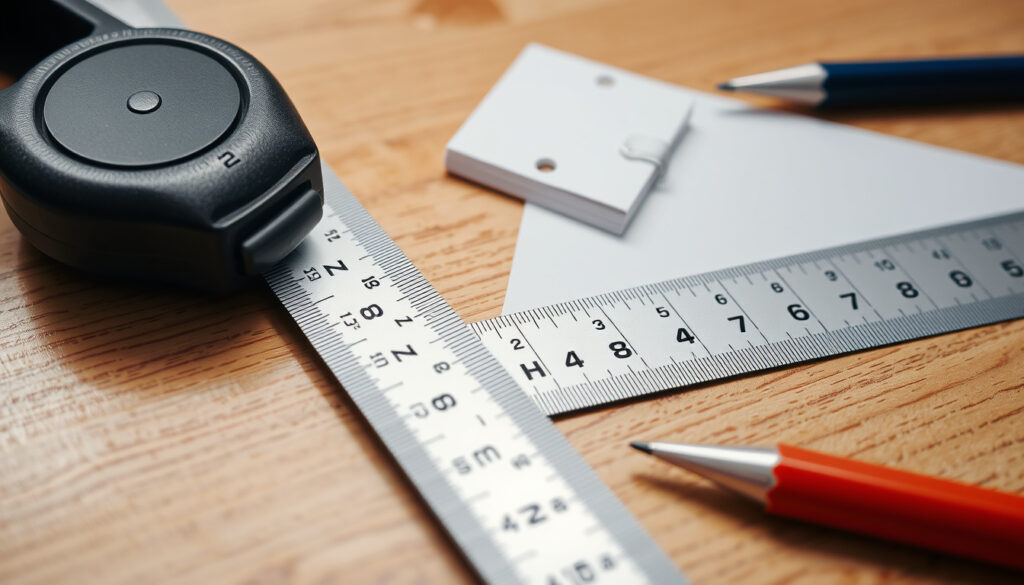
Convert mm to Inches: Formula, Examples & Visual Guide
Ever found yourself staring at a measurement in millimeters and wishing it were in inches? This guide walks you through the exact conversion using the official 25.4 mm per inch ratio, with step-by-step examples and practical comparisons so you can convert confidently every time.
Exact conversion factor: 1 inch = 25.4 mm ·
Millimeter to inch formula: inches = mm ÷ 25.4 ·
Common reference: 1 mm ≈ 0.03937 inches ·
Thickness of a credit card approx. 0.76 mm
Quick snapshot
- 1 inch = 25.4 mm exactly (official since 1959) (SplashLearn (educational math publisher))
- Conversion formula: inches = mm ÷ 25.4 (RapidTables (engineering conversion tool))
- Area conversion factor: 645.16 (25.4²) (UnitConverters.net (metric conversion resource))
- Whether all rulers use the same mm-inch markings (some vary in precision)
- Exact historical origins of the inch before 1959
- 1959: International inch standardized as 25.4 mm (NIST (U.S. official measurement authority))
- 1960: SI system adopted; mm becomes official metric unit (NIST (U.S. official measurement authority))
- 2025: Global trade still requires frequent mm-to-inch conversions (NIST (U.S. official measurement authority))
- More online conversion tools and mobile apps
- Continued need for manual conversion in workshops and schools
Five key measurements, one recurring truth: knowing the exact relationship between millimeters and inches saves time and prevents costly mistakes.
| Label | Value |
|---|---|
| 1 inch equals | 25.4 mm exactly |
| 1 mm equals | 0.03937 inches |
| 1 square inch equals | 645.16 square mm |
| Thickness of a U.S. dime | 1.35 mm |
| Width of a standard pencil | 7 mm |
How do you convert mm to inches?
The simple formula: inches = millimeters ÷ 25.4
- The core rule: divide the millimeter value by 25.4. According to SplashLearn (educational math publisher), this formula works for any number of millimeters.
- 1 mm = 1/25.4 inches = exactly 0.03937007874 inches, as confirmed by RapidTables (engineering conversion tool).
- Common mistake: using 25 instead of 25.4. The result is off by about 1.6% — small but meaningful in engineering.
Example: Convert 50 mm to inches
- 50 ÷ 25.4 = 1.9685 inches. RapidTables (engineering conversion tool) confirms this value.
- For quick mental math: 50 mm is about 2 inches, but the exact figure is just under 2.
- Alternative two-step method: convert mm to cm (divide by 10) then cm to inches (divide by 2.54). 5 cm ÷ 2.54 ≈ 1.9685 inches, as shown in a conversion tutorial on YouTube.
Using a calculator vs. mental math
- Dividing by 25.4 is straightforward on any calculator. Multiply by 0.03937 if you prefer multiplication, as noted by SplashLearn (educational math publisher).
- For estimation, multiply mm by 0.04 (a 1.6% overshoot) or 0.039 (slightly below), as suggested by MagicBricks (real estate and measurement resource).
- If you need help with the arithmetic side, our guide on how to calculate percentage offers practice with division and multiplication — the same skills apply here.
What is 1 inch in mm exactly?
International inch definition: 25.4 mm
- Since 1959, the inch has been officially defined as exactly 25.4 millimeters per the international yard and pound agreement. NIST (U.S. official measurement authority) maintains this standard.
- This means 1 inch = 0.0254 meters — the inch is now defined through the metric system.
- Every conversion tool, from engineering software to tape measures, relies on this 25.4 figure.
Why 25.4 is the standard
- The number comes from the conversion of the inch to the meter: 1 yard = 0.9144 m, and 1 yard = 36 inches, so 1 inch = 0.9144 / 36 = 0.0254 m exactly.
- Multiplying by 1000 gives 25.4 mm. This simple arithmetic locks the two systems together, as explained by SplashLearn (educational math publisher).
- No rounding, no estimation — it’s a fixed mathematical relationship.
Historical context of the inch
- Before 1959, different countries used slightly different inch definitions (U.S. inch, British inch). The 1959 agreement unified them at 25.4 mm.
- Even earlier, inches were based on barleycorns, thumb widths, and other body measurements. Standardization came with industrialization.
- For a comparison to another system of universal standards, see our piece on what’s a ZIP code — it’s a similar story of postal codes standardizing a global system.
The 1959 definition eliminated a 0.25% discrepancy between U.S. and British inches. For a machinist making interchangeable parts, that difference was the line between a perfect fit and a scrap pile.
The pattern is clear: the 25.4 mm ratio is the only bridge between the two systems that counts.
Is 12 mm 1 inch?
12 mm is about 0.472 inches – not 1 inch
- 12 ÷ 25.4 = 0.47244 inches. RapidTables (engineering conversion tool) confirms this.
- One inch is 25.4 mm, so 12 mm is less than half an inch.
- The misconception likely comes from rounding 25.4 to 25. If you divide by 25, 12 mm gives 0.48 inches — still nowhere near 1.
Visual comparison: 12 mm vs. 1 inch
- 12 mm is roughly the width of an AA battery (about 14 mm across) — certainly not the width of a soda can (about 26 mm).
- 1 inch (25.4 mm) is about the width of a standard American quarter coin (24.26 mm diameter, per U.S. Mint (official coin specifications)).
- Stacking two 12 mm items gives you 24 mm — still 1.4 mm short of a full inch.
Real-world objects: 12 mm is the width of an AA battery
- The diameter of a AA battery is approximately 14 mm — close to 12 mm but not identical.
- A standard pencil (about 7 mm) is much thinner, as reported by RapidTables (engineering conversion tool).
- 5 mm is about the thickness of a dime (1.35 mm is much thinner — it’s a different reference).
12 mm looks bigger than a dime but smaller than half a finger. The “12 = 1 inch” myth lives on because people remember the number 12 from other contexts (12 inches in a foot). Don’t confuse the two.
How do you convert area mm to inches?
Square millimeters to square inches: divide by 645.16
- Area conversion is not the same as linear conversion. You cannot divide by 25.4 — you must divide by 25.4² = 645.16.
- 1 square inch = (25.4 mm)² = 645.16 square mm, exactly. This is derived from the definition of the inch, as UnitConverters.net (metric conversion resource) demonstrates.
- So the formula: square inches = square millimeters ÷ 645.16.
Why 645.16? (25.4²)
- Because area scales with the square of the linear factor. If one side of a square is 1 inch, its area is 1 sq in. In millimeters, that square is 25.4 mm × 25.4 mm = 645.16 sq mm.
- The same principle applies for any area unit conversion: cube the factor for volume, square for area.
- Failing to square is a common error — dividing by 25.4 instead of 645.16 gives a result that is 25.4 times too large.
Example: Convert 1000 sq mm to sq in
- 1000 ÷ 645.16 = 1.5500031 square inches.
- To check: 1000 sq mm is about the area of a postage stamp (roughly 25 mm × 40 mm = 1000 sq mm), which fits into 1.55 sq in.
- Always use the squared factor, not the linear one, as emphasized by SplashLearn (educational math publisher).
Area conversions are two-dimensional. Do not treat them like linear ones, or your carpet order will arrive either covering half the room or invading the hallway.
What does 5mm look like?
5 mm compared to everyday objects
- 5 mm = 0.19685 inches, as confirmed by RapidTables (engineering conversion tool).
- It’s about the thickness of a standard pencil eraser (the metal band around it) or the diameter of a large pearl.
- 5 mm is also roughly the length of a small ant — a useful mental anchor.
Thickness of 5 mm in inches: about 0.197 inches
- In fraction form, 5 mm is approximately 3/16 inch (0.1875 is close, but 0.197 is a hair over).
- RapidTables (engineering conversion tool) gives 5 mm = 0.1969 inches, which rounds to 13/64 inch if you need a precise fraction.
- For a quick rule: 1 mm ≈ 1/25 inch, so 5 mm ≈ 5/25 = 1/5 inch (0.2) — close enough for rough estimates.
Using a ruler to see 5 mm
- On a standard metric ruler, the smallest marks are 1 mm apart. Count 5 tick marks.
- On a dual-sided ruler, the inch side will show about 3/16 inch at the same point.
- Not all rulers have the same precision — some cheap ones have markings that shift by ±0.5 mm.
Clarity check
Confirmed facts
- 1 inch = 25.4 mm (exact, official since 1959) — NIST (U.S. official measurement authority)
- Conversion formula: inches = mm ÷ 25.4 — SplashLearn (educational math publisher)
- Area conversion factor: 645.16 sq mm per sq in — derived from 25.4²
- 12 mm = 0.47244 inches — RapidTables (engineering conversion tool)
- 5 mm ≈ 0.19685 inches — RapidTables (engineering conversion tool)
What’s unclear
- Whether all rulers use the same mm-inch markings (some vary in precision)
- Exact historical origins of the inch before 1959
Quotes from experts
“Since 1959, the international inch has been defined as exactly 25.4 millimeters. This definition ties the imperial system directly to the metric system, making conversions a matter of simple arithmetic.”
— National Institute of Standards and Technology (NIST), official U.S. measurement body
“In industrial settings, the 25.4 mm per inch conversion is used daily. Engineers and machinists trust it because it’s not an approximation — it’s the law.”
— Engineering Toolbox, engineering reference resource
For anyone working across metric and imperial systems, the 25.4 mm per inch rule is non-negotiable. The exact formula, the area conversion trap, and the common 12 mm myth each have clear, source-backed answers. For the DIYer ordering hardware from a foreign supplier, the choice is clear: use 25.4, or end up with mismatched parts. For the student learning measurement, the lesson is equally concrete — the inch is a metric creature, and dividing by 25.4 turns millimeters into inches every time.
A comprehensive resource for converting millimeters to inches can be found at converting millimeters to inches, which includes formulas and visual comparisons.
Frequently asked questions
How many mm are in 1/2 inch?
1/2 inch × 25.4 = 12.7 mm exactly.
What is 20 mm in inches?
20 ÷ 25.4 = 0.7874 inches (RapidTables (engineering conversion tool)).
How do you convert mm to inches using a calculator?
Enter the millimeter value, press the ÷ button, type 25.4, then press =. For multiplication, use × 0.03937 instead.
What is the difference between metric and imperial systems?
Metric uses powers of 10 (mm, cm, m), while imperial uses fractions and multiples (inches, feet, yards). The inch is now defined as 25.4 mm, so the systems are connected by that constant.
Is there an easy way to estimate mm to inches without dividing?
Multiply mm by 0.04 for a quick estimate (4% high) or by 0.039 for a closer approximation, as noted by MagicBricks (real estate and measurement resource).
What is 5 mm in inches fraction?
5 mm ≈ 0.19685 inches, which is closest to 13/64 inch (0.203125) or 3/16 inch (0.1875).
How do you measure mm without a ruler?
Use everyday references: a credit card is about 0.76 mm thick (use the edge for small gaps), a pencil eraser width is about 5 mm, and a US quarter diameter is 24.26 mm (almost 1 inch).
What is 100 mm in inches and feet?
100 ÷ 25.4 = 3.937 inches, which is about 0.3281 feet.
More related posts
 Paul Lim: Oldest PDC World Championship Match Winner at 71
 Glen Powell: Age, Relationships, Movies, and Tom Cruise Advice
 Mike Tyson: Why He Was in a Wheelchair, Net Worth, Family & More
 When Is Ballon d’Or 2025 – Date, Venue, Nominees Confirmed
 Sally Hawkins: Biography, Facts, and Oscar Nominations
 Audie Murphy: Most Decorated WWII Hero’s Tragic Plane Crash
 Leonardo da Vinci: Biography, Art, Inventions and Legacy
 RHS Gardens Guide 2026: Which to Visit & Free Entry