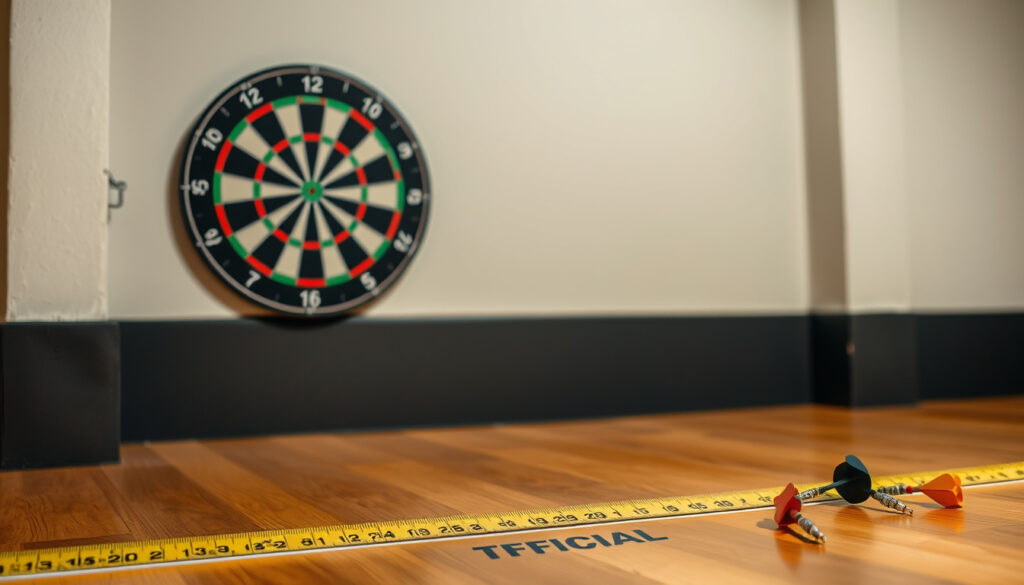
Dart Board Distance: Official Setup & Maintenance Guide
Anyone who has ever stood at a dartboard with a tape measure has asked the same question: am I standing in the right spot? The answer matters more than most casual players think — the official steel-tip throwing distance is 2.37 metres (7 ft 9¼ in), measured from the back of the oche to the face of the board (World Darts Federation (governing body)), and this guide covers that rule, the correct bullseye height, and the maintenance steps that keep a board throwing well for longer.
Official throwing distance: 2.37 m (7 ft 9¼ in) ·
Bullseye height: 1.73 m (5 ft 8 in) ·
Typical board life: 6–12 months with regular play
Quick snapshot
- Steel-tip distance is 2.37 m (7 ft 9¼ in) (GLD Products (dartboard manufacturer))
- Bullseye sits 1.73 m (5 ft 8 in) off the floor (World Darts Federation (governing body))
- Measure from the board face, not the wall (Wikipedia (community encyclopedia))
- Whether light sanding safely softens a hard board
- Best method for removing deep mould without surface damage
- Exact lifespan for a board in heavy social play
- Re-check the oche whenever you move or remount the board
- Watch for loose sisal fibres before they affect scoring
- Measure from the board face, then rotate the sisal every few weeks
- If darts fall out on good hits, it is time to replace the board
The six numbers that matter most, one pattern: the face of the board is the referee, not the wall behind it.
| Measurement | Standard value | Reference |
|---|---|---|
| Bullseye height | 1.73 m (5 ft 8 in) | World Darts Federation (governing body) |
| Steel-tip horizontal distance | 2.37 m (7 ft 9¼ in) | World Darts Federation (governing body) |
| Metric precision | 2.3688 m | Lakeside World Darts (tournament organizer) |
| Side clearance | At least 0.6 m each side | Darts-UK (darts retailer) |
| Board orientation | Number 20 at the top, mounted flush | Darts-UK (darts retailer) |
| Reference point | Board face, not the wall | Wikipedia (community encyclopedia) |
Why is darts 2.37 m?
The 2.37 m figure is the metric rounding of 7 ft 9¼ in — 2.3688 m to be precise — and the board-face distance used in international regulation play (Wikipedia (community encyclopedia)). The measurement is taken horizontally from the back of the oche to a vertical line at the face of the board, which makes the oche the real anchor of the setup.
What is the official distance in feet and inches?
- Imperial conversion: 7 ft 9¼ in
- Metric precision: approximately 2.3688 m (Lakeside World Darts (tournament organizer))
- Regulation rounding: 2.37 m for steel-tip play
The takeaway: the imperial measurement came first, and 2.37 m is the metric convenience, not the other way around.
How high should a dart board be?
- Bullseye centre: 1.73 m above the floor
- Number 20 at the top of the board
- Board mounted flush against the wall, not leaning forward
Height and distance work as a pair: once the bull is at 1.73 m, the oche can be measured with confidence.
How far from the wall should the dartboard be?
- The rule is anchored to the board face, not the wall
- A projecting cabinet changes the wall-to-oche gap but not the required face-to-oche distance
- When in doubt, measure from the face of the board
A thick surround can shift the wall-to-oche distance by several centimetres while the real rule stays still: 2.37 m from the face of the board. Measure from the wall and you are guessing.
If you want to see that distance hold under maximum pressure, Luke Humphries: World Champion 2024, Net Worth & Schedule shows how a modern title winner builds a game around a consistent oche rhythm.
How do you maintain a dartboard?
A board that survives a season of darts is one that gets rotated, kept dry, and never misted with water. This section is the part most setup guides skip.
Should I spray my dartboard with water?
- Short answer: no — water can swell and distort the sisal fibres
- Manufacturers who publish setup guidance generally recommend a dry board
- If a board has dried out, rotation and conditioning are safer fixes
The strategy: treat the board like a wooden floor — clean it dry, condition it occasionally, and never soak it.
How to rejuvenate a dartboard?
- Rotate the board so the busiest scoring segments change position
- Brush or vacuum loose sisal fibres before they work deeper into the board
- Use a dartboard conditioner or very fine sandpaper on hard spots
The subtle part: rotation is prevention, not repair; once the sisal is packed flat, only light conditioning or replacement will bring it back.
How to remove mould from a dartboard?
- Wipe with a dry cloth first, then use mild detergent only if needed
- Let the board dry completely before remounting
- Keep the board in a dry room rather than a damp garage
The trap: mould usually means the wall or room is the problem, so cleaning the board without fixing the moisture source just delays the return.
How to soften a hard dartboard?
- Rotate first — a hard patch is often an overused patch
- Lightly condition the sisal or use fine sandpaper on the affected area
- If the board will not hold darts after conditioning, it is done
A board that will not hold points does more than slow the game down — it changes what you practise, rewarding muscle instead of accuracy.
The implication: most maintenance is timing, not elbow grease. Do the boring work early and you avoid the dramatic fix later.
When should you replace a dart board?
Every board reaches a point where the sisal stops gripping and the wires decide the score. The question is how long you let that go on.
What is the lifespan of a dartboard?
- Typical bristle board: 6–12 months with regular play
- Heavier use moves that closer to the short end
- Replacement is driven by wear, not a calendar date
The read: a board used every night will wear faster than a weekend board, but rotation is the biggest variable in that range.
How to know if a dartboard is worn out?
- Darts fall out on hits that should stick
- Sisal fibres look loose, shiny, or pushed back into the board
- Surface cracks appear around the wire rings
A cheap board that is rotated can outlast an expensive one that is ignored. The board’s price matters less than the care routine attached to it.
The decision: replacing a board early costs money; replacing it late costs scoring consistency. In a league season, the second cost is higher.
What is an illegal throw in darts?
In most hobbies, “close enough” is fine. In darts, the line is the line — and the rules protect it.
What are the rules for throwing in darts?
- The oche is the line behind which the thrower must stand (Wikipedia (community encyclopedia))
- Any part of a player’s foot crossing the front edge of the oche makes the throw illegal
- The dart must be thrown with the hand, with no external aids
Can you lean over the oche?
- Leaning is allowed, but your foot cannot cross the line
- Players must release the dart before any part of the foot leaves the floor
- Tournament referees call it instantly, so practice the legal lean
Paul Lim, the oldest PDC World Championship match winner, built a career on steady footwork at that same line; his story shows how little the 2.37 m changes across generations.
The pattern: footwork at the oche is a skill you can practise; the line itself is the one thing you cannot negotiate.
Do longer darts fly straighter?
Longer darts look like they should fly straighter, but the equation is not that simple. Length changes balance, and balance changes everything.
What is the hardest number to hit on a dartboard?
- Triple 20 is the highest-value treble and the target most players chase in practice
- Bullseye is the smallest target relative to the value it carries
- “Hardest” depends on whether you mean precision or pressure
Why is 26 called bed and breakfast?
- 26 is the score you get from hitting 20, 5, and 1 with three darts — a common breakfast stumble
- Old British pub culture tagged it “bed and breakfast”
- It is a joke about a bad visit to the board, not a compliment
Dart length, weight, and barrel shape all change how a dart flies; no single setup fixes a shaky release.
The implication: before blaming distance, check your dart’s weight and grip — the oche is the same for everyone, but the equipment is not.
How to Set Up a Dartboard: Step-by-Step
Setting up a board is a sequence with a clear end point: a line that every player trusts. Follow it in this order and you avoid the usual half-inch arguments.
- Choose a space with at least 0.6 m of clearance on both sides of the board (Darts-UK (darts retailer))
- Mark the bullseye height at 1.73 m above the floor
- Mount the board flush, with the number 20 at the top
- Measure 2.37 m horizontally from the board face to the back of the oche
- Use the sequence that keeps the board honest: mark the bull, mount and level, then mark the oche from the board face (Lakeside World Darts (tournament organizer))
With the oche marked and the number 20 at the top, the setup is done. The rest is habit: check the line before you start, and rotate the board before it tells you.
Confirmed Facts vs. What’s Unclear
Confirmed facts
- Steel-tip throwing distance is 2.37 m from the oche to the board face (World Darts Federation (governing body))
- Bullseye height is 1.73 m (GLD Products (dartboard manufacturer))
- The reference point is the board face, not the wall (Wikipedia (community encyclopedia))
What’s unclear
- Whether light sanding safely softens a hard board
- Best method for removing deep mould without surface damage
- Exact lifespan in heavy social play
- How much rotation frequency extends life in practice
The pattern: the measurements are settled; the maintenance questions are where players still disagree.
What the Rules and the Retailers Say
The official bull-centre height is 1.73 metres, and the steel-tip throwing distance is 2.37 metres measured from the back of the oche to a vertical line at the board face.
World Darts Federation (governing body)
Measure from the board face, not the wall; a projecting cabinet changes the wall-to-oche gap but not the throwing distance.
GLD Products (dartboard manufacturer)
Mark the bull height, mount and level the board, then mark the oche from the board face.
Lakeside World Darts (tournament organizer)
The common thread: every reliable voice points back to the same two anchors — the bull at 1.73 m and the oche at 2.37 m from the board face.
For the home player, the choice is clear: measure once from the board face to the oche, keep the bull at 1.73 m, and rotate the board before the sisal looks ragged — or plan on replacing it before the year is out.
Frequently asked questions
Does the dartboard distance change for soft-tip darts?
Yes. Soft-tip electronic boards commonly use an 8 ft (2.44 m) throwing distance, with a 2.98 m diagonal bull-to-oche measurement.
What is the toe line (oche) rule?
The oche is the line behind which the thrower must stand. A throw is illegal if any part of the player’s foot crosses the front edge of the oche before the dart is released.
Can I use a tape measure from the wall to set distance?
Only if you compensate for the depth of the board or cabinet. The official 2.37 m is measured from the board face, not the wall.
What is the official distance for metric units?
The steel-tip horizontal distance is 2.37 m, the bullseye height is 1.73 m, and the diagonal bull-to-oche measurement is 2.93 m.
How do I measure the distance from the dartboard face?
Measure horizontally from the back of the oche to a vertical line at the face of the board, not to the wall behind it.
Is there a difference in distance for electronic dartboards?
Yes. Soft-tip electronic boards are commonly set at 2.44 m (8 ft) horizontally, with a 2.98 m diagonal measurement.
The FAQ answers keep the same anchors: the oche is measured from the board face, and soft-tip play is the main exception to the steel-tip standard.
More related posts
 Brad Garrett: Net Worth, Sobriety, Height & Life Today
 Where to Watch Sex and the City – 2025 Streaming Guide
 Nipah Virus Outbreak India – Kerala Cases, Symptoms, Prevention
 Nuno Espírito Santo: Career, Stats, and Coaching Journey
 Skye Nicolson: Loss to Tiara Brown and What’s Next
 Aaron Wan-Bissaka Nationality: England, DR Congo, Career News
 How Old Is Prince Andrew – Age, Family and 2026 Arrest
 The Ivy St Albans – Menu, Reviews and Booking Guide