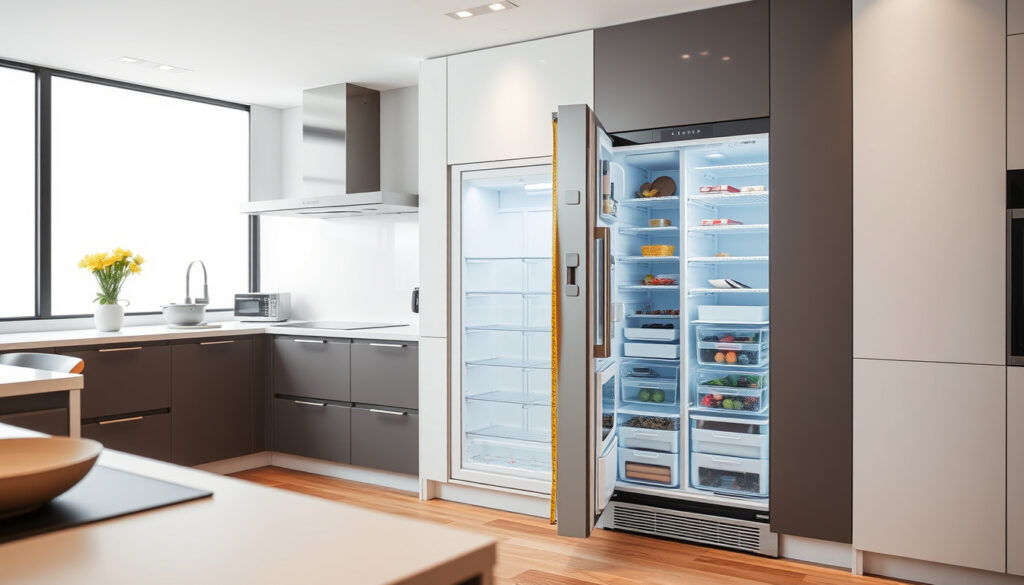
Fridge Integrated: A Guide to Sizes, Features & Buying
If you’re planning a kitchen renovation in Ireland, chances are you want that clean, seamless look — where your fridge hides behind a cabinet door, indistinguishable from the units around it. An integrated fridge does exactly that, and picking the right one means getting to grips with cabinet sizes, ventilation gaps, and the new energy labels that came into force in 2021, with Irish measurements, retailer insight, and practical steps to measure your space.
Standard integrated fridge height: 177–178 cm ·
Common energy rating: A+ to A+++ ·
Typical noise level: 35–42 dB ·
Warranty offered by top brands: Up to 10 years
Quick snapshot
- Integrated fridges require a cabinet door panel to blend with kitchen units. DID Electrical
- Ventilation gaps are essential for proper airflow and safe operation. Expert Ireland
- Frost free technology eliminates manual defrosting automatically. DID Electrical
- Exact market share of integrated versus freestanding fridges in Ireland is not publicly documented.
- The EU energy label scale changed from A+++/A++/A to A–G in 2021, making older ratings non-comparable. Beko Ireland
- Look for A or B energy ratings as integrated models increasingly adopt the new scale. DID Electrical
Five key measurements, one pattern: integrated fridge dimensions are largely standardised to fit Irish kitchen cabinetry, but small variations matter.
| Specification | Typical value |
|---|---|
| Standard height (full-height) | 177–178 cm |
| Standard width (most models) | 54–60 cm |
| Standard depth (without door panel) | 54–55 cm |
| Energy rating range | A+ to A+++ |
| Average noise level | 35–42 dB |
What is an integrated fridge?
Key characteristics of integrated fridges
An integrated fridge is designed to sit flush behind a kitchen cabinet door, making it invisible when closed. Unlike freestanding models, it has no finished sides or top — it relies on the surrounding cabinetry for support. According to DID Electrical (Ireland’s largest electrical retailer), integrated fridges are commonly sold in split configurations: 50/50, 70/30, and 60/40, with 70/30 often recommended for households that store more fresh food.
How integrated fridges blend with kitchen cabinetry
The appliance itself is a bare box. A custom door panel — supplied by the kitchen manufacturer — is attached to the fridge door, creating a uniform front. This integration requires precise measurements because the panel adds depth and weight. Expert Ireland (a specialist appliance retailer) advises that before ordering, you must check cabinet height, width, depth, hinge type, and ventilation space.
If you choose a 70/30 integrated fridge freezer, you get 70% fridge space — ideal for the typical Irish household that buys fresh groceries weekly. A 50/50 split suits those who rely on frozen meals.
The implication: Integrated fridges offer design continuity but require precise cabinet measurements and door panel fitting, making installation more involved than freestanding models.
What is the difference between integrated and built-in fridges?
Terminology overlap in the market
In Irish retail, “integrated” and “built-in” are often used interchangeably. However, a subtle distinction exists: integrated fridges are fully concealed behind a cabinet door, while “built-in” can sometimes refer to a freestanding appliance that fits into a cabinet recess but still has its own front panel. Expert Ireland (appliance guide) notes that the term “integrated” specifically implies the appliance is designed to accept a custom door panel.
Typical installation differences
Installation complexity differs. Integrated models require the kitchen door to be fixed onto the appliance using slide hinges or fixed brackets. Built-in fridges may simply slide into a space. Both need ventilation gaps, but integrated models particularly rely on the cabinet for airflow routing.
The table below highlights the key differences between integrated and built-in fridges as understood in the Irish market.
| Aspect | Integrated Fridge | Built-in Fridge |
|---|---|---|
| Visibility | Fully concealed behind custom door panel | May have own front panel visible |
| Door panel required | Yes, custom panel from kitchen manufacturer | Not always; can use own door |
| Installation complexity | Higher: requires attaching door panel and hinges | Lower: slides into recess |
If you buy an integrated fridge without checking your cabinet’s hinge configuration, you may need to order additional adapter kits — a detail often overlooked in online shopping.
The pattern: Integrated fridges demand more upfront planning but deliver a seamless look that built-in models cannot achieve.
What sizes are available for integrated fridges?
Undercounter integrated fridges
Undercounter models are typically 82–87 cm tall, fitting under worktops. Euronics Ireland (home appliance retailer) lists built-under integrated refrigeration models sized for 82–88 cm cabinet height, with net capacities around 127 litres. These are ideal for small kitchens or as additional cooling in utility rooms.
Full-height integrated fridges
Full-height integrated units stand about 177–178 cm tall, matching standard tall kitchen cabinets. A typical model listed at Donaghy Bros. (Northern Ireland appliance retailer) measures 1772 x 558 x 548 mm. Widths generally range from 54 to 60 cm, with depth around 54–55 cm before the door panel is added.
70/30 and 50/50 split fridge freezers
A 70/30 split gives 70% of the total capacity to the fridge compartment and 30% to the freezer. Expert Ireland’s buying guide states that for fresh-food-heavy households, 70/30 is the better choice; for heavy freezer use, a 50/50 split is preferable. An integrated model from Harvey Norman Ireland (national retailer) shows a 70/30 split with a new-label Energy Rating E.
Three size categories, one pattern: the right size depends on your kitchen cabinet height and whether you need a freezer alongside.
| Type | Height | Typical capacity |
|---|---|---|
| Undercounter integrated fridge | 82–87 cm | ~127 litres net |
| Full-height integrated fridge | 177–178 cm | ~294–296 litres |
| 70/30 integrated fridge freezer | 177–178 cm | ~70% fridge, ~30% freezer |
What are the benefits of a frost free integrated fridge?
How frost free technology works
Frost free fridges use a fan and a heating element to prevent ice build-up on the evaporator. The system automatically defrosts at intervals, keeping the interior frost-free. DID Electrical (appliance buying guide) notes that frost free integrated models maintain consistent temperature and reduce maintenance compared to manual defrost units.
Advantages over manual defrost fridges
With a frost free integrated fridge, you never have to chip away ice or drain water. Food stays at a stable temperature, which improves preservation and energy efficiency. The trade-off is slightly higher energy consumption for the defrost cycles, but modern compressors minimise this. According to Expert Ireland’s fridge buying guide, undercounter fridges are typically 800–850 mm tall, and many are available with frost free technology.
The pattern: Frost free integrated fridges trade a small energy overhead for the convenience of never defrosting and more stable food storage.
Where can I buy integrated fridges in Ireland?
Major retailers in Ireland
Integrated fridges are widely available through Irish electrical retailers. Key outlets include Harvey Norman Ireland (national chain), DID Electrical (Irish-owned retailer, buying guide), and Expert Ireland (specialist appliance retailer, installation guidance). Brands such as Bosch, Beko, and Siemens offer integrated models. Beko Ireland (manufacturer support page) explains the new A–G energy labels, helping shoppers compare efficiency across models.
Online vs. in-store purchasing considerations
Buying online offers convenience, but measuring your cabinet is critical. Expert Ireland recommends checking cabinet height, width, depth, hinge type, and ventilation space before ordering. Many retailers provide delivery and installation services, but ensure the retailer will remove old appliances and connect the new one. AO’s integrated fridge freezer measuring guide (YouTube, UK/Ireland appliance retailer) demonstrates that heights can vary from about 130 to 200 cm, and standard width is often 55 cm.
The takeaway: Online shopping for integrated fridges requires diligent measurement; retailers offer installation but double-check hinge compatibility.
Pros and cons of integrated fridges
Upsides
- Seamless kitchen design — no appliance gap, no protruding fridge
- Quieter operation because the cabinet absorbs sound
- Energy efficient models available with A+ to A+++ ratings
- Frost free options reduce maintenance
Downsides
- Higher upfront cost compared to freestanding equivalents
- Requires precise cabinet dimensions and ventilation planning
- Limited capacity — full-height models often smaller than freestanding
- Installation may require a professional for door panel fitting
How to measure for an integrated fridge: step-by-step
Follow these steps to avoid costly mistakes:
- Measure the internal height of your cabinet from the bottom to the underside of the worktop. Leave at least 2 cm for ventilation at the top.
- Measure the width between the side panels. Standard integrated fridges are 54–60 cm wide; check you have at least 5 mm clearance on each side.
- Measure the depth of the cabinet from the back wall to the front edge. Most units require 54–55 cm plus additional depth for the door panel (often 2–4 cm).
- Check the hinge type on your kitchen cabinet doors — hinged or sliding — and confirm the fridge supports that system.
- Identify the position of the electrical socket and water supply (if ice maker). The socket must be accessible after installation.
In Ireland, standard kitchen cabinets have a 60 cm width and 57–59 cm depth, so most integrated fridges fit. But as Expert Ireland (installation guidance) emphasises, always confirm ventilation space — a common oversight that can cause overheating and shorter appliance life.
Measure twice, order once. The difference between a perfect fit and a return lies in checking cabinet height, hinge type, and ventilation gaps before you click buy.
What’s confirmed and what’s unclear about integrated fridges
Based on current retailer data and manufacturer guidance, several facts are well established, while some questions remain open.
Confirmed facts
- Integrated fridges require a cabinet door panel for seamless integration, as stated by DID Electrical (appliance buying guide).
- Ventilation gaps are essential for proper airflow — Expert Ireland (installation advice).
- Frost free technology eliminates manual defrosting automatically, per DID Electrical (technology guide).
- New EU energy labels (A–G) replace the old A+++/A++/A scale from March 2021, as explained by Beko Ireland (energy label FAQ).
What’s unclear
- Exact market share of integrated versus freestanding fridges in Ireland is not publicly available.
- Long-term repair costs for integrated fridges compared to freestanding models are not well documented.
- Whether integrated fridges resell for the same premium as freestanding when moving house is uncertain.
- The specific impact of ventilation gap sizes on efficiency in integrated fridges is not standardized across brands.
Expert perspectives on integrated fridges
“Integrated fridge sizes are generally uniform to fit standard cabinetry, with standard and extra-height options available.”
Expert Ireland (refrigerator buying guide)
“Fridge freezer energy labels now run from A to G, with A being the most efficient appliance of that size and G the least efficient.”
“Integrated fridge buyers should measure cabinet height, width, depth, hinge type, and ventilation space before ordering.”
Expert Ireland (buying guide)
“A 70/30 integrated fridge freezer is better for fresh-food households, while a 50/50 model suits heavier freezer use.”
Expert Ireland (split recommendation)
The consensus among Irish retailers is clear: the right split depends on your household’s eating habits, not on a marketing preference. For Irish families that cook fresh meals, a 70/30 integrated fridge freezer saves both space and frustration.
irwinsmegastore.ie, youtube.com, mullendomestic.com, beko.ie, did.ie, buzzcircuit.org
Frequently asked questions
Do integrated fridges come with a freezer?
Many integrated models are sold as fridge freezers with a 70/30 or 50/50 split. Pure integrated fridges (larder fridges) are also available without a freezer compartment. Check the product description before buying.
Can I put an integrated fridge in an unheated garage?
Integrated fridges are designed for indoor kitchen environments (ambient temperature typically 10–38 °C). An unheated Irish garage may drop below 5 °C, which can cause the fridge to stop cooling or the compressor to fail.
How long do integrated fridges last?
With proper installation and maintenance, an integrated fridge can last 10–15 years. The warranty from brands like Bosch and Beko often covers up to 10 years on the compressor, as noted in Beko Ireland (warranty info).
What is the warranty on integrated fridges?
Most major brands offer 2–5 years parts and labour, with extended warranties up to 10 years available at point of sale. Always confirm with the retailer.
Are integrated fridges quieter than freestanding?
Because the surrounding cabinetry absorbs vibration and sound, integrated fridges are often quieter — typical noise levels are 35–42 dB, about the same as a quiet conversation.
Do I need a professional to install an integrated fridge?
While some handy homeowners can slide the unit in and connect hinges, attaching the custom door panel and ensuring proper ventilation often requires a kitchen fitter or appliance installer. Professional installation is recommended.
What is the best brand of integrated fridge in Ireland?
Bosch, Beko, and Siemens are the most common brands stocked by Irish retailers. The “best” depends on your budget, desired energy rating, and split ratio. DID Electrical (buying guide) recommends checking the energy label (A or B) and comparing noise levels.
For an Irish homeowner planning a kitchen upgrade, the choice is clear: measure your cabinet space, decide between a 70/30 and 50/50 split based on your fresh vs. frozen needs, and prioritise a model with an A or B energy label under the new scale. The result is a fridge that disappears behind your kitchen style — and keeps your food at the right temperature for years.
More related posts
 Newspaper – Definition History Types Revenue
 Tower Bridge Opening Times 2025: Hours, Tickets & Lift Schedule
 George Peppard: Biography, Death, and Relationships
 Size 5 in EU – US and UK Shoe Size Conversions
 Kyle Clifford: Hunt Family Murders Whole-Life Order
 Best Electric Toothbrush 2025: UK Reviews & Buying Guide
 Ross King: Presenter, Marriages, Net Worth, Strictly Come Dancing
 Katie Boulter: Age, Ranking, and Relationship with Alex de Minaur