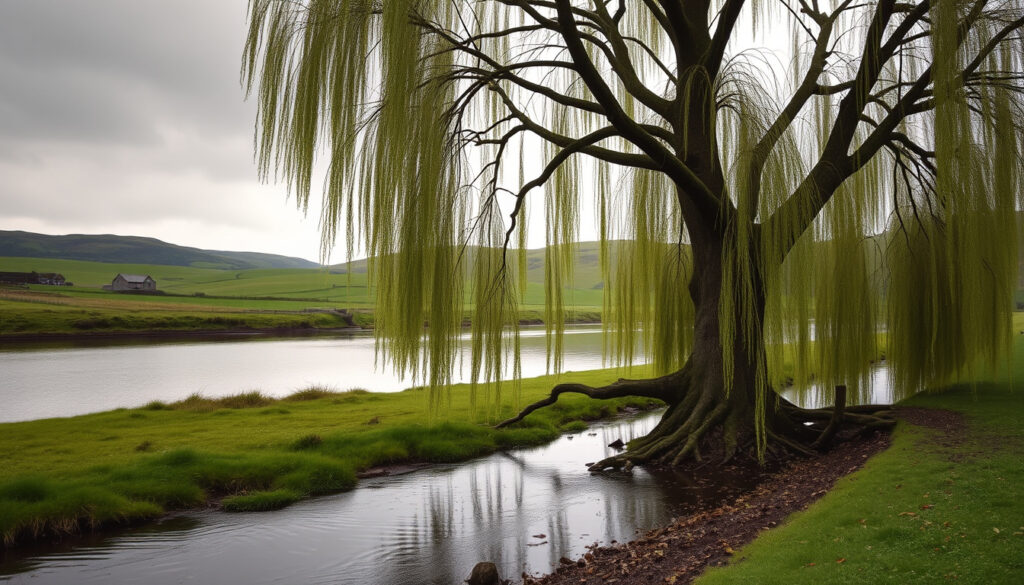
Willow Tree Ireland Guide: Species, Uses & Growing Tips
If you’ve ever noticed a willow tree’s long, sweeping branches brushing against a stream or garden pond and wondered whether it would be a good fit for your own patch of Irish soil, you are not alone. Willow trees are among the most recognisable and versatile trees in Ireland, deeply woven into both the landscape and the country’s cultural heritage.
Species in genus Salix: ~350 · Native willow species in Ireland: Several, including Salix viminalis and Salix cinerea · Average height at 10 years: 15–30 feet (4.5–9 m) · Growth rate per year: Up to 8 feet (2.4 m) · Sacred trees of Ireland (willow rank): One of the five
Quick snapshot
- Genus Salix, ~350 species — Wildlife Trust BCN
- Deciduous trees and shrubs (Wildlife Trust BCN)
- Catkins (pussy willows) in spring (Wildlife Trust BCN)
- One of five sacred trees of Ireland (University College Cork)
- Native species: Salix viminalis, Salix cinerea — University College Cork
- Irish name: Saileach (University College Cork)
- Basket weaving, cricket bats — Trees for Life
- Biomass and erosion control — Teagasc
- Ornamental in gardens (Trees for Life)
- Thrives in damp, acidic soil — O’Brien Horticulture
- Fast-growing: up to 8 ft/year (O’Brien Horticulture)
- Suitable for shelter belts (O’Brien Horticulture)
A quick glance at the willow’s key traits reveals why it holds such a unique position in Ireland’s natural and cultural landscape.
| Attribute | Value |
|---|---|
| Scientific name | Salix spp. |
| Native to Ireland | Yes, several species — Irish Examiner |
| Irish name | Saileach |
| Growth rate | Up to 8 feet per year |
| Height at 10 years | 15–30 feet (4.5–9 m) |
| Sacred tree status | One of the five sacred trees of Ireland |
What is special about a willow tree?
Symbolism and cultural significance
The willow tree holds a unique place in Irish tradition as one of the five sacred trees of Ireland, alongside the oak, hazel, holly, and yew. Its Irish name, saileach, is derived from the Old Irish sal, and it is associated with the Ogham letter S — Irish Examiner notes. This connection ties the tree to ancient Celtic writing and lore, where each letter in the Ogham alphabet was named after a tree.
For anyone exploring Irish heritage, the willow is not just a tree but a living symbol of the country’s pre-Christian past. Its bark once provided the raw material for aspirin, and its branches were used to write messages in the Ogham script.
Botanical uniqueness
Willow trees belong to the genus Salix, which includes approximately 350 species worldwide — Wildlife Trust BCN. They are deciduous, meaning they lose their leaves in winter, and produce catkins — soft, fuzzy flower clusters — in early spring. What makes willows stand out is their preference for damp, waterlogged soil, which explains why they thrive in Ireland’s famously rainy climate.
One of the most remarkable traits of the willow is its rapid growth. While many trees take decades to reach maturity, a willow can shoot up 8 feet (2.4 metres) in a single year under ideal conditions — O’Brien Horticulture.
The pattern: willow’s combination of sacred status and exceptional fast growth makes it a tree that defies easy classification — it is both a spiritual symbol and a practical workhorse of the Irish landscape.
Do willow trees grow well in Ireland?
Native Irish willow species
Ireland is home to about a dozen native willow species, though hybrids and natural intermixing can make identification tricky — Irish Examiner. Among the most common is Salix cinerea, described by University College Cork as the most widespread willow found in Ireland, thriving in both acidic and base-rich wet soils.
While many willow species are native, the exact number of distinct, non-hybridised species is not fully settled — even Teagasc notes that identification can be difficult due to hybridisation.
Ideal growing conditions in Ireland
Willows prefer damp, acidic soil with plenty of moisture, making them well-suited to Ireland’s wet, mild climate. They are often planted as shelter belts to protect crops from wind, and they thrive in the kind of boggy, peaty ground that is common in many parts of the country — Native Irish Trees Facebook group.
The trade-off is clear: willows love water, and they will seek it out aggressively. For Irish gardeners with poorly drained soil, this is a blessing — but for anyone with foundations or drainage pipes nearby, it can become a problem.
The implication: willow’s thirst is its defining trait — a superpower in boggy land, but a hazard near buildings.
What is the Irish name for the willow tree?
Irish names: Saileach, Sail, Saille
The traditional Irish word for willow is saileach (pronounced sall-ock), and it appears in the Ogham alphabet as the letter S. According to Irish Examiner, the name is linked to the sail tree, which is also sometimes called saille in older texts. This connection with Ogham writing gives the willow a special status — it is one of the few trees whose name is literally part of Ireland’s ancient alphabet.
What this means: the willow’s name is not merely a label — it is a direct link to the Ogham alphabet, the earliest known form of Irish writing.
What is a willow tree used for?
Traditional uses: basket weaving, medicine
Willow has been used for centuries in Ireland for practical purposes. Its wood is valued for its flexibility and shock-absorbing properties, making it ideal for cricket bats and baskets — Trees for Life. Historically, willow was used for building houses and making furniture, and its bark contains salicin, a natural compound that was a precursor to aspirin — Patti Wigington.
Modern uses: biomass, erosion control, ornamental
Today, willow is grown for short rotation coppice (SRC) — a system where young trees are cut back every few years for biomass fuel — as detailed in Teagasc’s willow identification guide. It is also used for streambank stabilisation, where its roots help hold soil together in wet areas, and for ornamental purposes in gardens where a weeping form is desired.
For Irish homeowners, willow is a dual-purpose tree: it can provide quick screening, fast-growing fuel, and garden beauty — but only if planted well away from pipes, foundations, and drains.
The pattern: willow’s uses span from ancient basket-making to modern biomass energy, making it one of the most versatile trees in the Irish landscape.
What are the downsides of having a willow tree?
Invasive root systems
Willows are notorious for their aggressive, water-seeking roots. They will actively search for moisture, and if that means cracking a drain pipe or invading a foundation, they will do it — Facebook group. This makes them a poor choice for small gardens or near buildings.
Weak wood and storm damage
Willow wood is relatively soft and brittle, which means branches break easily in high winds. A 10-year-old willow can be top-heavy, and its wood tends to snap rather than bend — O’Brien Horticulture. This makes them less suitable for urban or suburban settings where falling branches are a risk.
The catch: willow’s fast growth comes at a cost — its roots and wood are both liabilities in confined spaces.
How fast do willow trees grow?
Growth rate by species
Willows are among the fastest-growing trees in Ireland. Under good conditions, they can add up to 8 feet (2.4 metres) of height each year — O’Brien Horticulture. This means a young tree can go from knee-high to head-high in a single summer.
Size at 10 years
At 10 years old, a typical willow reaches 15–30 feet (4.5–9 metres) tall, with a spread of roughly the same width — University College Cork. This gives it a mature but not enormous size, suitable for larger gardens or countryside settings rather than small suburban plots.
The implication: willow’s growth rate is its greatest asset — and its most demanding constraint, as it quickly outgrows small spaces.
What is the superstition about willow trees?
Folklore and mythology
In Irish and broader Celtic folklore, the willow is associated with the moon and water, and is sometimes linked to mourning and loss — Trees for Life. The weeping willow, with its drooping branches, is especially associated with sadness and funerals. Some old superstitions say that a willow planted near a house will bring tears or that its roots will seek out the dead — Patti Wigington.
These superstitions are part of the tree’s charm, but for Irish homeowners considering a willow, the practical downsides — invasive roots and weak wood — are far more likely to cause trouble than any supernatural curse.
The catch: willow’s folklore adds to its mystique, but the real risks are physical, not supernatural.
What is still unclear about willow trees in Ireland?
What’s unclear
The exact number of pure, non-hybridised willow species native to Ireland is not fully known. The Irish Examiner notes that hybridisation makes identification difficult, and Teagasc points out that many commercial willow varieties are bred from UK and Swedish programmes, not native Irish stock. For anyone looking to plant a truly native Irish willow, the safest bet is to buy from a local supplier who can identify the parent tree.
The origin of some willow superstitions is also unclear — while many traditions are ancient, some may have been embellished in the 19th century.
The pattern: the uncertainty around willow species identification reflects the tree’s complex nature — even experts struggle to pin down its exact classification.
Willow tree in Ireland: Key takeaways
For Irish gardeners, the willow is a fast, versatile, and historically significant tree — but it comes with real trade-offs. If you have space, damp soil, and no nearby drains or foundations, a willow can be a wonderful addition. If your garden is small or your house is built on clay, the safer choice is to plant a willow in a container or choose a less aggressive tree.
The bottom line for Irish homeowners: willow offers unmatched speed and cultural depth, but demands respect for its roots and its fragility.
Related reading: Malvern Hills: Walks, Famous Residents & Nearby Towns · Miniature Dachshund: Care, Training & Health Guide
magill.ie, maps.biodiversityireland.ie, youtube.com, downunderbrief.org
Gardeners interested in native Irish willow species can refer to native Irish willow species for detailed guidance on growth habits and practical uses.
Frequently asked questions
Can willow trees grow in Ireland?
Yes, several willow species are native to Ireland and grow well in its damp, mild climate. University College Cork notes that Salix cinerea is the most common willow in the country.
What is the Irish name for willow?
The Irish word is saileach, from Old Irish sal, and it appears in the Ogham alphabet — Irish Examiner.
How big is a 10 year old willow tree?
A 10-year-old willow typically reaches 15–30 feet (4.5–9 metres) tall — University College Cork.
What are the 5 sacred trees of Ireland?
They are the oak, hazel, holly, yew, and willow — Irish Examiner.
Should I plant a weeping willow tree?
Only if you have a large, damp space and no nearby pipes or foundations. Its roots are aggressive — O’Brien Horticulture.
What does a willow tree flower look like?
Willows produce catkins — soft, fuzzy clusters of tiny flowers — in early spring. Wildlife Trust BCN has detailed illustrations.
How to draw a willow tree?
Focus on the drooping, sweeping branches and the slender trunk — Trees for Life.
Where can I buy willow trees in Ireland?
Check local nurseries or Teagasc for supplier lists.
More related posts
 Guy Pearce: Biography, Divorce, Relationships, and Career
 Millie Bright: Retirement, Career Stats and Personal Life
 Robbie Fowler: Biography, Net Worth, Career, and Personal Life
 Amad Diallo: Biography, Transfer, Salary, and Latest News
 Prince William: royal life, family, and key questions
 Does Rice Have Gluten – Safe Varieties and Risks
 How to Calculate Percentage: Formulas, Examples & Excel
 Matching Family Christmas Pajamas: Top Picks & Sizing Tips