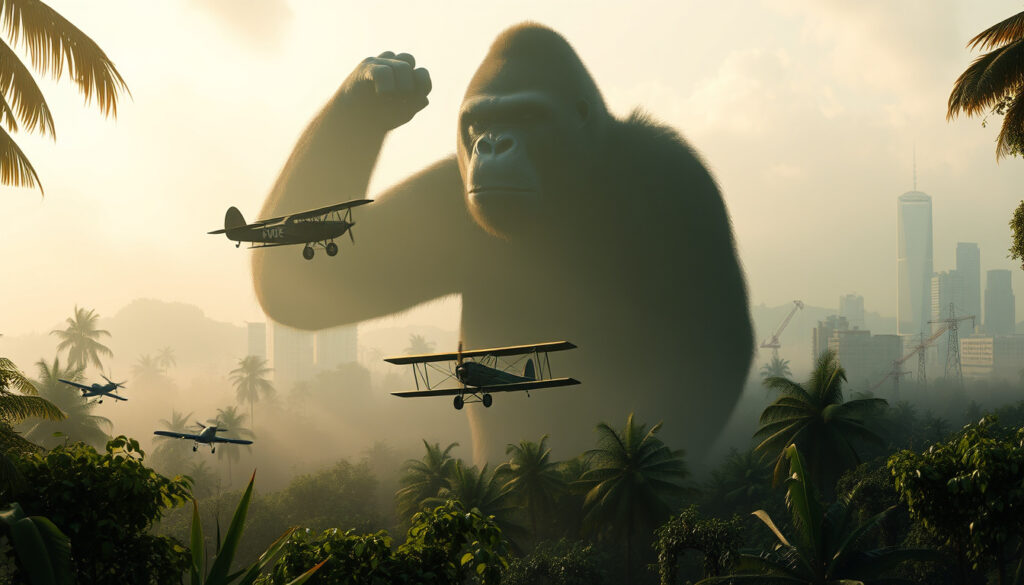
King Kong: From Colonial Allegory to MonsterVerse Icon
Few fictional characters have sparked as much interpretation over the decades as a 50-foot ape that first climbed a skyscraper in 1933. On its opening day at Radio City Music Hall and the Roxy Theater, 50,000 people lined up to see King Kong — a number that tells you how quickly the giant gorilla became a cultural touchstone.
First appearance: 1933 ·
Number of major films: 12+ ·
2005 film global box office: $550 million ·
Height (1933 original): 50 feet (15 m) ·
Height (MonsterVerse): 335 feet (102 m) ·
Creator: Merian C. Cooper
Quick snapshot
- Exact symbolic intention of the original filmmakers regarding slavery metaphor (The Film Foundation)
- Whether King Kong will return to solo films or continue in crossovers (Gojipedia)
- New MonsterVerse film in development (Gojipedia)
- Fan anticipation for solo Kong adventure or another Godzilla crossover (Gojipedia)
Here are six key facts about the King Kong franchise.
| Label | Value |
|---|---|
| First appearance | 1933 film King Kong (TCM) |
| Creator | Merian C. Cooper (The Film Foundation) |
| Number of major film appearances | 12 (including remakes and reboots) (King Kong Wiki) |
| Height across versions | 18–335 feet (TCM) |
| Notable directors | Cooper, Guillermin, Jackson, Jordan Vogt-Roberts (Wikipedia) |
| Cultural impact | One of the most recognizable monsters in pop culture (TCM) |
What exactly is King Kong?
King Kong is a fictional giant ape who first appeared in the 1933 American pre-Code adventure horror film directed by Merian C. Cooper and Ernest B. Schoedsack. The character was brought to life through stop-motion animation by Willis O’Brien — an 18-inch model that appeared as a 40-foot creature on screen (TCM). The plot follows filmmaker Carl Denham who captures Kong from a remote island and brings him to New York City, where the ape escapes and climbs the Empire State Building.
Kong was created during the Great Depression, and his capture-and-display narrative resonated with a public that saw itself as both powerless and fascinated by the exotic. The film’s pre-Code status allowed racial and sexual undertones that later censors would cut.
Why was King Kong banned?
- Later re-releases in 1938 required 29 scenes removed to receive approval (TCM).
- Scenes depicting cannibalistic natives and Kong’s sexualized pursuit of Ann Darrow were deemed too explicit after the Hays Code took full effect (The Film Foundation).
The implication: censorship shaped how audiences later saw the film, and the cuts reveal the racial and sexual anxieties of the era.
Is King Kong 2005 hit or flop?
Peter Jackson’s 2005 remake cost $207 million to produce and grossed $550 million worldwide (Wikipedia). Financially it was a success but not a blockbuster on the scale of Jackson’s Lord of the Rings trilogy. Critically, it holds 84% on Rotten Tomatoes but only 61% audience score, reflecting a split between critics and general viewers.
The 2005 film is technically a box-office success and a critical hit, yet its 187-minute runtime and slower pacing alienated many casual moviegoers. For Peter Jackson, the challenge was recreating a beloved classic in a post-CGI world — a feat that earned respect but not universal love.
Is King Kong good or bad?
- Critics praise the motion-capture performance by Andy Serkis and the visual spectacle.
- Common audience complaints: excessive length, slow second act, and over-reliance on CGI that replaced Willis O’Brien’s handcrafted charm.
The pattern: the 2005 film succeeded commercially but left a divided legacy, proving that new technology can’t automatically replicate the original’s magic.
Is King Kong a metaphor for slavery?
Scholars and critics have long interpreted the 1933 film as a metaphor for American slavery and racial fears. Kong, a black male captured from his island, is chained and exhibited before eventually breaking free and being killed by white civilization. The “Beauty and the Beast” dynamic with Ann Darrow echoes colonial narratives of the “savage” tamed by white womanhood (TCM).
Reading Kong purely as a racial allegory risks flattening the film’s many layers — Depression-era class anxiety, entertainment industry critique, and primal fear of the unknown. But the metaphor remains powerful because it was not accidental. Cooper and Schoedsack deliberately drew on imperialist themes of exploration and domination.
Why was King Kong so obsessed with the girl?
- Kong’s obsession with Ann Darrow is ambiguous — protectiveness vs. possession (The Film Foundation).
- Some interpretations see it as a monstrous version of the Beauty and the Beast trope, where the beast’s desire is both innocent and threatening.
The implication: Kong’s “obsession” is less about lust and more about the colonial trope of the savage claiming a symbol of civilization. It’s a mirror of the film’s own anxieties about race and gender.
Was King Kong filmed in Vietnam?
Kong: Skull Island (2017) was partially filmed in Vietnam, specifically in Ninh Binh province and Ha Long Bay (Gojipedia). The lush limestone karsts served as a stand-in for the fictional Skull Island’s jungle. Earlier King Kong films (1933, 1976, 2005) were not filmed in Vietnam.
Why this matters: The choice of Vietnam as a location gave the MonsterVerse Kong a distinctly Southeast Asian aesthetic, distancing it from the generic Pacific island tropes of earlier films.
Why is Kong no longer called King Kong?
Since Kong: Skull Island (2017), Legendary Pictures has referred to the character simply as “Kong” within the MonsterVerse. According to the franchise lore, this younger Kong has not yet earned the title of “King.” The rebrand also avoids confusion with the original 1933 film and reflects Warner Bros. and Legendary’s shared universe strategy (Gojipedia). Legal and branding factors also played a role: using “Kong” alone allows the character to coexist with Godzilla as a peer rather than a subordinate.
Here is a comparison of major King Kong films by key metrics.
| Film | Year | Director | Height | Box office (approx.) |
|---|---|---|---|---|
| King Kong (original) | 1933 | Cooper & Schoedsack | 40 ft (model 18 in) | $1.7 million (1933) |
| King Kong (1976) | 1976 | John Guillermin | ~40 ft | $80 million |
| King Kong (2005) | 2005 | Peter Jackson | 25–30 ft (digital) | $550 million |
| Kong: Skull Island | 2017 | Jordan Vogt-Roberts | 104 ft (young) | $566 million |
| Godzilla vs. Kong | 2021 | Adam Wingard | 335 ft | $470 million |
Five films, one pattern: Kong’s height has multiplied nearly tenfold since 1933, and his role has shifted from tragic monster to franchise protagonist.
Upsides
- Kong remains one of cinema’s most recognizable monsters — enduring appeal across generations.
- The MonsterVerse gave Kong a fresh identity as a younger, more relatable hero.
- Vietnam filming locations added visual authenticity to Skull Island.
Downsides
- Some fans feel the original stop-motion charm was lost with CGI-heavy remakes.
- The slavery metaphor, while rich, can be misunderstood or misused in modern discourse.
- 2005 film’s slow pacing alienated audiences despite technical excellence.
Timeline of King Kong through the decades
- — Original King Kong released, directed by Merian C. Cooper (Wikipedia)
- — First remake, directed by John Guillermin (Wikipedia)
- — Peter Jackson’s King Kong released (Wikipedia)
- — Kong: Skull Island kicks off Legendary’s MonsterVerse (Gojipedia)
- — Godzilla vs. Kong released (Gojipedia)
- — Planned MonsterVerse sequel announced (Gojipedia)
What we know for sure — and what’s still fuzzy
Confirmed facts
- King Kong is a fictional giant gorilla first appearing in 1933 (Wikipedia)
- The 2005 film grossed over $550 million worldwide (Wikipedia)
- Kong: Skull Island was partially filmed in Vietnam (Gojipedia)
- Kong is no longer called “King” in the MonsterVerse (Gojipedia)
What’s unclear
- Exact symbolic intention of the original filmmakers regarding slavery metaphor (The Film Foundation)
- Whether King Kong will return to solo films or continue in crossovers (Gojipedia)
King Kong was often credited as the first film to use miniature rear projection for special-effects sequences.
— Turner Classic Movies (TCM)
Cooper paid Max Steiner $50,000 out of pocket to compose the score with a 46-piece orchestra.
— The Film Foundation (The Film Foundation)
The story of King Kong is ultimately a story about how we use monsters to process our own fears — of the unknown, of the colonized, of technology, and of the stories we tell about power. For the MonsterVerse, the challenge is clear: keep evolving Kong’s identity beyond the shadow of 1933, or risk losing the very myth that made him iconic. For audiences, the choice is simple: engage with the layers, or just enjoy the spectacle. Either way, Kong endures.
kingkong.fandom.com, wikizilla.org, reddit.com, tohokingdom.com, imdb.com, en.wikipedia.org, irelandreport.net
For a detailed breakdown of how the character transformed over the decades, see this King Kongs evolution guide.
Frequently asked questions
How many King Kong movies are there?
At least 12 major film appearances including the original 1933 film, two remakes (1976, 2005), and several MonsterVerse entries (Kong: Skull Island, Godzilla vs. Kong).
Is King Kong related to Godzilla?
In the MonsterVerse, Kong and Godzilla are two ancient Titans who are rivals. They fought in Godzilla vs. Kong (2021).
Who created King Kong?
Merian C. Cooper conceived the character and co-directed the 1933 film with Ernest B. Schoedsack.
What is the MonsterVerse?
The MonsterVerse is a shared cinematic universe by Legendary Pictures and Warner Bros. that includes Godzilla, Kong, and other giant monsters.
Will there be another King Kong movie?
A MonsterVerse sequel is planned for 2024, though details about solo Kong films remain unconfirmed.
What is the correct order to watch King Kong movies?
Chronologically by release: 1933 original, 1976 remake, 2005 remake, then the MonsterVerse: Kong: Skull Island (2017), Godzilla vs. Kong (2021).
Is King Kong based on a true story?
No, King Kong is a completely fictional character. The myth of a giant ape was inspired by real gorilla expeditions but is not based on a specific true event.
More related posts
 IKEA Beds in Ireland: Sizes, Frames & Delivery Tips
 Nice Restaurants Near Me – Top Picks, Apps and Booking Tips
 Tina Majorino: Bio, Net Worth, Iconic Roles, and Career
 Estevao Willian: Chelsea Signing, Injury & Endrick Comparison
 Khloe Kardashian Relationship Status 2025: Is She Single
 Forest Whitaker: Medical Condition, Family, Career and More
 Omar Sy: Biography, Ethnicity, Languages, Net Worth and Career
 Dirk Bogarde Biography: Life, Films, and Partner Anthony Forwood