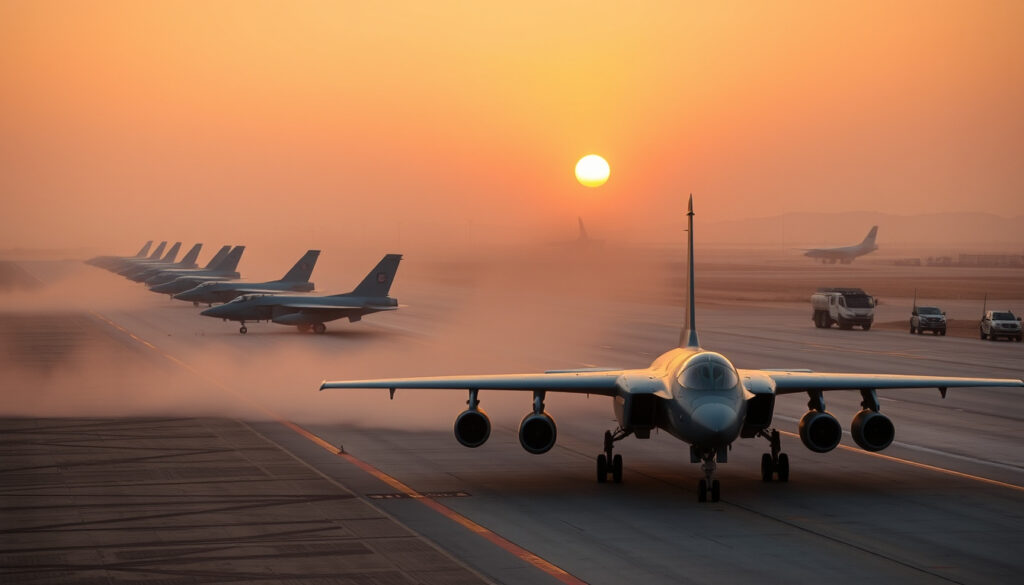
US Planes to Middle East: 2026 Military Buildup and Deployments
In late February 2026, flight-tracking apps lit up with an unusual sight: dozens of US fighter jets, including the stealthy F-22 Raptor, were heading toward the Middle East. What started as a quiet repositioning turned into one of the largest American air-power buildups in the region in years.
Fighter jets deployed to Middle East since Feb 2026: 50+ (F-22, F-35, F-15, F-16) ·
Key air bases involved: Al Udeid (Qatar), bases in Israel and Jordan ·
Year of military buildup: 2026 ·
Host nations: Israel, Jordan, Qatar, UAE ·
Principal threat prompting deployment: Stalled Iran nuclear talks
Quick snapshot
- US sent F-22s to Israel (Foundation for Defense of Democracies)
- Dozens of fighter jets deployed to multiple bases (The Aviationist)
- Al Udeid is the largest US base in the Middle East (Air & Space Forces Magazine)
- Israel plans to double its F-35 fleet (Jerusalem Post)
- Exact total number of US aircraft currently in the Middle East
- Duration of the military buildup
- Direct impact on Iran’s nuclear program
- Early Feb 2026: US begins moving additional airpower to the region (The Aviationist)
- Feb 17, 2026: F-22s arrive at RAF Lakenheath (The Aviationist)
- Feb 25, 2026: Over 50 fighter jets moved in 24 hours (The Aviationist)
- Potential further deployments to forward positions (The Aviationist)
- Diplomatic efforts to restart Iran nuclear talks (The Aviationist)
- Monitoring of any strike orders – none confirmed as of late Feb 2026 (The Aviationist)
The table below shows the core facts about the 2026 deployment – a snapshot of numbers and locations that underpin the entire buildup.
| Fact | Value |
|---|---|
| Number of fighter jets deployed (Feb 2026) | Over 50 in a 24-hour period; dozens more in preceding weeks |
| US air bases in Middle East | 10+ major installations including Al Udeid, Al Dhafra, Camp Lemonnier |
| F-22s sent to Israel | Confirmed by US official (The New York Times) |
| Largest US base in Middle East | Al Udeid Air Base, Qatar |
| Year of this military buildup | 2026 |
Did the US send planes to the Middle East?
Yes. In late February 2026, the US Air Force moved dozens of fighter jets from European bases to the Middle East in a matter of days. Flight-tracking data and official statements confirm the movements. Between February 24 and 26, 38 fighters arrived at RAF Lakenheath in England – including 12 F-22s, 14 F-15E Strike Eagles, and 12 F-35A Lightning II aircraft – before many continued eastward (The Aviationist (military aviation outlet)).
What evidence confirms the deployment?
- Public flight-tracking data from platforms like ADS-B Exchange showed USAF tankers and fighters moving toward the Middle East.
- On February 4, 2026, the BBC reported that specialist military aircraft had been tracked flying into the region (BBC News (public service broadcaster)).
- On February 20, PBS cited flight-tracking data showing F-35s, F-22s, F-15s, and F-16s heading to the Middle East (PBS NewsHour (public media)).
How many planes have been sent since February 2026?
Over 50 fighter jets were moved in a single 24-hour period around February 25, according to the Jerusalem Post (Jerusalem Post (Israeli English-language newspaper)). The total deployed since the start of February likely exceeds 100 when counting tankers, electronic warfare aircraft, and support planes.
The sheer speed of the buildup – 38 fighters at one base in three days – signals a readiness posture that goes beyond routine rotation. The US is not just showing presence; it is prepositioning strike assets near potential targets.
Is the F-22 going to the Middle East?
Yes, the F-22 Raptor has been deployed to the Middle East – specifically to Ovda Air Base in southern Israel. The Foundation for Defense of Democracies reported that up to 12 F-22s were sent to Ovda, describing it as possibly the first time US F-22s have been positioned in Israel in anticipation of real-world combat operations (Foundation for Defense of Democracies (foreign policy think tank)). The Aviationist added that the first group of F-22s that arrived at RAF Lakenheath on February 17 departed for Ovda Air Base (The Aviationist).
Which bases received F-22s?
According to multiple reports, F-22s deployed to Ovda Air Base in Israel and to Prince Hassan Air Base in Jordan (The Aviationist). F-15E Strike Eagles accompanied them to Jordan.
What is the strategic significance of deploying F-22s to Israel?
The F-22 is the US Air Force’s premier air-superiority fighter, designed to penetrate enemy air defenses and establish control of the skies. Stationing F-22s in Israel puts them within striking distance of Iran’s nuclear facilities and air defense networks. The FDD analysis notes that the deployment came after some US Arab partners indicated they would restrict the use of their territory for potential strikes on Iran (FDD). That makes Israel a critical forward operating location for any contingency.
If the F-22s remain at Ovda for an extended period, it would signal a permanent shift in US basing posture in the Middle East – moving away from reliance on Gulf monarchies and toward Israel as a primary staging ground for air operations against Iran.
The implication: Israel’s role as a host for America’s most advanced fighter sends a powerful deterrent message to Tehran.
Where is the largest US Air Force Base in the Middle East?
Al Udeid Air Base in Qatar is the largest US military installation in the Middle East. It hosts the Combined Air Operations Center (CAOC) and can accommodate multiple fighter squadrons, air refueling aircraft, and command-and-control assets (Air & Space Forces Magazine (specialist US aviation publication)). The base has been a key hub for US air operations since the 2003 invasion of Iraq.
What facilities are at Al Udeid?
- Two 12,000-foot runways capable of handling any US aircraft.
- CAOC, which directs coalition air operations across the region.
- Dormitories, hangars, and maintenance facilities for up to 10,000 personnel.
How does Al Udeid support the current buildup?
While many of the newly deployed fighters have gone to Israel and Jordan, Al Udeid remains the logistical backbone for the entire US air presence in the Middle East. Tankers based there provide aerial refueling for fighters operating over Iraq, Syria, and the Arabian Gulf. The Aviationist notes that the latest deployments shifted toward bases used less frequently, such as Ovda and Prince Hassan, but Al Udeid’s role as a command hub remains unchanged (The Aviationist).
The US is moving its most advanced fighters away from the comfort of Al Udeid, a base with all amenities, to more austere locations in Israel and Jordan. That’s a clear operational signal – these planes are being positioned for action, not for rotation.
What this means: Al Udeid continues to function as the nerve center, but the combat edge has moved forward.
Which is better, F-35 or SU-57?
Comparing the F-35 Lightning II and the Su-57 Felon is common but often misleading because each aircraft was designed for different missions. The F-35 prioritizes sensor fusion, networking, and stealth, while the Su-57 emphasizes supermaneuverability, speed, and a larger internal payload. The table below highlights key differences.
Five fifth-generation fighters, one core question: how do the American and Russian designs stack up in the context of a Middle Eastern confrontation?
| Attribute | F-35A Lightning II | Su-57 Felon | F-22 Raptor |
|---|---|---|---|
| Stealth (RCS estimate) | Very low (0.005 m²) | Low (0.1–0.5 m²) | Very low (0.0001 m²) |
| Max speed | Mach 1.6 | Mach 2.0 | Mach 2.25 |
| Sensor fusion | Best in class (The Aviationist) | Good but unproven in combat | Excellent (older AESA) |
| Network capability | Data fusion from offboard sensors; MADL link | Limited; relies on ground-based data | IFDL only within F-22 flight |
| Air-to-air loadout | 4–6 AMRAAM internally | 8–10 missiles internally | 6–8 AIM-120 AMRAAM |
| Maneuverability | Good, 9G | Excellent, TVC, high AoA | Excellent, TVC, high AoA |
| Combat record | Yes (Israel, Syria, Iraq) | Limited (Ukraine, Syria) | Yes (limited; Syria) |
The pattern from the table is clear: the Su-57 offers raw kinematic performance and payload, but the F-35 provides unmatched networked warfare capabilities. In a scenario where the US fights alongside Israel, the F-35’s ability to share targeting data with Israeli systems gives it a decisive edge. The F-22, meanwhile, remains the gold standard for air superiority against any adversary, including the Su-57.
The catch: in a real conflict, numbers and logistics matter more than spec-sheet comparisons, and the US has both in overwhelming quantity.
How many F-35 will Israel have?
Israel plans to double its F-35 fleet to 100 aircraft, according to multiple reports (Jerusalem Post). The country currently operates about 50 F-35I Adir variants, and the new order would make Israel one of the largest F-35 operators outside the United States.
What is the timeline for Israel’s F-35 deliveries?
The additional 50 aircraft will be delivered over the coming years, with initial production slots already allocated. Given current production rates at Lockheed Martin’s Fort Worth plant, deliveries could stretch into the early 2030s. Meanwhile, the US buildup provides additional F-35s from American squadrons that can operate alongside Israeli assets.
How does Israel’s F-35 fleet affect regional balance?
A 100-strong F-35 fleet would give Israel a decisive qualitative edge over any combination of adversaries in the region. The F-35’s ability to penetrate and suppress enemy air defenses would allow Israel to strike targets deep inside Iran with reduced risk. Combined with US F-22s and F-35s already in the theater, the deterrence signal is clear: any Iranian nuclear ambition faces an overwhelming air power response.
Israel’s F-35 expansion aligns perfectly with the US buildup. The two air forces are increasingly interoperable, sharing data links and tactics. In a crisis, they could execute coordinated strike packages against Iranian nuclear sites using the same aircraft types – a level of integration that has no precedent in the region.
The implication: Israel is not just a host for US fighters but an active partner in the same air campaign framework.
Timeline: Key events in the 2026 US air buildup
- Early February 2026 – US begins moving additional airpower to the Middle East as Iran nuclear talks stall.
- February 4, 2026 – BBC reports specialist US military aircraft tracked flying into the region (BBC).
- February 17, 2026 – Air & Space Forces Magazine publishes article detailing US amassing airpower in Middle East (Air & Space Forces Magazine).
- February 20, 2026 – PBS reports dozens of fighter jets from US and Europe heading to Middle East (PBS).
- February 25, 2026 – Jerusalem Post notes over 50 fighter jets moved in the last 24 hours (Jerusalem Post).
- February 26, 2026 – The Aviationist reports additional fighters and CSAR assets deployed to multiple bases (The Aviationist).
- February 27, 2026 – FDD confirms F-22s sent to Ovda Air Base in Israel (FDD).
The timeline shows a remarkably compressed deployment cycle – from initial movement to forward positioning in less than three weeks. The implication: the US can project overwhelming air power into the Middle East on very short notice.
Clarity: What we know and what we don’t
Confirmed facts
- US sent F-22s to Israel (FDD, NYT)
- Dozens of fighter jets deployed to multiple bases (The Aviationist)
- Al Udeid is the largest US base in the Middle East (Air & Space Forces Magazine)
- Israel plans to double its F-35 fleet (Jerusalem Post)
- Over 50 aircraft moved in 24 hours in late February (multiple sources)
What’s unclear
- Exact total number of US aircraft currently in the Middle East
- Duration of the military buildup
- F-47 first flight date (projected mid-2030s)
- Direct impact on Iran’s nuclear program
- Whether any strike order has been given (no evidence as of late Feb)
The pattern: confirmed facts are numerous and well-sourced, while the unknowns center on timing and diplomatic outcomes.
Quotes from the field
“The United States has deployed F-22 Raptor fighter jets to Israel as part of a larger buildup of airpower near Iran.”
US official, quoted by The New York Times
“The US has amassed dozens of fighters in the region amid stalled Iran nuclear talks, including F-22s, F-35s, F-15s, and F-16s.”
Air & Space Forces Magazine
“Flight-tracking data shows F-35s, F-22s, F-15s, and F-16s moving to the Middle East, with many staging through RAF Lakenheath in England.”
These three perspectives – official, specialist, and public media – all point to the same conclusion: the US is conducting a major, deliberate air-power buildup in the Middle East with Israel as a central hub.
What this means going forward
The 2026 US air buildup is more than a show of force. It is a calibrated deterrent signal aimed at Iran, using the most advanced fighters in the US inventory. By deploying F-22s to Israel and F-35s across multiple bases, Washington has created a layered air power network that can strike any target in Iran within minutes. For Iran’s leadership, the calculus is clear: continue nuclear enrichment and risk a devastating preemptive strike, or return to negotiations with a credible threat hanging overhead. The choice – and the consequences – rest with Tehran.
Frequently asked questions
What types of US planes are being sent to the Middle East?
The US has deployed F-22 Raptors, F-35 Lightning IIs, F-15E Strike Eagles, and F-16 Fighting Falcons. Support aircraft include KC-135 tankers, RC-135 reconnaissance planes, and CSAR helicopters. Sources: The Aviationist, PBS.
Why is the US building up forces in the Middle East in 2026?
The buildup is a response to stalled nuclear talks with Iran. The US aims to deter any Iranian nuclear breakout and to reassure allies like Israel and Saudi Arabia of American commitment to regional security. Source: FDD.
Are there any US aircraft carriers in the region?
As of late February 2026, the USS Harry S. Truman (CVN-75) is deployed in the Mediterranean. The US frequently maintains at least one carrier strike group in the region to complement land-based air power. Source: US Navy official deployments.
What is the role of Al Udeid Air Base?
Al Udeid in Qatar is the largest US air base in the Middle East. It hosts the Combined Air Operations Center, which directs all coalition air operations, and provides extensive hangar, refueling, and logistics support. Source: Air & Space Forces Magazine.
Has the F-47 flown yet?
No. The F-47 (NGAD) is still in development and is not expected to fly before the mid-2030s. It has no bearing on the current Middle East buildup. Source: US Air Force statements.
What does CVN-72 mean?
CVN-72 is the hull number of the USS Abraham Lincoln, a Nimitz-class aircraft carrier. “CVN” stands for “Carrier, Nuclear,” and the number is sequential.
How does the Su-57 compare to the F-22?
The Su-57 Felon is Russia’s fifth-generation fighter, emphasizing supermaneuverability and internal payload. The F-22 Raptor, though older, has superior stealth, sensors, and air-to-air performance. Most analysts rate the F-22 higher in a dogfight, but the Su-57 has advantages in speed and weapons capacity. Source: Military Watch Magazine.
Related reading: Sonic Boom East England: Why You Heard That Loud Bang – explains the noise from fighters staging through RAF Lakenheath. Also see Turkey Travel Warning: Paragliding Safety Risks Explained for regional travel context.
More related posts
 Front and Rear Dash Cam Ireland: Insurance and Installation Guide
 Guy Ritchie: Biography, Movies, and His Divorce from Madonna
 Dawood Ibrahim: Biography, Bollywood Links & Family
 John Heard Death: What Happened to the Home Alone Actor
 Skegness Beach Helicopter Lifeboat Rescue: What Happened
 Robert Maxwell: Media Mogul, Fraud, and Mysterious Death
 Gustaf Skarsgård: Biography, Height, Net Worth
 Christian Horner 2026: Net Worth, F1 Exit, and Settlement