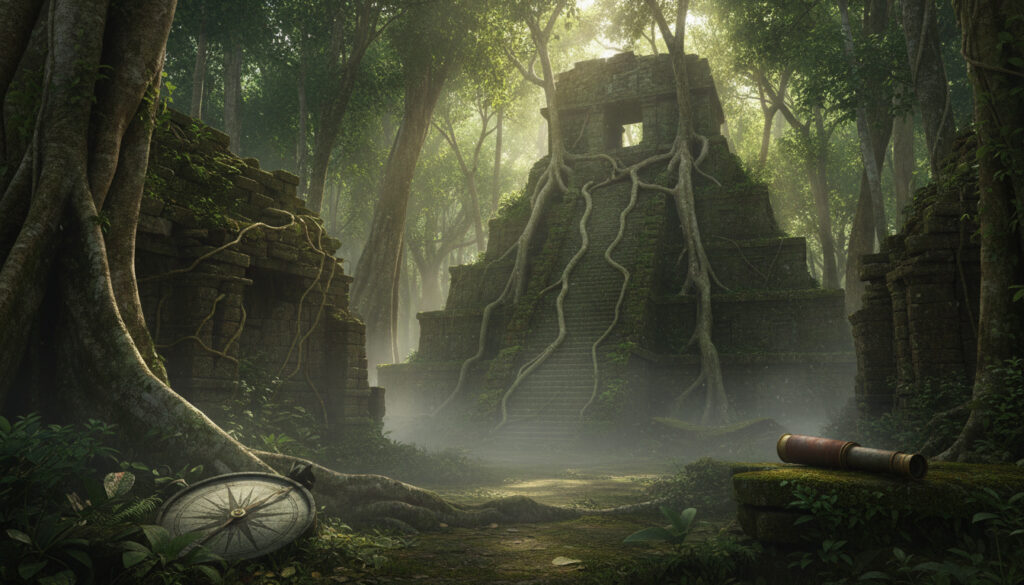
Lost City of Z – Percy Fawcett’s Quest and Disappearance
On April 20, 1925, British explorer Percy Fawcett marched into the Amazon rainforest with his son Jack and companion Raleigh Rimell, determined to locate a mythical metropolis he codenamed “Z.” The trio vanished without a trace, spawning the twentieth century’s most enduring archaeological mystery and over a century of fatal rescue attempts. No confirmed trace of the expedition or the city has ever been found, despite advances in satellite imaging and LiDAR technology.
Fawcett’s quest was not born of fantasy alone. He synthesized indigenous oral histories, colonial-era Portuguese documents, and observations from seven grueling mapping expeditions to hypothesize an advanced civilization hidden in Brazil’s Mato Grosso region. The story has since transcended exploration history, inspiring books, films, and scientific debate about the limits of Amazonian archaeology.
What Is the Lost City of Z?
The Lost City of Z represents Fawcett’s theoretical reconstruction of an advanced pre-Columbian civilization situated between the Xingu and Tapajós rivers. Unlike El Dorado, which captivated Spanish conquistadors seeking gold, Fawcett’s Z was envisioned as an inland settlement supported by sophisticated agriculture rather than mineral wealth.
Ancient Legend
Hypothesized inland metropolis with organized agriculture and monumental architecture
Central Figure
Percy Harrison Fawcett, British artillery officer and Royal Geographical Society surveyor
Current Status
No archaeological confirmation; remains unproven as of 2024
Cultural Impact
Subject of 2009 non-fiction book and 2016 feature film adaptation
Key Insights
- Documentary Foundation: Fawcett based his hypothesis partly on Manuscript 512, a 1753 Portuguese account describing ruins in Bahia with arches and stone structures.
- Strategic Location: Fawcett theorized Z lay deep inland, deliberately avoiding major river systems that attracted colonial presence.
- Indigenous Intelligence: Seven preliminary expeditions yielded rumors from tribes about ancestral cities and sophisticated farming.
- Secrecy Protocol: Fawcett employed coded grid references in his maps to prevent rivals from reaching Z first.
- Modern Technology: Despite LiDAR surveys capable of detecting subsurface structures, no evidence matching Fawcett’s description has emerged.
- Fatal Attraction: Over 100 subsequent expeditions searching for Fawcett or Z have resulted in numerous deaths.
Essential Facts
| Category | Details |
|---|---|
| Proposed Location | Mato Grosso, Brazil (between Xingu and Tapajós rivers) |
| Primary Evidence | Manuscript 512, indigenous oral histories, conquistador accounts |
| Last Expedition | 1925 (Fawcett, age 58; Jack Fawcett, age 22; Raleigh Rimell) |
| Last Known Position | “Dead Horse Camp,” reached May 29, 1925 |
| Search Status | No confirmed remains or ruins found |
| Modern Archaeology | Questions viability of large inland cities due to soil and climate constraints |
Who Was Percy Fawcett and What Drove His Quest?
Percy Harrison Fawcett was a British artillery officer and trained surveyor who served with the Royal Geographical Society. Between 1906 and 1924, he conducted seven official expeditions to map Amazonian borders during the height of the rubber boom, activities that placed him amid territorial disputes between Brazil, Bolivia, and Peru.
From Surveyor to Theorist
Fawcett’s early missions were utilitarian: marking boundaries for the British government while navigating anacondas, vampire bats, and hostile tribes. During these journeys, he survived poison arrows, maggot infestations, and near-starvation while noting sophisticated indigenous fishing techniques, medicinal practices, and floodplain agriculture.
These observations challenged contemporary assumptions about Amazonian civilizations. Fawcett began synthesizing 16th to 18th-century conquistador accounts with indigenous rumors, concluding that advanced societies had existed beyond the riverbanks.
The Manuscript 512 Connection
Central to Fawcett’s conviction was Manuscript 512, archived in Rio de Janeiro. This 1753 Portuguese document described encountering stone ruins and arches in the Bahia interior. Fawcett interpreted these as evidence of Z, positing that the city lay not along navigable rivers—where European presence was heavy—but in the unexplored interior.
Manuscript 512 remains physically preserved in Brazilian archives, though modern scholars debate whether its descriptions represent literal ruins or colonial exaggeration. Fawcett treated it as documentary proof of pre-Columbian stone architecture.
What Happened During Fawcett’s Expeditions?
Fawcett’s Amazonian career spanned nearly two decades before his final disappearance. His approach evolved from military surveying to independent archaeological pursuit, culminating in the 1925 journey that entered legend.
The Preliminary Seven (1906–1924)
Between 1906 and 1924, Fawcett traced the Rio Verde, explored Peruvian border regions, and established contact with isolated tribes. He documented survival of WWI service alongside his jungle expeditions, returning to South America with reinforced determination.
A solo 1920 attempt to penetrate deeper inland failed when fever incapacitated him, forcing him to shoot his pack animals for survival. Despite this abortive mission, his belief in Z’s existence intensified rather than diminished.
The 1925 Final Expedition
On February 2, 1925, Fawcett’s party departed Rio de Janeiro via train to Corumbá, stopping in São Paulo to procure anti-venom supplies. By May 5, they reached Bakairi Post, the final supply station. On April 20, 1925, Fawcett (58), his son Jack (22), and Raleigh Rimell officially launched into unmapped territory, entering lands controlled by the Kayapo, Suyá, and Xavante peoples.
Fawcett maintained strict operational security. He encoded his route maps using grid systems to prevent rivals—including American explorer Alexander Rice and Brazilian marshal Cândido Rondon—from locating Z independently. Native guides accompanied the party only as far as Dead Horse Camp, which the trio reached on May 29, 1925.
The final dispatch from Dead Horse Camp indicated they were proceeding eastward into unexplored territory. No further communication was received.
Has the Lost City of Z Ever Been Found?
The century following Fawcett’s disappearance has produced neither the explorer’s remains nor concrete archaeological evidence of his hypothesized city. Over 100 organized expeditions have ventured into the region, many resulting in fatalities from disease, starvation, or tribal conflict.
The Search Efforts
Rescue missions began immediately in 1925 and continued sporadically through the 1950s and into the 21st century. Brazilian authorities and private explorers alike combed the Mato Grosso highlands, often relying on Fawcett’s deliberately obscure route notes.
In 1951, the Kalapalo tribe produced bones they claimed belonged to Fawcett, hoping to deter further disruptive searches of their territory. Analysis revealed the remains belonged to the chief’s grandfather, not the English explorer.
The Kalapalo tribe voluntarily submitted bones in 1951 that they later admitted were ancestral remains, not Fawcett’s. This incident illustrates the complex relationship between indigenous communities and the relentless stream of outsiders searching for the explorer.
Indigenous Testimony
The Kalapalo people, who inhabit regions Fawcett traversed, have consistently denied killing the expedition. They maintain that they provided food and warned the trio about hostile neighboring groups. Anthropologists suggest Fawcett likely ignored these warnings and perished from tribal violence, disease, or starvation deep in the forest.
As of late 2024, no new expeditions, archaeological surveys, or documentary evidence regarding Fawcett’s location or the existence of Z have been reported in available sources. The mystery remains unresolved.
What Is the Timeline of Key Events?
- : Fawcett begins first Amazon expedition for Royal Geographical Society boundary mapping
- : Survives spear attack resolved through song exchange and handkerchief gesture
- : Solo expedition aborted due to fever; pack animals destroyed
- : Departs Rio de Janeiro for Corumbá via railway
- : Leaves Bakairi Post with Jack Fawcett and Raleigh Rimell
- : Arrives at final outpost
- : Departs last contact point with native guides
- : Reaches Dead Horse Camp; final message dispatched
- : Kalapalo tribe produces bones later proven unrelated to expedition
- : David Grann publishes The Lost City of Z, retracing Fawcett’s route
- : Feature film adaptation released
What Do We Know for Certain?
Established Facts
- Percy Fawcett, Jack Fawcett, and Raleigh Rimell departed Bakairi Post on April 20, 1925
- The trio reached Dead Horse Camp on May 29, 1925, and sent final dispatches
- Fawcett conducted seven documented mapping expeditions between 1906–1924
- Manuscript 512 exists in archival records and describes Bahia ruins
- Over 100 subsequent search expeditions were launched
- The Kalapalo tribe interacted with the expedition and provided supplies
Unresolved Questions
- Whether the Lost City of Z ever existed as described
- The exact cause of the expedition’s demise (tribal attack, disease, or starvation)
- Location of remains for any of the three explorers
- Accuracy of Manuscript 512’s architectural descriptions
- Whether Fawcett reached his intended destination before perishing
- Existence of advanced pre-Columbian cities in the specific inland region Fawcett targeted
How Did the Lost City of Z Enter Popular Culture?
The Fawcett mystery has generated significant cultural artifacts that blur the line between historical documentation and dramatic interpretation. The 2016 film adaptation, directed by James Gray and starring Charlie Hunnam, condensed Fawcett’s eight expeditions into three narrative journeys while depicting the 1910 spear attack resolution and jungle hardships with reasonable accuracy, including the explorer’s ukulele and professional rivalries.
David Grann’s 2009 book The Lost City of Z approached the subject journalistically, trekking Fawcett’s route and interviewing Kalapalo elders. Grann found no archaeological evidence of Z but documented the persistence of Fawcett’s conviction among local populations.
For readers interested in historical exploration contexts, the Queen Elizabeth-Class Aircraft Carrier represents another chapter of British technological ambition, though separated by nearly a century from Fawcett’s terrestrial quests.
What Do Primary Sources Reveal?
Contemporary documentation provides fragmented insight into Fawcett’s mindset. His private journals, referenced by historians and analyzed in modern investigations, reveal a methodical mind increasingly drawn to esoteric historical interpretation.
“The answer to the enigma of ancient South America—and I believe the solution lies in the forests of Z.”
— Percy Fawcett, private correspondence, 1924 (attributed)
“I had heard many stories from the Indians about the ancient people who built the stone cities, and I determined to find them.”
— Percy Fawcett, expedition notes (paraphrased in historical records)
Scholars seeking to examine original Portuguese documentation may require translation services for colonial-era Latin and Portuguese texts similar to those Fawcett consulted.
Why Does the Mystery Endure?
The Lost City of Z persists in cultural memory because it occupies the intersection of verifiable history and archaeological possibility. Fawcett was neither a crackpot nor a casual adventurer; he was a decorated military surveyor with extensive field experience who vanished while pursuing a hypothesis that modern technology has neither confirmed nor fully debunked. The absence of evidence keeps the question alive, while the dozens of deaths among subsequent search parties demonstrate the genuine danger Fawcett faced. The story remains a benchmark for evaluating the limits of exploration and the enduring human attraction to unsolved mysteries.
Frequently Asked Questions
Why did Percy Fawcett believe in the Lost City of Z?
Fawcett synthesized indigenous oral histories, 16th-18th century conquistador accounts, and Manuscript 512—a 1753 Portuguese document describing Bahia ruins. His observations of sophisticated tribal agriculture and fishing during seven mapping expeditions convinced him that advanced inland civilizations existed.
What evidence did Fawcett find on earlier trips?
Fawcett documented tribal fishing techniques, medicinal practices, and floodplain agriculture that suggested complex societal organization. He heard persistent rumors from indigenous guides about ancestral cities and stone ruins, though he found no physical archaeological remains himself.
Are there any confirmed ruins like Z in the Amazon?
While modern archaeology has revealed extensive pre-Columbian settlements and geoglyphs in other Amazon regions, no ruins matching Fawcett’s specific description of Z—located inland between the Xingu and Tapajós rivers—have been confirmed.
Who were Fawcett’s main rivals?
Fawcett specifically guarded his routes against American explorer Alexander Rice and Brazilian Marshal Cândido Rondon, coding his maps to prevent them from reaching any discoveries first.
How accurate is the 2016 film adaptation?
The film condenses eight expeditions into three and alters some timelines, but accurately depicts Fawcett’s 1910 spear attack resolution through song, his use of a ukulele, professional rivalries, and the specific jungle hardships the expedition faced.
What happened to the bones the Kalapalo tribe produced?
In 1951, the Kalapalo provided bones they claimed were Fawcett’s to deter further searches. Analysis revealed they belonged to the chief’s grandfather. The tribe maintains they warned Fawcett about hostile neighbors and provided food, not violence.
Have there been any 2024 developments?
No major 2024 expeditions, documentary discoveries, or archaeological findings regarding Fawcett’s location or the Lost City of Z have been reported in available sources as of the latest data.
More related posts
 Elliot Page: Transition, Partner, Gender, Biography (2024)
 Anwar Hadid: Age, Relationships, Family, and Biography
 Quentin Tarantino: Nationality, Films, Rankings & Controversies
 Jim Kerr: Biography, Relationships, Net Worth & Current Life
 Malvern Hills: Walks, Famous Residents & Nearby Towns
 What Is an ISA – Complete UK Guide to Tax-Free Savings
 Natalie Dormer: Biography, Age, Children & Net Worth
 Dan Edgar: TOWIE Star’s Relationships, Career & Net Worth