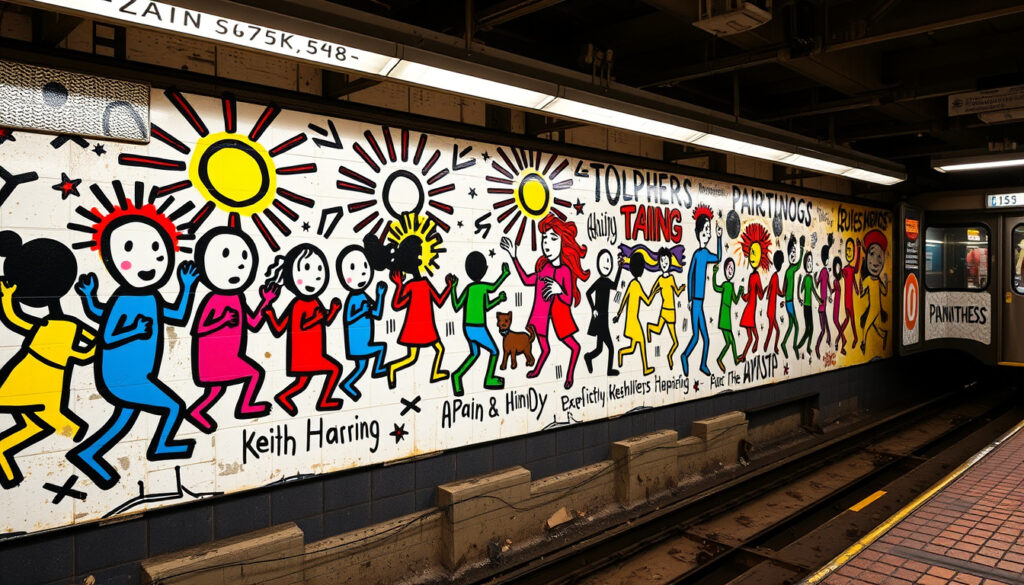
Keith Haring: The Artist Who Redefined Pop Art and Activism
Few artists have turned a subway station into a gallery quite like Keith Haring, and by the time he died at 31 in 1990, his radiant babies and barking dogs were already global icons. This article traces how a kid from Pennsylvania built a visual language that still commands millions at auction and speaks to activists today.
Born: May 4, 1958 ·
Died: February 16, 1990 ·
Record Auction Price: $6.5 million ·
Public Murals: Over 50 ·
Foundation Established: 1989
Quick snapshot
- Born May 4, 1958, in Reading, Pennsylvania (Keith Haring Foundation (official foundation))
- Died February 16, 1990, from AIDS complications (Christie’s (international auction house))
- Record auction price: $6.5 million for Untitled (1982) (Heritage Auctions (major auction platform))
- Founded the Keith Haring Foundation in 1989 (Christie’s (international auction house))
- Exact number of public murals is debated; often cited as “over 50”
- Precise details of his relationship with Juan Rivera are occasionally contested in secondary sources
- Exact start date of subway drawings — widely cited as 1980 but some sources vary
- Auction record price may shift as new sales occur; $6.5 million is the most recent publicly verified figure
- 1980–1985: subway chalk drawings (Christie’s)
- 1986: Pop Shop opens (Christie’s)
- 1988: diagnosed with HIV (Christie’s)
- 1989: foundation established (Christie’s)
- 1990: died at age 31 (Christie’s)
- Keith Haring Foundation continues to license imagery globally
- Major exhibitions still touring (e.g., Tate retrospectives)
- Auction demand shows no sign of cooling
Seven facts about Haring’s life and career reveal a pattern of rapid ascent and lasting influence.
| Field | Details |
|---|---|
| Full Name | Keith Allen Haring |
| Born | May 4, 1958 |
| Died | February 16, 1990 |
| Nationality | American |
| Movement | Pop Art, Graffiti |
| Known For | Public murals, subway chalk drawings, Radiant Baby |
| Foundation | Keith Haring Foundation (1989) |
Why is Keith Haring’s art so popular?
What themes dominate Haring’s work?
- Social issues — AIDS, apartheid, drug addiction — gave his images moral weight (Tate (UK national museum))
- Bright colors and bold outlines made the work instantly legible (The Art Story (arts reference site))
- Repeatable icons — Radiant Baby, barking dog — turned his vocabulary into a brand (Tate (UK national museum))
The pattern: Haring’s themes tackled real pain and joy, wrapped in a package that anyone could read. That combination built an audience far beyond the gallery.
How did subway drawings ignite his career?
Starting in 1980, Haring drew on unused black advertising panels in New York subway stations using white chalk (Christie’s (international auction house)). He produced hundreds of these short-lived works, catching the eye of commuters and eventually critics. The subway became his first “gallery” — free, public, and immediate.
What role did social activism play?
- He organized an anti-nuclear rally in Central Park in 1982 (HENI News (arts publisher))
- His Crack is Wack mural (1986) addressed drug addiction
- He created Ignorance = Fear and Silence = Death posters for AIDS activism (Andipa Editions (specialist gallery))
The implication: Haring didn’t just make art about issues — he gave the proceeds and his reputation to fight them. That integrity deepened his appeal.
Why does his art still resonate today?
Decades after his death, Haring’s imagery appears on clothing, murals, and museum walls. The Keith Haring Foundation manages licensing, ensuring his estate funds children’s programs and AIDS research (Christie’s (international auction house)). New generations discover his work through collaborations with brands and social media — his visual language remains fluent.
The catch: accessibility also invited mass reproduction, which can dilute perceived value among fine-art purists.
What is Keith Haring’s style of art called?
How does Haring’s style relate to pop art?
Art historians often classify Haring as a fusion of Pop Art and Graffiti Art (The Art Story (arts reference site)). Like Warhol, he drew from commercial culture; like Basquiat, he brought street energy. The result was a style that felt both familiar and disruptive. Haring’s work helped legitimize street art within galleries and museums (The Art Story (arts reference site)).
What are the defining visual elements?
- Bold black outlines and flat, bright colors — a limited palette that popped (Tate (UK national museum))
- Cartoonish, energetic figures with simplified anatomy
- Repetition of a small set of icons (Radiant Baby, barking dog, crawling figures) (Phillips (international auction house))
The pattern: he created a visual shorthand that could be drawn in seconds and remembered forever.
What is the meaning of the Radiant Baby?
The Radiant Baby — a crawling infant surrounded by light rays — represents purity, potential, and the energy of new life. Haring used it as a personal logo throughout his career (Tate (UK national museum)).
How did graffiti influence his art?
Haring’s early subway chalk drawings were inherently graffiti: illegal, ephemeral, and public. But he refined the raw energy of street tagging into a polished visual system. His line quality — rapid, fluid, confident — came directly from the pressure of drawing in transit stations before police arrived.
Haring’s art was born from vandalism yet now hangs in the world’s most prestigious museums. The same style that authorities once scrubbed off subway walls commands millions at auction.
The meaning: what the establishment once erased, it now canonizes — a rare reversal in art history.
How much is an original Keith Haring painting worth?
What is the most expensive Keith Haring painting sold?
The record price for a Haring work is $6.5375 million for Untitled (1982), sold at Sotheby’s in 2019 (Heritage Auctions (major auction platform)). This figure surpassed his prior record, indicating steady demand (HENI News (arts publisher)).
How do Haring prints and originals differ in value?
- Original paintings on canvas: typically sell in the high six- to seven-figure range (Artsy (online marketplace))
- Signed prints and posters: more accessible, from low thousands to mid five-figures
- Unlicensed reproductions: have no investment value — only works with provenance from the foundation or major galleries matter
What factors affect the price of Haring works?
Four variables determine what collectors pay, from authenticity seals to subject recognition.
| Factor | Impact on value |
|---|---|
| Provenance | Direct ownership history from foundation or trusted collection increases price |
| Condition | Subway drawings are delicate; well-preserved works command premiums |
| Size | Large-scale canvases fetch higher multiples |
| Subject matter | Iconic images (Radiant Baby, barking dog) are most sought after |
The pattern: authenticity and rarity drive value. Early subway drawings are especially prized because of their historical significance.
Where can I check current auction results?
Major auction houses like Sotheby’s, Christie’s, and Phillips regularly publish results online. Platforms such as Artsy and Heritage Auctions also track sales data. Always verify authenticity through the Keith Haring Foundation’s authentication process.
The takeaway: for serious buyers, provenance documentation is non-negotiable — a painting without it is speculation, not investment.
What happened to Keith Haring?
How did Keith Haring die?
Haring was diagnosed with HIV/AIDS in 1988 (Christie’s (international auction house)). He died of complications from the disease on February 16, 1990, at age 31 (Christie’s (international auction house)).
Who inherited Keith Haring’s estate?
Haring established the Keith Haring Foundation in 1989 (Keith Haring Foundation (official foundation)). The foundation controls his estate and licensing; it is a charitable trust, not inherited by any single relative. Revenue funds AIDS research, children’s programs, and art education.
What is the Keith Haring Foundation?
Founded a year before his death, the foundation manages Haring’s copyrights, organizes exhibitions, and gives grants. It ensures his activism continues beyond his lifetime.
Who was Keith Haring’s partner?
Haring’s long-term partner was Juan Rivera, a dancer (The New York Times (major newspaper)). Rivera was with Haring through his illness and remains a voice on his legacy. Secondary sources occasionally debate the details, but the relationship is well-documented.
The implication: Haring’s personal life was as public and principled as his art, refusing to hide even when stigma was fierce.
Is Keith Haring LGBTQ?
How did Haring’s sexuality influence his art?
- He was openly gay and integrated homoerotic imagery into his work
- His Ignorance = Fear and Silence = Death posters directly addressed the AIDS crisis and government inaction (Andipa Editions (specialist gallery))
- His art celebrated joy and desire within the gay community at a time when stigma was fierce
The trade-off: Haring’s openness cost him some commercial opportunities in the 1980s, but it cemented him as an LGBTQ icon whose work continues to inspire pride and protest.
What was his role in the LGBTQ community?
Haring used his fame to fundraise for AIDS organizations and challenge stigma. He marched, he spoke, and he let his art carry the message. Today, his foundation remains a major funder of LGBTQ+ youth programs.
Did he create works addressing gay rights?
Yes. Ignorance = Fear (1989) is a landmark protest poster. Another series depicts men in loving embrace, normalizing gay intimacy through art.
How did his art respond to the AIDS crisis?
Haring lost many friends to AIDS and faced his own diagnosis in 1988. His later works carry a raw, urgent quality — as if he knew time was short. He packed them with safe-sex messages, calls for research funding, and defiance against indifference.
Timeline: Keith Haring’s life and career
A chronological look at the key milestones that shaped his rise, his activism, and his lasting influence.
| Date | Event |
|---|---|
| 1958 | Born in Reading, Pennsylvania (Keith Haring Foundation (official foundation)) |
| 1978 | Moves to New York City to study at the School of Visual Arts (Christie’s (international auction house)) |
| 1980-1985 | Creates hundreds of subway chalk drawings in New York transit stations (Christie’s (international auction house)) |
| 1986 | Opens the Pop Shop retail store in SoHo (Christie’s (international auction house)) |
| 1988 | Diagnosed with HIV/AIDS (Christie’s (international auction house)) |
| 1989 | Establishes the Keith Haring Foundation (Christie’s (international auction house)) |
| 1990 | Dies of AIDS-related complications on February 16 (Christie’s (international auction house)) |
Clarity check
Confirmed facts
- Born May 4, 1958, died February 16, 1990
- Openly gay and LGBTQ activist
- Record auction price: $6.5 million for Untitled (1982)
- Founded Keith Haring Foundation in 1989
What’s unclear
- Exact number of public murals — often reported as “over 50”
- Precise nature of relationship with Juan Rivera — occasionally contested in secondary sources
- Exact start date of subway drawings — widely cited as 1980 but some sources vary
- Auction record price may shift as new sales occur; $6.5 million is the most recent publicly verified figure
Voices on Haring
“Art is for everybody.”
— Keith Haring, in a 1989 interview
“Haring’s bold, graphic imagery has become a widely recognized visual language of the 20th century.”
— Tate museum, on Haring’s impact
Haring’s mantra was simple, but the consequence is profound: his work crossed class, language, and geography. For young artists today, his career offers a lesson in staying authentic while reaching millions. For collectors, the takeaway is equally clear: Haring’s value lies not just in rarity, but in the enduring relevance of what he stood for.
Related reading: **Yoko Ono: Answers to Your Questions About Her Life and Legacy** · **Charlie Mackesy: Biography, Quotes, Faith, and Loss**
pbs.org, en.wikipedia.org, haringkids.com, japanmorningnews.com
For a deeper dive into his life and work, explore his biography and artistic legacy, which details his rise from subway drawings to global icon.
Frequently asked questions
Where can I see Keith Haring’s art in person?
Major collections include the Tate (London), the Museum of Modern Art (New York), and the Keith Haring Foundation’s public murals in New York, Berlin, and Tokyo.
Is Keith Haring’s art copyrighted?
Yes, all works are copyrighted by the Keith Haring Foundation. Unauthorized reproduction requires licensing.
What was the Pop Shop and why did Haring open it?
Opened in 1986 in SoHo, the Pop Shop sold affordable merchandise (t-shirts, posters, buttons) to make his art accessible. It was a direct challenge to gallery exclusivity (Christie’s (international auction house)).
How did Keith Haring start drawing in the subway?
He saw empty black advertising panels in subway stations and began drawing on them with white chalk in 1980. The results were ephemeral but hugely popular (Christie’s (international auction house)).
What materials did Keith Haring primarily use?
For subway drawings: white chalk. For studio works: acrylic paint on canvas, and later, markers on paper. He also worked in sculpture and digital media.
Did Keith Haring ever collaborate with other artists?
Yes. He collaborated with Jean-Michel Basquiat, Andy Warhol, and Madonna (for a stage design). He was part of the East Village art scene that included Kenny Scharf and Jenny Holzer (Artsy (online marketplace)).
Are there any Keith Haring exhibitions currently running?
The Keith Haring Foundation website lists current and upcoming exhibitions. Major retrospectives happen regularly at institutions like the Tate and the Museum of Contemporary Art in Los Angeles.
More related posts
 Olivia Colman: Husband, Kids, Net Worth & More
 Size 5 in EU – US and UK Shoe Size Conversions
 Mark Zuckerberg: Bio, Net Worth, Family, and Verified Facts
 Tim Burton: Helena Bonham Carter, Disney Exit, and New Movies
 Ross King: Presenter, Marriages, Net Worth, Strictly Come Dancing
 Mary-Louise Parker: Children, Career & Key Facts
 Emma Kenny: Psychologist, Age, Family, Net Worth, Tour Facts