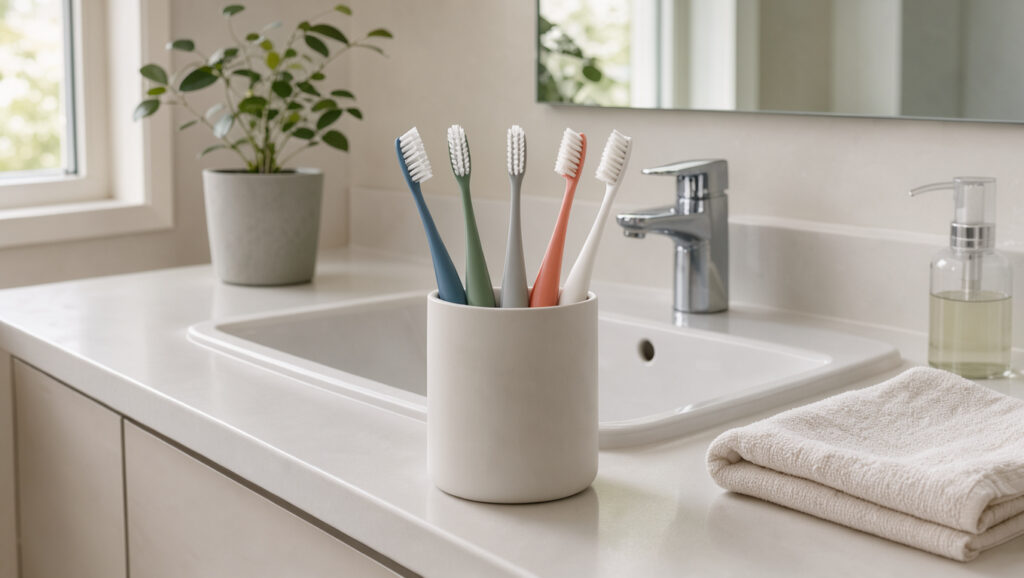
Toothbrush Holder: Storage, Hygiene and Buying Guide
Most of us never think about the toothbrush holder until the brush starts looking tired on the edge of the sink, yet a brush that dries slowly stays damp between uses, which gives the holder a bigger job than it seems. The American Dental Association (national dental authority) recommends replacing a brush every 3-4 months, and this guide separates that dental guidance from the marketing printed on holder boxes.
Recommended replacement interval: 3-4 months (American Dental Association) · Top organic results analyzed: 5 · Related searches identified: 6 · Holder materials in top results: Ceramic, glass, stick-on plastic
Quick snapshot
- The American Dental Association says to store a brush upright and let it air-dry (Colgate (oral-care manufacturer’s guide))
- Colgate advises a holder with air holes, not plastic bags or foil (Colgate (oral-care manufacturer’s guide))
- Reportedly, UV holder makers claim up to 99% bacteria elimination, and BestReviews’ buyer guide cites no independent evidence (BestReviews (consumer buyer guide))
- None of the sources reviewed tests drying time or bacterial load across holder materials (BestReviews (consumer buyer guide))
- Consumer Reports’ cleaning guide, dated , cites CDC advice (Consumer Reports (independent testing nonprofit))
- Colgate’s US storage guide is dated (Consumer Reports (independent testing nonprofit))
- Skip soaking brushes in mouthwash or disinfectant, a CDC caution relayed by Consumer Reports (Enamelly (electric holder guide))
- Reportedly, suction-cup mounts release in humidity and heat, per Enamelly’s holder guide (Enamelly (electric holder guide))
Most rows below trace to dental bodies and testers, and the one retail row is flagged as a listing observation rather than a test.
| Item | Value |
|---|---|
| Replacement interval | 3-4 months (American Dental Association) |
| Storage position | Upright, air-dried (American Dental Association) |
| Flush aerosol exposure | Keep storage away from the toilet (Colgate India (oral-care manufacturer’s guide)) |
| Wall-mount distance from toilet | At least four feet, dated (Colgate India) |
| Electric brush drying | Can dry upright in its own base (Consumer Reports) |
| Single-study soak result | About 85% bacterial reduction in one cited study, with little data overall on sanitizing (American Dental Association) |
| Holder materials in top results | Ceramic, glass, stick-on plastic (retail listings, not tested for hygiene) |
| Six-foot toilet advice | No scientific evidence supports it, dated (Delta Dental of Iowa (dental insurer’s expert view)) |
What is the best way to store a toothbrush to keep it clean and germ-free?
Airflow does more work here than any accessory. Consumer Reports recommends rinsing a brush with tap water, storing it upright to air-dry, and avoiding closed containers for moist brushes, citing CDC guidance. The storage routine therefore matters more than the price of the holder.
- Rinse the brush head under tap water after brushing to clear paste and debris.
- Shake off the excess water and stand the brush upright.
- Keep stored brush heads apart so they do not touch, as the ADA Council on Scientific Affairs (reproduced guidance) recommends.
- Skip plastic bags and foil, since Colgate calls for a holder with air holes instead.
Should a toothbrush holder be covered?
- Not routinely. The ADA Council on Scientific Affairs advises against routinely covering brushes or storing them in closed containers.
- Cleveland Clinic (academic medical center) lists dirty cups, drawers, and travel cases as poor storage spots, and advises against routinely covering brushes.
What is the most sanitary toothbrush holder?
- The one that dries the brush fastest. Drying is the variable that the storage guidance actually controls.
- Sealed or UV designs are the category most often marketed as sanitary, and the BestReviews buyer guide offers no independent test for them.
Sanitary depends on drying speed, not on the lid or the label. A holder that lets the head dry fully does the job, and one that seals it in does not.
The implication: spend the money on airflow, and treat “sanitizing” on a box as a claim to verify rather than a feature to pay for.
Is it gross to keep your toothbrush in the bathroom?
Not by itself. The question turns on distance from the toilet and how quickly the brush dries in that room.
Colgate India advises keeping storage away from the toilet because of flush aerosols, and places a wall-mounted holder at least four feet from the bowl. That guidance is dated .
Where is the best place to store a toothbrush in a small bathroom?
- Away from the toilet lid and flush spray. The National Maternal and Child Oral Health Resource Center (federal child-care resource) keeps holder slots out of toileting areas in child-care settings.
- Where it dries. In a steamy room a brush dries slowly, so airflow decides the spot more than floor space does.
- On a wall, if counter space is tight. According to BestReviews, mounted holders save counter space.
Are wall-mounted toothbrush holders more hygienic?
- The sources reviewed do not show that they are. Their clear advantages are counter space and distance from the sink.
- Distance from the toilet is the real advantage, and four feet is the figure to plan around.
The 2005 flush-aerosol study named in our brief has no source link we could verify, so this guide leaves it out and relies on Colgate’s flush guidance instead.
The catch: a wall mount far from the toilet is a sensible default, but the six-foot rule that circulates has weak support, so spacing and airflow matter more than any single number.
What are the best toothbrush holders?
No holder design in our sources has been tested head to head for drying or hygiene, so the comparison below rests on airflow, drainage, and mounting.
Four holder types, one pattern: the designs that dry a brush best keep air moving around it, and the sanitizing claims rarely come with test data.
| Holder type | What supports it | Main caveat |
|---|---|---|
| Open countertop holder with drainage | Upright storage with air around the head, per Consumer Reports | Solid models can let water collect, according to BestReviews |
| Covered or closed holder | Ventilated covers work only when airflow is adequate | Routine covers trap moisture, and the ADA Council on Scientific Affairs advises against them |
| Wall-mounted holder with suction cups or adhesive | Frees counter space and can sit away from the toilet and sink | Reportedly, suction cups release with humidity, and adhesive can damage paint or grout, per Enamelly |
| UV or sanitizing holder | Manufacturers claim up to 99% bacteria elimination | No independent evidence in the buyer guides reviewed, per BestReviews |
Nine checks separate a holder that dries brushes from one that only holds them, and airflow, drainage, and the electric brush fit matter most.
| Check | What to look for |
|---|---|
| Airflow | Open sides or air holes, which Colgate recommends for drying |
| Drainage | Slots or holes that let water leave the base; solid bases can collect water |
| Slot spacing in shared settings | At least 2 inches apart and labeled, per the National Maternal and Child Oral Health Resource Center |
| Electric brush fit | A base or slot that holds the handle upright, since Consumer Reports says electric brushes can dry in their own base |
| Material | Ceramic, glass, or stick-on plastic in top listings; no tested hygiene difference found |
| Mount type | Suction cups need a smooth, non-porous surface; adhesive can damage paint or grout, per Enamelly |
| Covers | No routine covers; the ADA Council on Scientific Affairs advises against them |
| Cleaning | Wash weekly with hot soapy water, according to Safeway (retailer buying guide) |
| Replacement cadence | Every 3-4 months (American Dental Association) |
UV and sanitizing claims carry the most marketing weight and the least evidence in our sources. Pay for airflow first and treat a sanitizing badge as a claim to check.
The implication: judge a holder by the same test as the storage routine, namely whether the brush can dry fully and stay apart from the others.
Are toothbrush holders worth it?
A holder earns its place by keeping brushes off the counter and out of sink splash. Whether it is worth buying depends on your layout and how many brushes you store, not on the feature list.
Upsides
- Keeps brush heads off the counter and out of sink splash
- Open designs let heads dry fully, as Consumer Reports describes for upright air-drying
- Wall mounts can free counter space in small bathrooms, according to BestReviews
Downsides
- Covered designs trap moisture and work against drying
- Reportedly, suction cups release in humidity, and adhesive mounts can damage paint or grout on removal, per Enamelly
- Sanitizing claims lack independent test data in our sources
What can I use instead of a toothbrush holder?
- An open cup or a wall hook, provided the brush head dries fully.
- Anything that seals the brush in. Avoid plastic bags and foil, which Colgate counts among makeshift covers to avoid.
What else can a toothbrush holder be used for?
- Drying a brush on a trip, where Delta Dental of Iowa (dental insurer’s expert view) considers a short-term cover acceptable.
- Holding an electric brush in its own base, which Consumer Reports says can dry it upright.
The trade-off: a holder buys counter space and airflow, and the price is one more object to keep dry and clean.
When should you throw away your toothbrush?
The American Dental Association says to replace a toothbrush every 3-4 months, or sooner if the bristles become matted or frayed. A well-dried brush still wears out, so the calendar matters more than the holder.
Replacement depends on the bristles as much as the date, and a holder cannot slow that wear.
Should you replace a toothbrush after an illness?
- The sources reviewed for this guide do not address replacement after illness, so the 3-4 month cadence is the point we can verify.
- Frayed or splayed bristles are the sign the American Dental Association names for replacing a brush early.
Confirmed facts
- Replace brushes every 3-4 months (American Dental Association)
- Store brushes upright and let them air-dry (American Dental Association)
- Keep stored brushes apart and avoid routine covers (ADA Council on Scientific Affairs)
What’s unclear
- Whether holder material changes bacterial load
- How much drainage or wall-mounting helps in practice
- What an ADHD toothbrush is and whether any standard applies
- Which brands perform best on hygiene
Storage location makes little difference, because no toothbrush is sterile, according to Dr. Amesh Adalja of the Johns Hopkins Center for Health Security (paraphrased).
There is no scientific evidence supporting keeping a toothbrush six feet from the toilet, though distance can be a precaution (paraphrased).
— Dr. Jeffrey Chaffin, Delta Dental of Iowa
Bacteria on toothbrushes are considered anaerobic and die in the presence of oxygen, so air-drying reduces most of them (paraphrased).
— Cleveland Clinic (academic medical center)
For buyers in a small bathroom, the choice is clear: pick an open, drained holder placed away from the toilet, or pay for a sealed design whose sanitizing claim our sources do not verify. A brush that dries fully and stays apart from others does more for hygiene than any feature printed on a box.
Related reading: Basketball Hoops buying guide for kids and outdoor freestanding models · Barbie dolls UK where to buy and price guide
publicreport.uk, health.clevelandclinic.org, bustle.com, smilemeetsdesign.de
Frequently asked questions
How often should a toothbrush holder be cleaned?
According to Safeway, a holder should be washed weekly with hot soapy water.
Can two people share one toothbrush holder?
Sharing the holder is not the main issue. The ADA Council on Scientific Affairs recommends not sharing toothbrushes, because body fluids and microorganisms can pass between them.
Do electric toothbrushes need a separate holder?
Not necessarily. Consumer Reports states electric toothbrushes can dry upright in their own base.
What materials are toothbrush holders made from?
Top retail listings use ceramic, glass, and stick-on plastic. None of the sources reviewed tests those materials for hygiene.
Does a toothbrush holder with drainage keep brushes drier?
Drainage reduces standing water, which is a design principle rather than a tested ranking. The sources reviewed contain no drying-time test by design, so the size of the benefit remains unclear.
Can a toothbrush holder go in the dishwasher?
Wash it by hand. The American Dental Association advises against dishwashing toothbrushes because high heat can damage the brush.
The pattern across these answers: drying and cleaning habits do more than the holder itself, and a buyer who pays for a sealed design without test data is paying for a claim, not for drying.
More related posts
 When Is iOS 26 Coming Out? Release Date, Compatibility & Features
 Hard Rock Hotel Tenerife – Reviews Facilities and 2025 Guide
 Amy Hunt: British Sprinter, Olympic Medallist, and Family Tragedy
 Jimmy Floyd Hasselbaink: Career, Net Worth, and Coaching
 Personalised T-Shirts Ireland: Compare & Buy Online
 Mental Health Support Ireland 2025: Helplines, Signs, and Free Help
 Peter Purves: Where Is the Blue Peter Presenter Now