Van Gogh: Life, Fame, Famous Paintings and Where to See Them
Most people picture sunflowers and a swirling night sky when they hear Van Gogh, not a man who sold almost nothing while he was alive. He was born on 30 March 1853 in Zundert, Netherlands, and his path to global fame runs through a surprisingly small circle of family members and dealers, so this piece follows the money: who paid for his life, who kept his work, and who built the reputation that arrived after 1890.
Died: 29 July 1890, Auvers-sur-Oise, France (Wikipedia (online encyclopedia)) · Paintings produced: approx. 900 (Encyclopaedia Britannica (general reference encyclopedia)) · Career span: 1880 to 1890 (Encyclopaedia Britannica, general reference encyclopedia)
Quick snapshot
- Died 29 July 1890 in Auvers-sur-Oise, France, aged 37 (Wikipedia, online encyclopedia) (Van Gogh Museum (official museum records))
- Van Gogh Museum in Amsterdam opened on 2 June 1973 (Van Gogh Museum (official museum records))
- Minor lifetime sales or trades are reportedly suggested but not documented (David Charles Fox (art market blog))
- No documented evidence of a male lover (Van Gogh Museum (official museum records))
- The painting career ran from 1880 to 1890 (Encyclopaedia Britannica (general reference encyclopedia))
- His letters were published mostly in 1914 (according to SciHub101 (art history explainer))
- Orchard with Cypresses sold for US$117.2 million in 2022, a record for Van Gogh (Biography.com, biography reference site) (Christie’s (international auction house))
- Reputation questions now turn on auction records, such as Sunflowers at £23 million in 1987 (Christie’s (international auction house))
Eight rows, one pattern: the biographical dates are firmly documented, while the money figures rest on fewer references.
| Item | Detail |
|---|---|
| Born | 30 March 1853, Zundert, Netherlands (Biography.com, biography reference site) |
| Died | 29 July 1890, Auvers-sur-Oise, France, aged 37 (Wikipedia, online encyclopedia) |
| Career span | 1880 to 1890 (Encyclopaedia Britannica, general reference encyclopedia) |
| Paintings produced | Roughly 900 paintings and 1,100 drawings (Encyclopaedia Britannica, general reference encyclopedia) |
| Lifetime sales | One painting, The Red Vineyard (1888) (Biography.com, biography reference site) |
| Main museum collection | Van Gogh Museum, Amsterdam, opened 2 June 1973 (Van Gogh Museum, official museum records) |
| Most famous work | The Starry Night (1889), in the Museum of Modern Art, New York, since 1941 (Biography.com, biography reference site) |
| Second-largest collection | Kröller-Müller Museum, Otterlo, with 91 paintings according to one count (Lonely Planet (travel guide publisher)) |
The pattern holds across the table: the dates are settled, and the figures that depend on sales or collection counts are where sources disagree.
What is the sad story of Van Gogh?
His life was short, restless and often lonely, and the outline is well documented. He was the eldest of six children born to a Protestant minister, according to WahooArt (art biography database). He painted for about a decade, and that stretch included a move to Arles in 1888, where FamousArtist (artist biography site) records that Paul Gauguin joined him briefly that winter before the collaboration collapsed.
He entered the Saint-Paul-de-Mausole asylum at Saint-Rémy-de-Provence in April 1889 and stayed for a year, as Google Arts & Culture (museum partnership platform) reports. He died on 29 July 1890 in Auvers-sur-Oise, France, two days after shooting himself, at age 37 (Wikipedia, online encyclopedia).
Is Van Gogh deaf?
- The ear injury in Arles in December 1888 is widely reported as self-inflicted, and the museum summaries reviewed here document no hearing loss (Van Gogh Museum, official museum records).
Did Van Gogh have a male lover?
- No documented evidence of a male lover appears in museum summaries of his life, and claims on this point rest on speculation (Van Gogh Museum, official museum records).
The catch: the sad story carries more legend than documentation, and the documented part is the one that explains the money.
Did Van Gogh get famous after he died?
Yes, and quickly for a painter who had struggled so visibly. Christie’s describes a move from obscurity to wide recognition within 15 years of his death (Christie’s, international auction house).
Why did no one like Vincent van Gogh’s paintings?
- Few people bought his work while he lived, and the money that kept him going came from his brother rather than from sales (Biography.com, biography reference site).
- Albert Aurier’s essay in January 1890 is the notable exception in print (Christie’s, international auction house).
The short answer is that few people bought the paintings, not that nobody looked at them.
Which famous artist died penniless?
- Van Gogh is the usual answer: he died with almost no income from sales and depended on his brother Theo for support (Biography.com, biography reference site).
The reputation was built by other people. Zoomer’s art market coverage describes Johanna van Gogh-Bonger, Theo’s widow, as the heir to the bulk of the paintings and letters, and as the person who promoted his legacy (Zoomer (art market coverage)).
- She published his letters, mostly in 1914 (according to SciHub101, art history explainer).
- Irving Stone’s 1934 novel Lust for Life, based on the letters, and the 1956 film widened his fame, especially in the United States (Wikipedia, online encyclopedia).
The reputation arrived after the income stopped, and the people who held the paintings then decided how the story was told.
What this means: the money that followed Van Gogh went to other people, and the reputation still rests on the archive they kept.
What is Van Gogh’s most famous painting?
The Starry Night is the answer most readers expect, and the record supports that choice. It was painted at the Saint-Rémy asylum and has been in the Museum of Modern Art’s collection since 1941 (Biography.com, biography reference site).
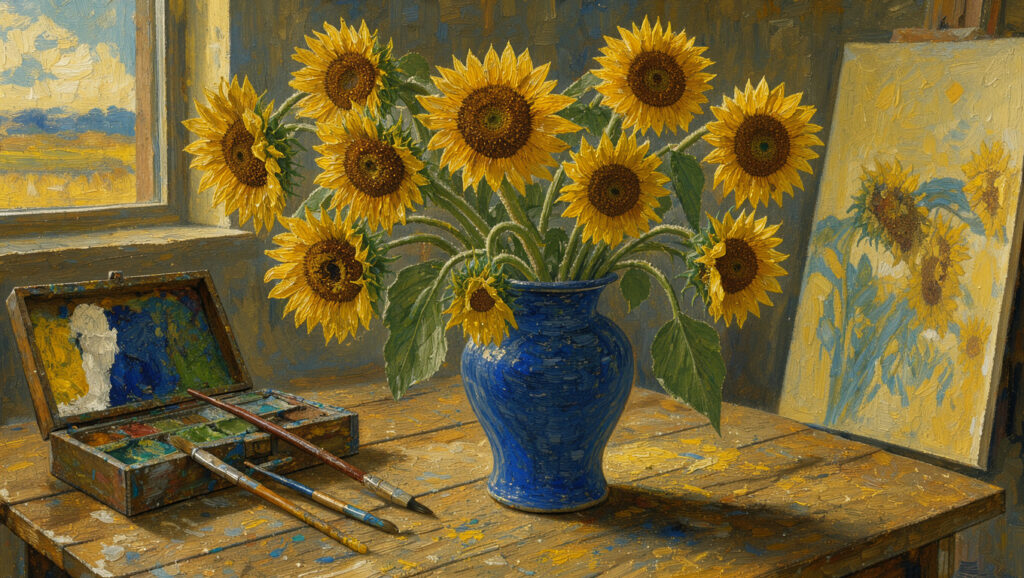
- Van Gogh’s Sunflowers, a still life, sold for £23 million at Christie’s London in 1987 (Christie’s, international auction house).
- Starry Night Over the Rhône (1888) is among a couple of dozen Van Gogh works at the Musée d’Orsay in Paris (TheCollector (art history publisher)).
The implication: a few images carry the legend, while the work itself is spread across several countries and collections.
Who came first, Monet or Van Gogh?
Claude Monet was born in 1840, eleven years before Van Gogh, so Monet is the older artist. Van Gogh’s career ran from 1880 to 1890 (Encyclopaedia Britannica, general reference encyclopedia). For a comparable 19th-century painter’s market story, see John Constable biography and famous paintings.
Where are Van Gogh’s most famous paintings kept?
The public collections sit mainly in the Netherlands, with important works in France, the United States, the United Kingdom and Japan. The Van Gogh Museum opened on 2 June 1973 and holds over 200 paintings and 500 drawings, after the family collection was moved to a foundation in 1962 (Van Gogh Museum, official museum records).
Helene Kröller-Müller began buying in 1907 or 1908, when prices were low, according to Zoomer (art market coverage).
- The Kröller-Müller Museum in Otterlo holds the second-largest collection, with 91 paintings and 180 drawings according to Lonely Planet (travel guide publisher), while other sources cite 88 paintings.
- The Art Institute of Chicago holds The Bedroom (1889), a version painted at Saint-Rémy (TheCollector, art history publisher).
- The Sompo Museum of Art in Tokyo reportedly holds the Yasuda Sunflowers from 1888 (Explore With Gaia (travel blog)).
The catch: the works are public, but the money trail that made them valuable ran through private hands.
What was Van Gogh’s only sold painting?
Only one lifetime sale is documented, and it was modest. Van Gogh sold just one painting during his lifetime, The Red Vineyard (1888), and he relied largely on his brother Theo for money (Biography.com, biography reference site).
According to Zoomer (art market coverage), the painting was shown at the 1890 Les XX exhibition in Brussels and bought by Anna Boch for 400 francs.
Christie’s records Sunflowers at £23 million in 1987 (Christie’s, international auction house), while the only documented lifetime sale brought 400 francs. The gap is the money trail: the value rose after the painter was no longer there to collect it.
- L’Allée des Alyscamps sold for US$66.3 million at Sotheby’s New York in 2015 (Wikipedia, online encyclopedia).
- The museums listed above hold much of the best-known work, which narrows what private buyers can reach.
A single price cannot describe a body of work that spans many paintings, conditions and sale dates. The trade-off: a painter with one documented sale now sits at the top of a market that never paid him.
Nine dated moments, one pattern: the money arrives late, long after the painter has stopped needing it.
| Date | What happened |
|---|---|
| 1880 to 1890 | Painting career runs for about a decade (Encyclopaedia Britannica, general reference encyclopedia) |
| 1888 | Moves to Arles; Paul Gauguin joins him briefly that winter (FamousArtist, artist biography site) |
| December 1888 | Ear injury in Arles, widely reported as self-inflicted (Van Gogh Museum, official museum records) |
| April 1889 | Enters the Saint-Rémy asylum (Google Arts & Culture, museum partnership platform) |
| 1890 | The Red Vineyard is bought by Anna Boch for 400 francs, according to Zoomer (art market coverage) |
| 29 July 1890 | Dies in Auvers-sur-Oise, France (Wikipedia, online encyclopedia) |
| 1914 | Letters published, mostly by Johanna van Gogh-Bonger (according to SciHub101, art history explainer) |
| 1941 | The Starry Night enters the Museum of Modern Art collection (Biography.com, biography reference site) |
| 1962 and 1973 | Family collection moves to a foundation in 1962; the Van Gogh Museum opens in 1973 (Van Gogh Museum, official museum records) |
Confirmed versus unclear
Several claims about Van Gogh circulate with more confidence than the record allows, so the open questions run as long as the settled facts.
Confirmed facts
- Born 30 March 1853 in Zundert, Netherlands (Biography.com, biography reference site)
- Died 29 July 1890 in Auvers-sur-Oise, France (Wikipedia, online encyclopedia)
- The Van Gogh Museum opened on 2 June 1973 (Van Gogh Museum, official museum records)
- The Starry Night has been in the Museum of Modern Art’s collection since 1941 (Biography.com, biography reference site)
What’s unclear
- Whether The Red Vineyard was his only lifetime sale; minor sales or trades are reportedly suggested but undocumented (David Charles Fox, art market blog)
- Whether he had a male lover, since no documented evidence exists (Van Gogh Museum, official museum records)
- Some sources give 27 July as the date of the shooting, not 29 July (Wikipedia, online encyclopedia)
- The painting count at Otterlo, where sources give 91 or 88 paintings (Lonely Planet, travel guide publisher)
- Current prices for any specific painting, which change with each sale
The catch: the unclear list runs longer than the confirmed list, so the settled facts are the smaller share of the record.
What the sources say
“this robust and true artist… with the soul of a mystic.”
Albert Aurier, French critic writing in Mercure de France, quoted by Christie’s (international auction house)
Van Gogh was never famous during his lifetime and struggled with poverty, depending largely on his brother Theo financially.
Summary from Biography.com (biography reference site), paraphrased rather than quoted
The implication: the praise and the poverty came from different sources, and the record of both is thin in the places where it matters most.
Where the money ended up
The money path ran from a brother’s support to a sister-in-law’s archive, and then on to museums and auction houses. Each step moved the value further from the painter, who never saw the later prices. For a visitor planning a trip to Amsterdam, the choice is clear: book through the official museum site, or budget for prices you cannot confirm in advance.
Related reading: John Constable biography and famous paintings
Frequently asked questions
When was Vincent van Gogh born and when did he die?
He was born on 30 March 1853 in Zundert, Netherlands (Biography.com, biography reference site), and he died on 29 July 1890 in Auvers-sur-Oise, France (Wikipedia, online encyclopedia).
Where did Van Gogh spend his final months?
He spent a year at the asylum in Saint-Rémy from April 1889 (Google Arts & Culture, museum partnership platform), then moved to Auvers-sur-Oise near Paris in 1890 (FamousArtist, artist biography site).
How many paintings did Van Gogh make?
He produced roughly 900 paintings and 1,100 drawings during about a decade of work (Encyclopaedia Britannica, general reference encyclopedia).
Who was Theo van Gogh?
Theo was Vincent’s brother, and he supported him financially for most of his career (Biography.com, biography reference site).
Where is The Starry Night kept today?
The painting has been in the Museum of Modern Art’s collection in New York since 1941 (Biography.com, biography reference site).
Can original Van Gogh paintings be bought today?
Rarely. Most of the major works sit in museums, and any sale price depends on the painting’s condition and the date of the sale.
More related posts
 Doc Martens 2026: Pricing, Sizing, Foot Health & Fake Spotting
 Simon Armitage: Poet Laureate, Biography, Poems & Net Worth
 Lisa Riley: Biography, Age, Weight Loss, Partner, and Net Worth
 Hugo Weaving: Biography, Iconic Roles, and Personal Life
 Mark Carney: Biography, Family, Criticisms, and Political Rise (2025)
 Jacob Murphy: Twin Brother Josh, Newcastle Salary & Transfer Fee
 Diego Calva: Biography, Movies, and Personal Life Facts
 Riccardo Calafiori: Transfer Cost, Height, Wage & Arsenal Fit