John Constable: Biography, Famous Paintings, and Legacy
Few artists have treated a weather forecast as seriously as John Constable did. In the early 1820s he climbed Hampstead Heath with an oil box and a notebook, writing down wind direction, cloud colour and the time of day on the same surface he painted.
Born: 11 June 1776, East Bergholt, Suffolk ·
Died: 31 March 1837, London (aged 60) ·
Most famous work: The Hay Wain (1821) ·
Hampstead cloud studies: about 100 ·
Main London collections: National Gallery and Tate Britain
That habit turned the son of a Suffolk corn merchant into one of England’s most studied landscape painters — and produced The Hay Wain, his most reproduced image. Here’s how he worked, where his paintings live now, and why his sky studies still matter.
Quick snapshot
- Born 11 June 1776 in East Bergholt, Suffolk; died in Hampstead in 1837 (Tate (UK national collection))
- Painted The Hay Wain, the work now associated with the National Gallery, London (National Gallery, London (UK public collection)) (Tate (UK national collection))
- Made about one hundred cloud studies around Hampstead (Tate (UK national collection)) (Tate (UK national collection))
- Whether Constable and Turner ever met in person is undocumented
- The exact number of surviving oil sketches is not publicly catalogued
- The medical cause of death is often repeated as heart failure, but the record is thin
- Direct open-air cloud studies began in 1821 (Royal Academy of Arts (UK art institution)) (Metropolitan Museum of Art (US encyclopedic museum))
- The most concentrated cloud-study period is dated to 1821–22 (Metropolitan Museum of Art (US encyclopedic museum))
- A study dated 11 September 1821 records wind, cloud colour and a rain forecast (National Gallery of Australia (public art museum)) (Metropolitan Museum of Art (US encyclopedic museum))
- See The Hay Wain at the National Gallery in Trafalgar Square
- Look for cloud studies and sketchbooks at Tate Britain and the V&A
- Compare Constable with Turner side by side in the same exhibition rooms
Six facts, one pattern: Tate (UK national collection) and the National Gallery, London (UK public collection) agree on the basics of Constable’s biography, even when they tell the story from different sides.
| Field | Detail |
|---|---|
| Full name | John Constable |
| Born | 11 June 1776, East Bergholt, Suffolk, England |
| Died | 31 March 1837, London, England |
| Nationality | English |
| Known for | Landscape painting and the Romantic movement |
| Famous painting | The Hay Wain |
What was John Constable known for?
Constable is usually classified as a Romantic landscape painter (Metropolitan Museum of Art (US encyclopedic museum)), but the label sits awkwardly on a man who spent years copying clouds from a hilltop. His method was closer to field science than to studio fantasy.
What subjects did Constable paint?
- The Suffolk countryside around the River Stour — his principal subject, according to the National Gallery (National Gallery, London (UK public collection))
- The working river landscape of mills, locks and water meadows, shaped by his father’s trade as a corn merchant and miller (Metropolitan Museum of Art (US encyclopedic museum))
- Salisbury Cathedral and its surroundings, studied closely during a six-week visit in 1820 (National Gallery, London (UK public collection))
- The sky itself — clouds, wind, light and weather — observed from the elevated ground of Hampstead (Royal Academy of Arts (UK art institution))
Tate notes that Constable described the scenes of his Suffolk childhood as having made him a painter (Tate (UK national collection)), and he returned to the Stour Valley on canvas throughout his career. He was also largely self-taught; the National Gallery records him as a Royal Academy student in 1800.
What techniques did Constable use?
- Open-air oil sketching on location, including about one hundred cloud studies in the Hampstead period (Tate (UK national collection))
- Systematic weather notes on the study itself — cloud colour, wind, light and time of day (National Gallery of Australia (public art museum))
- Elevated viewpoints, chosen because Hampstead’s high ground offered an advantageous view of the sky (Royal Academy of Arts (UK art institution))
- Large finished exhibition canvases assembled indoors from those outdoor notes — the opposite of studio-invented landscape
One study dated 11 September 1821 carries the time, cloud colour, wind direction, a temperature impression and a forecast of rain, inscribed by the artist’s own hand (National Gallery of Australia (public art museum)). That is not decoration; it is data.
Constable treated the sky as the subject, not the backdrop. Because he dated and labelled so many studies, the Hampstead sketches now read as an unofficial weather diary from the 1820s — decades before organised weather observation became standard.
The implication: Constable’s innovation was patience with the ordinary — weather, water, working farmland — elevated by a scientific eye. That combination is why the cloud studies still startle art historians today.
Were Turner and Constable friends?
The short answer is no direct evidence. The archive doesn’t confirm the two ever met, and the famous compliment attributed to Turner — “He is a great man!” — survives as an anecdote rather than a dated letter or diary entry.
How did Constable and Turner differ?
- Constable built paintings from outdoor oil sketches and written weather notes, a field-science approach to landscape
- Turner worked more from memory and studio invention, reaching for theatrical light and atmosphere
- Constable stayed close to the Suffolk landscape he knew; Turner travelled Europe and painted classical, alpine and marine scenes
Did they influence each other?
Influence is undocumented in either direction. The one widely repeated link is Turner’s reported compliment — respect, but not a documented working relationship. Treat the friendship and rivalry claims as anecdote, not correspondence.
What is John Constable’s most famous painting?
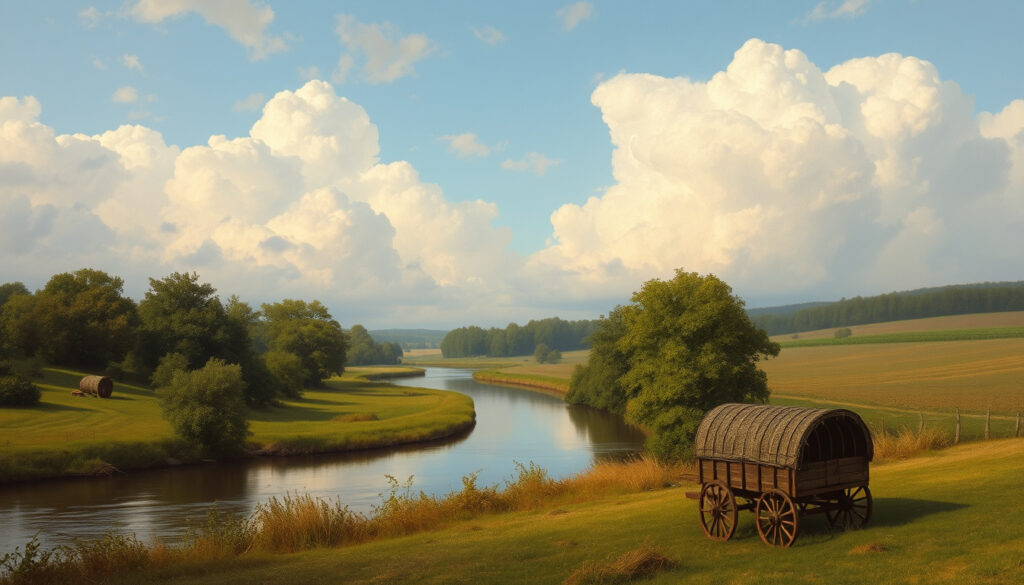
The uncontested answer is The Hay Wain. The painting shows a timber wheeled wain crossing a shallow stretch of the River Stour, and it is the image most visitors name first when asked about Constable.
Museum pages and catalogues keep returning to the same shortlist (National Gallery, London (UK public collection)):
- The Hay Wain (1821) — now in the National Gallery, London
- The White Horse (1819) — the large Stour scene that marked his turn to big exhibition canvases
- Dedham Vale (1802) — an early, calmer view of the valley he grew up in
- Salisbury Cathedral from the Meadows (1831) — a late, more dramatic treatment of the cathedral subject
The National Gallery’s Constable biography is built around the Stour Valley and his Suffolk upbringing (National Gallery, London (UK public collection)), and The Hay Wain is the fullest expression of that world — a working river landscape, not an idealised one.
What did Constable think of his own best painting?
Constable never left a definitive ranking of his own canvases. What he left instead is a pattern: the works he laboured over longest were large Stour subjects — the landscape he said had made him a painter.
So “best” depends on the question you’re asking. By fame, The Hay Wain. By influence, the cloud studies — the small Hampstead sketches that taught later painters to watch the sky.
The trade-off: The Hay Wain wins the popularity vote, while the sky studies win the influence vote.
Where can I see John Constable paintings in London?
London holds the strongest concentration of Constable’s work in any single city. Two national museums carry the core of it, and a third keeps his working sketchbooks.
National Gallery — start with The Hay Wain
- The Hay Wain hangs in the National Gallery at Trafalgar Square (National Gallery, London (UK public collection))
- The gallery’s Constable collection also spans early Suffolk landscapes
- Admission to the permanent collection is free for all visitors
The National Gallery describes Constable as largely self-taught (National Gallery, London (UK public collection)). Seeing The Hay Wain’s surface close up makes that invisible education visible: the water, the trees and the clouds all carry the weight of his outdoor studies.
Tate Britain and the V&A
- Tate Britain holds the deepest national collection of Constable’s work, spanning his full career (Tate (UK national collection))
- Tate’s online artist record documents his Hampstead years and his roughly one hundred cloud studies
- The V&A in South Kensington holds Constable sketchbooks that show his drawing process
A practical London route: National Gallery in the morning for The Hay Wain, Tate Britain in the afternoon for the oil sketches, then a walk across Hampstead Heath if the sky is active — you will be standing on the same high ground Constable used for his sky studies.
Why this matters: seeing the finished canvas beside the studies is the fastest way to understand Constable’s method. The museum visit is the explanation, not just the experience.
How old was John Constable when he died?
He was 60. Born on 11 June 1776 in East Bergholt, Suffolk, Constable died in Hampstead on 31 March 1837 (Tate (UK national collection)).
The circumstances of his death
- He died in Hampstead, where he had begun renting a house in 1819 (Tate (UK national collection))
- The Hampstead move was prompted partly by his wife’s ill health (Tate (UK national collection))
- The cause of death is usually reported as heart failure, but the contemporary diagnosis is not well documented
His final decade was framed by the same skies he painted. The concentrated cloud-study period of 1821–22 (Metropolitan Museum of Art (US encyclopedic museum)) came at a time when his wife’s health was already fragile — the Hampstead house was meant as a healthier home.
Where is Constable buried?
- He was buried in Hampstead Parish Church, close to the heath he had painted for years
- The church stands near the elevated ground he used as his observation point for the cloud studies (Royal Academy of Arts (UK art institution))
A parish burial rather than a national monument suits a painter who spent most of his life outside the honours he finally received in old age.
The pattern: the high ground that gave Constable his cloud studies also became his final address. The sky he observed from Hampstead is the sky he was buried under.
Key dates: Constable’s life
Seven moments, one arc: from a Suffolk mill house to the Royal Academy’s walls and the high ground of Hampstead.
- : Born in East Bergholt, Suffolk (Tate (UK national collection))
- : Began renting a house in Hampstead (Tate (UK national collection))
- : Six-week visit to Salisbury; produced studies of the cathedral from different viewpoints (National Gallery, London (UK public collection))
- : Began direct open-air cloud studies; three sky-and-landscape studies made on 27 September (Royal Academy of Arts (UK art institution))
- : A sky study inscribed with time, cloud colour, wind direction and a rain forecast (National Gallery of Australia (public art museum))
- 1821–22: Most concentrated period of cloud study (Metropolitan Museum of Art (US encyclopedic museum))
- : Died in Hampstead, aged 60 (Tate (UK national collection))
The shape of the story: a merchant’s son with no early patronage used repeated outdoor study to change how landscapes were painted — slowly, publicly, and without shortcuts.
Separating the record from the legend
Some parts of the Constable story are museum-grade documentation. Others have been repeated for two centuries until they feel like fact, even when the archive is quiet.
What’s confirmed
- Born 11 June 1776 in East Bergholt; died 31 March 1837 in Hampstead (Tate (UK national collection))
- The Hay Wain is held by the National Gallery, London (National Gallery, London (UK public collection))
- About one hundred cloud studies survive from the Hampstead period (Tate (UK national collection))
- A six-week Salisbury visit in 1820 produced studies from multiple viewpoints (National Gallery, London (UK public collection))
What’s unclear
- Whether Constable and Turner ever met in person
- The true extent of their personal rivalry
- The complete number of surviving oil sketches across public and private collections
- The precise medical cause of his death
- Which cloud studies were finished artworks rather than working notes
The lesson for readers: treat the marquee quotes — the Turner compliment, the heart-failure diagnosis — as reported colour, not primary documentation.
Two quotes that explain Constable
Two sentences carry most of the weight in Constable’s reputation: his own about home, and Turner’s about him.
“I should paint my own places best.”
John Constable, letter to his friend John Fisher, 1821
He wrote that at the height of his early success, and he meant the Suffolk water meadows — not a grander, more fashionable subject.
“He is a great man!”
J.M.W. Turner, reported remark on Constable, quoted in artist biographies
Notice the word “reported.” The compliment is part of Constable lore, but it survives as an anecdote rather than a dated letter or diary entry.
Read them together and you get the whole dynamic: one painter turned inward to the place he knew; the era’s most famous rival looked at that local devotion and called it greatness.
Why Constable still matters
Constable’s real legacy is the licence to paint what you actually know — the lane behind your house, the weather over your own street — and to take it seriously enough to write down the wind direction. For visitors to the National Gallery and Tate Britain, the implication is clear: give the sky more time than the queue, or you’ll leave with a postcard of a painting you never really saw — the clouds are where the artist lives.
digital.nga.gov.au, digital.nga.gov.au, digital.nga.gov.au, nationalgallery.org.uk
Frequently asked questions
Are there any living descendants of John Constable?
The line continued through Constable’s marriage to Maria Bicknell — the couple had seven children — but no official registry tracks present-day descendants. Most claims you’ll find online are genealogical research rather than museum documentation.
Where did John Constable live in London?
His best-documented London base is the house he began renting in Hampstead in 1819 (Tate (UK national collection)), chosen partly because the air there was better for his wife’s health. Earlier he trained in the city as a Royal Academy student (National Gallery, London (UK public collection)).
What is the most expensive John Constable painting?
Museum sources don’t compile private auction records, so there is no official figure. Large finished landscapes of the kind museums compete for have set the high-water marks when they appear at auction.
How much is an original John Constable painting worth?
Value depends on whether the work is a finished exhibition canvas, a preparatory oil sketch, or a drawing; provenance and condition decide the rest. Since most major works sit in public collections, they rarely reach the open market at all.
What is the saddest painting of all time?
There’s no canonical ranking. In Constable’s case, the turbulent skies he painted around Hampstead after his wife’s health declined are often described as mournful — a biographical reading that makes the cloud studies feel sadder than the finished idylls.
How did John Constable die?
He died in Hampstead in March 1837 at the age of 60 (Tate (UK national collection)). The cause is usually stated as heart failure, but the contemporary record is thin, so that detail is reported rather than confirmed.
Related reading
More related posts
 Charles Hanson Latest News: Where Is He Now After Trial
 Bobby Vylan: Net Worth, Age, Real Name, and Fred Perry
 Leylah Fernandez: Age, Ranking, Net Worth, and Career Stats (2025)
 Zoe Slater: Michelle Ryan’s Return and Death Storyline
 Cheap City Breaks in Europe: Best Deals from Dublin
 What Does Arthritis Feel Like – Symptoms and Differences
 Georgia Stanway: Career, Personal Life and Endorsements
 New York Times Strands: Today’s Hints, Spangram & Answers