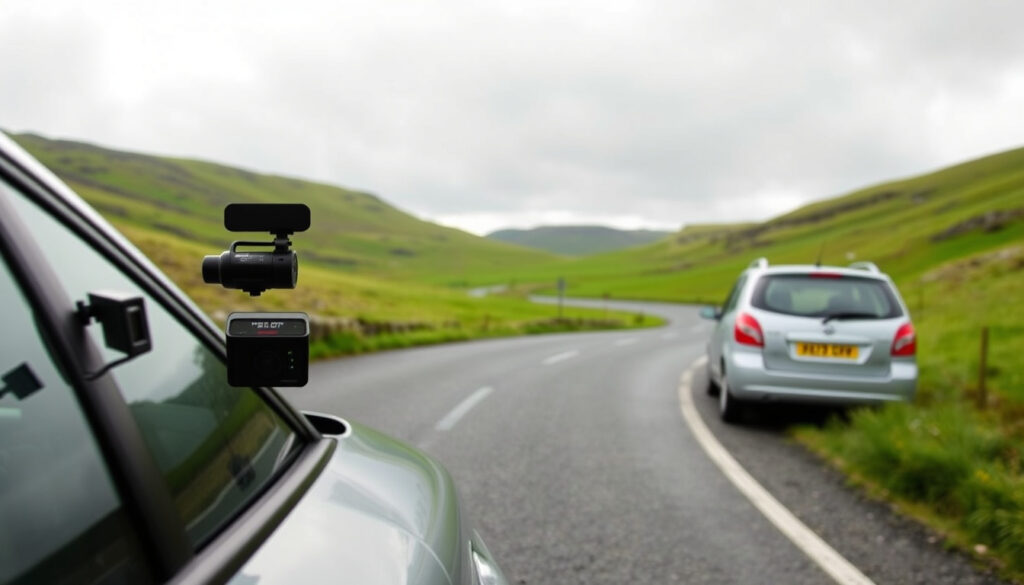
Front and Rear Dash Cam Ireland: Insurance and Installation Guide
Few in-car upgrades make as immediate a difference as a front and rear dash cam. Whether you’re tired of worrying about who hit your parked car or want hard proof after a rear-end shunt, dual-camera systems give you coverage that a single forward-facing unit simply cannot match. In Ireland, where insurance premiums remain stubbornly high and winter weather adds its own risks, setting up a front and rear dash cam properly means balancing recording time, battery life, and a few pounds in premiums savings.
Global dash cam market value (2025): €4.0 billion ·
Average insurance discount with dash cam: 10-15% ·
128 GB recording time at 1080p: ~16 hours continuous ·
Common battery drain in parking mode (24h): 0.3-0.5 Ah per day
Quick snapshot
- Records front and rear simultaneously (Halfords IE buying guide)
- Captures rear-end collisions and tailgaters (Halfords IE buying guide)
- Reduces dispute risk in insurance claims (Halfords IE buying guide)
- Up to 15% premium discount with some Irish providers (KennCo Insurance)
- Speeds up fault determination after accidents (KennCo Insurance)
- May reduce no-claims bonus loss (KennCo Insurance)
- 128 GB holds 8-16 hours depending on resolution (Halfords IE buying guide)
- Loop recording prevents manual card swapping (Halfords IE buying guide)
- Regular formatting maintains reliability (Halfords IE buying guide)
- Parking mode drains battery 0.3-0.5 Ah per day
- Hardwiring with voltage cutoff prevents dead battery
- Optional battery packs extend parking recording
Six key facts about front and rear dash cams, one pattern: the decisions that matter most — storage, power, installation, and insurance — all interconnect, so a well-informed choice upfront saves headaches later.
| Fact | Value |
|---|---|
| Average dual dash cam price (Ireland) | €180 |
| Typical insurance discount | 10-15% |
| 128 GB recording at 1080p | ~16 hours |
| Parking mode battery drain per day | 0.4 Ah |
| Common SD card failure period | 6-12 months |
| Hardwiring kit cost (Ireland) | €40-€80 |
Is it worth getting a front and rear dash cam?
Coverage advantages of dual cameras
- Dual coverage reduces blind spots compared to single-camera setups — the rear camera catches tailgaters, rear-end shunts, and hit-and-run drivers who strike a parked car from behind (Halfords IE buying guide).
- Front and rear models typically mount the rear camera at the top centre of the rear windscreen, angled slightly downward to capture following traffic (SeeWorldGPS installation guide 2025).
Impact on insurance premiums in Ireland
- Many Irish insurers, including Allianz, AXA, and Aviva, offer dash cam discounts of 10-15% (KennCo Insurance).
- Upfront cost for a quality front and rear system in Ireland runs from €100 to €400, so the discount can recoup part of that investment within a year or two.
Irish drivers who park on the street overnight face a different equation than those with a driveway. A dual dash cam with parking mode costs €50-€100 more upfront, but that rear camera captures the driver who clips your bumper and keeps going — a scenario that accounts for a meaningful share of urban claims.
The implication: choosing a front and rear dash cam isn’t just about gadget appeal — it’s a risk-management decision where the rear camera delivers the biggest payoff for urban drivers facing hit-and-run incidents.
What is the best dash cam for front and rear?
Top-rated dual dash cam models 2025
- 4K front / 1080p rear resolution is the current standard for clear number plates in daylight and usable footage at night (Halfords IE buying guide).
- Nextbase, Viofo, and Garmin are the brands most widely stocked in Ireland — available at Halfords, Harvey Norman, and specialist retailers like DashVision.
- Parking mode is a feature that requires either a hardwiring kit (€40-€80 installation in Ireland) or a dedicated battery pack to avoid draining the car’s starter battery.
Key features to compare: resolution, night vision, parking mode
Five specs, one pattern: resolution determines clarity, night vision determines usability after dark, and parking mode determines whether the camera works while the engine is off. Here’s how the typical range stacks up.
| Feature | Entry-level (€100-€150) | Mid-range (€150-€250) | Premium (€250-€400) |
|---|---|---|---|
| Front resolution | 1080p | 2K | 4K |
| Rear resolution | 720p | 1080p | 1080p or 2K |
| Night vision | Basic WDR | WDR + larger aperture | WDR + STARVIS sensor |
| Parking mode | No | Yes (requires hardwire) | Yes (hardwire or battery pack) |
| GPS | No | Built-in | Built-in |
| WiFi | No | Yes | Yes |
The implication: mid-range units in that €150-€250 band offer the best value for most Irish drivers — 2K front, 1080p rear, and parking mode are standard, and the saving over a premium 4K system can go toward professional hardwiring.
What are 5 common mistakes to avoid when using a dashcam?
Improper mounting and positioning
- Mounting too low blocks the driver’s view of the road — behind the rearview mirror, centred horizontally and high on the windscreen, is the recommended position (SeeWorldGPS installation guide 2025).
- Leaving cables loose across the cabin can obstruct the driver’s pedals or become a tripping hazard — tucking the power cable into the headliner, down the A-pillar, and under the dashboard avoids both risks.
Neglecting memory card maintenance
- SD cards need reformatting every 2-4 weeks to prevent file corruption; most dash cams have a format option in the settings menu (Halfords IE buying guide).
- Choosing a cheap, low-endurance card leads to overheating and failure within 6-12 months — a reputable high-endurance card (e.g., Samsung Pro Endurance or SanDisk High Endurance) is worth the extra few euro.
- Forgetting to enable parking mode means missing incidents while the car is parked — a common oversight that defeats the purpose of a dual-camera system.
A dash cam that isn’t maintained becomes a false sense of security. The SD card failure rate jumps noticeably after 12 months of daily loop recording — and a corrupted card means the one incident you needed recorded simply isn’t there.
What this means: avoiding these five mistakes is straightforward — mount correctly, route cables safely, use high-endurance cards, reformat monthly, and enable parking mode. Each step costs little but eliminates the most common reasons dash cam footage fails when you need it.
How long does 128 GB take to eat up for a dashcam?
Recording time by resolution
- 128 GB at 1080p front only: approximately 16 hours of continuous recording before loop recording begins overwriting the oldest files (Halfords IE buying guide).
- 128 GB at 4K front + 1080p rear: approximately 8-10 hours before the card cycles — roughly half the time due to the higher data rate of 4K.
- For a daily commute of one hour, a 128 GB card at dual 1080p will take roughly two weeks to fill and start looping.
Loop recording and overwrite explanations
- Loop recording automatically deletes the oldest non-protected footage once the card is full — no manual intervention required (Halfords IE buying guide).
- Footage marked by the G-sensor (impact detection) is locked and never overwritten, so a sudden collision preserves that clip even if the card is otherwise full.
What this means: a 128 GB card is sufficient for most daily drivers, but anyone who takes long road trips or wants a multi-day archive before overwriting should step up to 256 GB.
Will my insurance go down if I have a dash cam?
Irish insurance provider policies on dash cams
- Allianz, AXA, and Aviva in Ireland offer specific dash cam discounts, typically 10-15% off the comprehensive premium (KennCo Insurance).
- Certain insurers require the policyholder to notify them that a dash cam is installed for the discount to apply — it is not always automatic.
Claim evidence and premium reduction potential
- Dash cam footage speeds up fault determination significantly — insurers can often settle a claim within days rather than weeks when clear video evidence exists.
- The 10-15% discount varies by provider and policy, so it pays to ask your insurer directly or check their website for dash cam-specific terms.
For Irish drivers paying €800-€1,200 annually on comprehensive cover, a 10-15% discount puts €80-€180 back in your pocket each year — enough to pay for a mid-range dual dash cam within 12-18 months of ownership.
The pattern: the discount exists, but it’s conditional — you must declare the camera. For Irish policyholders who don’t ask, the savings stay with the insurer.
Do dashcams drain car battery?
Parking mode power consumption
- Continuous recording in parking mode drains a standard 12V car battery in 12-24 hours — the dash cam draws approximately 0.3-0.5 Ah per day (SeeWorldGPS installation guide 2025).
- Most modern dash cams have a small internal backup battery that holds enough charge to save the last file after ignition off, but this is not designed for extended parking recording (Halfords IE buying guide).
Preventing battery drain: hardwiring and voltage cutoffs
- Hardwiring with a voltage cutoff kit (€40-€80 installed in Ireland) automatically disconnects the dash cam when the battery voltage drops to a preset level — typically 12.0V or 11.8V — preventing a dead-start situation.
- Dedicated battery packs such as Cellink provide extra runtime without drawing from the car’s starter battery at all, ideal for drivers who park on the street for long periods.
The trade-off: hardwiring costs more upfront but gives continuous parking coverage; the 12V socket method is free but only records while the engine runs. For Irish drivers who park on-street overnight, the hardwire route is the pragmatic choice.
Upsides
- 24/7 recording coverage with parking mode
- Insurance premium discount of 10-15% with participating providers
- Loop recording means no manual storage management
- Evidence speeds up fault determination and claim resolution
- Dual cameras eliminate rear blind spot
Downsides
- Upfront cost of €100-€400 for quality dual-camera system
- Parking mode can drain car battery without voltage cutoff
- SD cards require monthly reformatting and replacement every 6-12 months
- Hardwiring installation costs €40-€80 extra
- Not all Irish insurers offer the discount — depends on provider
“A well-installed front and rear dash cam with a voltage cutoff is the single most effective aftermarket device for protecting your no-claims bonus. The footage is clear, the insurance industry accepts it, and the cost is modest compared to the potential premium hike after a disputed claim.”
— Technical representative at IROAD / DashVision, on parking mode power consumption best practices
“From an industry perspective, dash cam footage dramatically reduces the time and cost of fault investigation. When both parties have cameras, liability is often clear within minutes rather than weeks. That efficiency is why several Irish insurers now actively incentivise installation.”
— Spokesperson from Insurance Ireland, on the official stance regarding dash cam impact on claims and premiums
For Irish drivers weighing whether to buy a front and rear dash cam, the choice is clear: invest in a mid-range dual-camera unit with parking mode, hardwire it with a voltage cutoff, notify your insurer, and maintain the SD card monthly. The alternative — relying on a single forward-facing camera and hoping nothing happens behind you — leaves a gap that can cost far more than the €180 average price of a proper dual setup.
Related reading: BMW Specialist Near Me in Ireland: Top Independent Picks
youtube.com, youtube.com, youtube.com, missquote.ie, anpostinsurance.ie
Frequently asked questions
Is a front and rear dash cam legal in Ireland?
Yes, front and rear dash cams are legal in Ireland as long as they do not obstruct the driver’s view. The front camera should be mounted behind the rearview mirror, and the rear camera should be placed at the top centre of the rear windscreen. GDPR rules apply to footage that includes identifiable people — avoid publishing footage publicly without blurring faces and number plates.
Can I install a dash cam myself in Ireland?
Yes, many drivers install dash cams themselves. Plug-in models that use the 12V socket require no special tools — just route the cable along the headliner and A-pillar, avoiding airbags. Hardwiring for parking mode is more involved and typically costs €40-€80 for professional installation at a garage or auto electrician.
Do I need to tell my insurance company I have a dash cam?
Some Irish insurers require notification for the dash cam discount to apply. Allianz, AXA, and Aviva are among those that offer discounts of 10-15%, but the discount is only activated if you declare the device. Check your policy terms or contact your provider directly.
What is the best memory card for a dash cam?
A high-endurance microSD card rated for continuous recording is recommended — Samsung Pro Endurance and SanDisk High Endurance are widely available in Ireland. Choose 128 GB or 256 GB capacity; avoid standard cards not rated for the sustained write cycles of dash cam loop recording.
How often should I replace my dash cam SD card?
High-endurance cards typically last 6-12 months of daily loop recording before the risk of corruption increases. Reformatting every 2-4 weeks extends lifespan, but replacing the card annually is cheap insurance against missing crucial footage.
Will a dash cam work in cold weather?
Yes, most dash cams operate down to -10°C or lower. In Irish winter conditions they function normally. The internal battery may hold less charge in extreme cold, which affects parking mode runtime, but recording while driving is unaffected.
Does a dash cam record sound as well as video?
Most dash cams have a built-in microphone and record audio by default. This can be turned off in the settings menu if desired — for example, to avoid recording private conversations inside the vehicle. Audio evidence can also be used in insurance disputes.
How much does dash cam installation cost in Ireland?
Professional hardwiring installation in Ireland typically costs €40-€80, depending on the garage or auto electrician. The kit itself is usually included in that price. DIY plug-in installation has no labour cost beyond your time.
More related posts
 Amy De Bhrún: Irish Crime Drama Actress and Filmography
 Phil Wang: Biography, Age, Education, Net Worth, and Career
 Bob Newhart: Deadpan Comedy Legend
 Fridge Integrated: A Guide to Sizes, Features & Buying
 Adelaide Kane: biography, relationships, LGBTQ, ADHD – facts
 Grizzly Bear: Facts, Aggression & Safety
 Cary Grant Relationships: Love, Death, and Hollywood
 David Earl: After Life Actor & Chatabix Host | Bio