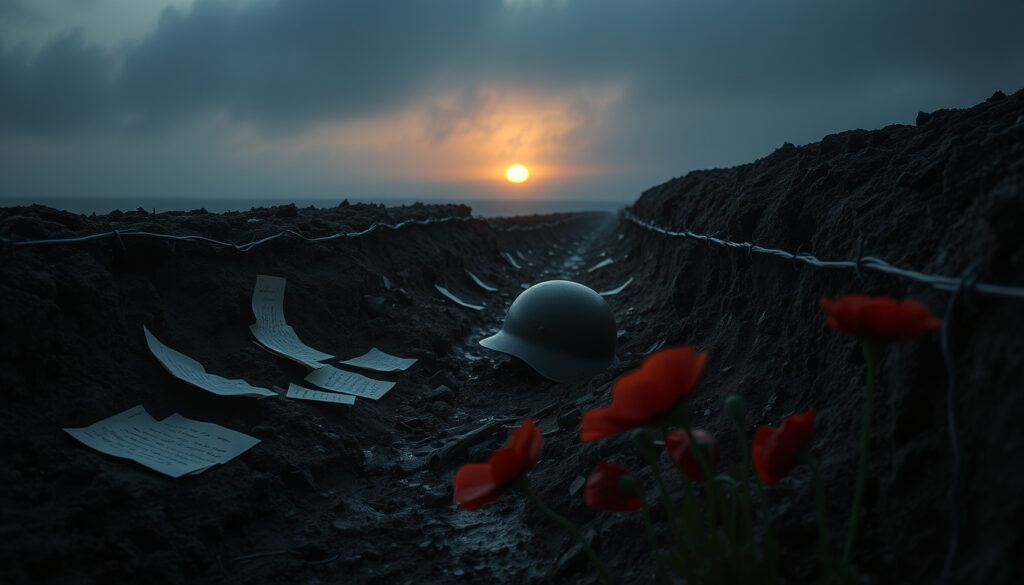
Wilfred Owen: The Voice of World War I Poetry
There are poets who write about war from imagination, but Wilfred Owen wrote from the trench. In just over a year, while recovering from shell shock at Craiglockhart War Hospital (Wilfred Owen Association), he composed the poems that would define a generation — including “Anthem for Doomed Youth” and “Dulce et Decorum Est,” works that still unsettle readers a century later; by the time his family received news of his death, the guns had already fallen silent (National Portrait Gallery).
Born: 18 March 1893 ·
Died: 4 November 1918 ·
Nationality: English ·
Known As: World War I Poet ·
Major Poems: Anthem for Doomed Youth, Dulce et Decorum Est, Strange Meeting
Quick snapshot
- English poet and soldier (1893-1918) (University of Oxford War Collections)
- Key voice of WWI poetry (Wilfred Owen Association) (University of Oxford War Collections)
- Wrote famous works in just over a year (Wilfred Owen Association) (University of Oxford War Collections)
- Anthem for Doomed Youth (Wilfred Owen Association)
- Dulce et Decorum Est (Wilfred Owen Association)
- Strange Meeting (Wilfred Owen Association)
- Pity and sorrow of war (University of Oxford War Collections)
- Loss of youth (University of Oxford War Collections)
- Indictment of war leaders (University of Oxford War Collections)
- Killed a week before Armistice (National Portrait Gallery)
- Buried in Ors, France (National Portrait Gallery)
- Influenced modern war poetry (Wilfred Owen Association)
The snapshot: Owen’s biography is short and his output is small, but the combination of wartime service, shell shock, and Sassoon’s mentorship made him the defining poetic voice of the First World War.
Six facts that define Wilfred Owen: from his full name to the poems that made him a literary voice of the Great War.
| Attribute | Value |
|---|---|
| Full Name | Wilfred Edward Salter Owen |
| Birth | 18 March 1893 |
| Death | 4 November 1918 |
| Nationality | English |
| Known As | World War I Poet |
| Major Works | Anthem for Doomed Youth, Dulce et Decorum Est, Strange Meeting |
What Is Wilfred Owen Known For?
Wilfred Edward Salter Owen is remembered as the defining poetic voice of the First World War. His short life and small body of work — roughly eighty poems, only five published before his death — left an outsized mark on English literature. He is best known for poems that refuse to glorify conflict, instead offering a raw, compassionate account of what soldiers endured (University of Oxford War Collections).
What is a fact file about Wilfred Owen?
- Full Name: Wilfred Edward Salter Owen (University of Oxford War Collections)
- Born: 18 March 1893 (University of Oxford War Collections)
- Died: 4 November 1918 (National Portrait Gallery)
- Nationality: English (Wilfred Owen Association)
- Known As: World War I Poet (Wilfred Owen Association)
- Major Works: Anthem for Doomed Youth, Dulce et Decorum Est, Strange Meeting (listed in Wilfred Owen Association biography)
The implication: Owen’s entire legacy rests on a year of intense creativity, shaped directly by his war experience and the mentorship he received at Craiglockhart.
What Was the Context of Wilfred Owen’s Poetry?
To understand Owen’s poetry, you need to understand his war. He enlisted in the Artists’ Rifles in autumn 1915 (University of Oxford War Collections), was commissioned as a second lieutenant in the Manchester Regiment on 4 June 1916 (University of Oxford War Collections), and crossed to France on 29 December 1916 (National Portrait Gallery). He served in combat around the Somme and the Western Front in early 1917 (National Portrait Gallery).
At Craiglockhart War Hospital, Owen was treated for shell shock and simultaneously nurtured by Siegfried Sassoon (Wilfred Owen Association). This dual experience — medical and literary — transformed him from a conventional Georgian poet into a voice of anti-war witness.
Owen suffered shell shock — then called neurasthenia — and was sent to Craiglockhart War Hospital in Edinburgh in 1917 (University of Oxford). There he reportedly met Siegfried Sassoon (Wilfred Owen Association), a fellow poet already established, who reportedly encouraged him to develop poetry based directly on his experience.
Owen’s famous preface — drafted but never fully published in his lifetime — stated his artistic manifesto: “The Poetry is in the pity.” (Wilfred Owen Association)
Why did Wilfred Owen write poems about war?
- Owen’s early work was pastoral, not political. The change came after his combat experience and meeting with Sassoon. (University of Oxford War Collections)
- He wanted to show “the pity of war” and to warn future generations against nationalism. (Wilfred Owen Association)
The pattern: Owen’s poetry emerged not from abstract pacifism but from the specific trauma of the Western Front, filtered through the encouragement of an older poet who understood the need for a new kind of war writing.
When Did Wilfred Owen Die?
Wilfred Owen was killed on 4 November 1918 while leading his men across the Sambre–Oise Canal in northern France (National Portrait Gallery). He was shot by a German machine gun. The precise moment remains uncertain, but the result is clear: Owen died at 25 years old, just seven days before the Armistice that ended World War I.
News of his death reached his family at Shrewsbury on Armistice Day itself, as church bells were ringing to celebrate the ceasefire (Wilfred Owen Association).
How did Wilfred Owen die?
- Killed in action on 4 November 1918 (National Portrait Gallery)
- Died while leading the 2nd Manchesters across the Sambre–Oise Canal (University of Oxford War Collections)
- His family learned of his death on Armistice Day (Wilfred Owen Association)
The tragedy: Owen died so close to peace that he became the emblematic lost poet of the war — talent cut short, his voice silenced a week before the guns stopped.
What Are the Main Themes Explored in Wilfred Owen’s Poems?
Owen’s poetry is unified by a single emotional force: pity. As he wrote in his draft preface, “The Poetry is in the pity” — pity for the soldiers, pity for the victims of war on both sides. From this core radiate several recurring themes.
- The pity of war — the central theme, evident in almost every poem (Wilfred Owen Association).
- The horror and futility of conflict — “Dulce et Decorum Est” describes a gas attack with unflinching detail (University of Oxford War Collections).
- The loss of youth — “Anthem for Doomed Youth” mourns the young men sent to die (University of Oxford War Collections).
- Betrayal by the older generation — Owen accuses the leaders who preached glory from safety (University of Oxford War Collections).
- Disillusionment with patriotic ideals — the Latin title “Dulce et Decorum Est” is used ironically to reveal the lie of patriotic death (University of Oxford War Collections).
In “Dulce et Decorum Est”, Owen does not flinch. The poem’s graphic description of a soldier dying from a gas attack — “the guttering, choking, suffocating” — confronts the reader with the physical reality that propaganda tried to mask.
The meaning: Owen used his poetry to create a counter-narrative to the official propaganda, portraying the soldier as a victim of a failing system. His work is a sustained act of compassion and indictment.
Where Is Wilfred Owen Buried?
Wilfred Owen is buried in Ors Communal Cemetery, Ors, in northern France (National Portrait Gallery). The cemetery contains his grave, which has become a place of pilgrimage for admirers of his poetry. His gravestone is a standard Commonwealth War Graves Commission marker with his name, rank, and date of death. The epitaph chosen by his family is not included on the military headstone but is recorded separately.
Why this matters: The grave at Ors is a site of memory where the gap between Owen’s brief life and his lasting influence is most visible.
How Many Poems Did Wilfred Owen Write?
Owen wrote roughly eighty poems in his lifetime (University of Oxford War Collections). The exact number is difficult to pin down because some fragments and juvenilia survive, but the canonical count is around eighty. The vast majority — including all his most famous works — were composed between August 1917 and September 1918 (Wilfred Owen Association). Only five poems were published in his lifetime (National Portrait Gallery).
The trade-off: Owen’s fame rests on a fraction of his writing. That his reputation grew so large from so few works speaks to their concentrated power.
Timeline of Wilfred Owen’s Life
Five key dates that map Owen’s journey from Shropshire schoolboy to iconic war poet.
| Date | Event |
|---|---|
| 1893 | Born in Oswestry, Shropshire (University of Oxford War Collections) |
| 1915 | Enlists in the Artists’ Rifles (University of Oxford War Collections) |
| 1917 | Wounded, diagnosed with shell shock, sent to Craiglockhart Hospital; meets Siegfried Sassoon (University of Oxford) |
| 1917-1918 | Composes nearly all his famous poems (Wilfred Owen Association) |
| 4 Nov 1918 | Killed in action on the Sambre–Oise Canal (National Portrait Gallery) |
The shape: Owen’s public biography is concentrated into about three years, yet those years produced the poems that still define how the war is remembered.
Clarity: What We Know and What Remains Uncertain
Confirmed facts
- Date of birth: 18 March 1893 and death: 4 November 1918 (University of Oxford War Collections)
- Service in the Manchester Regiment (University of Oxford War Collections)
- Authorship of major poems (Wilfred Owen Association)
- Meeting with Siegfried Sassoon at Craiglockhart (Wilfred Owen Association)
What’s unclear
- Exact circumstances of his final attack and death (National Portrait Gallery)
- Number of complete poems (estimates vary) (University of Oxford War Collections)
- Specific details of his family relationships
- Exact composition dates of some surviving fragments (Wilfred Owen Association)
The balance: the confirmed record anchors Owen’s legacy, while the unresolved details keep his story open to continued archival research.
Quotes: Owen’s Voice and those who preserved it
“The Poetry is in the pity.”
Wilfred Owen, draft preface (Wilfred Owen Association)
“Owen was the finest poet of the war, and his work will last as long as the language.”
Siegfried Sassoon (attributed), as recorded in biographies (National Portrait Gallery)
“Dulce et Decorum Est uses its Latin title irony to expose the lie of patriotic sacrifice.”
Common reading among literary scholars (University of Oxford War Collections)
The takeaway: Owen’s own preface, Sassoon’s tribute, and the scholarly consensus all point the same way — the pity was the poetry.
Related reading
- Franz Ferdinand: Band, History, and the Archduke Behind the Name — contextual background to the war that shaped Owen.
- Francisco Goya Saturn Devouring His Son: Artwork Analysis & Meaning — parallels in visual art with Owen’s depiction of violence.
The connection: one piece explains the political explosion that started the war; the other examines how artists turn violence into unsettling imagery — both provide context for Owen’s work.
Summary: Owen’s Enduring Legacy
Owen’s poetry remains a set text in English classrooms precisely because it refuses easy answers. It asks students and adults alike to confront the human cost of nationalism.
Wilfred Owen wrote for just over a year, but that year changed the way war is written about. He refused to glorify, refused to sentimentalize, and instead offered pity as the only honest response to mass death. For students studying his poems for GCSE English literature, the lesson is not just about poetic devices but about a voice that held power accountable. For readers encountering his work for the first time, the discovery is that a soldier’s anger can become art — and that art can outlast the empire that sent him to die.
en.wikipedia.org, euppublishing.com, portal.sds.ox.ac.uk, wilfredowen.org.uk
Frequently Asked Questions
Was Wilfred Owen married?
No, Owen never married. He had close relationships with several people, including male friends, but no marriage is recorded. His letters reveal deep attachment to his mother and a circle of fellow poets.
What is the poem ‘Dulce et Decorum Est’ about?
The poem describes a gas attack on the Western Front with graphic physical detail. Its Latin title — meaning “it is sweet and proper” — is used ironically to condemn the idea that dying for one’s country is glorious.
Why is Wilfred Owen called a ‘poet of pity’?
Because his own stated artistic goal was to convey “the pity of war.” He wanted readers to feel compassion for soldiers on both sides rather than celebrate victory.
What was Wilfred Owen’s relationship with Siegfried Sassoon?
They met at Craiglockhart War Hospital in 1917. Sassoon became Owen’s mentor and editor, encouraging him to transform his war experience into poetry. Their friendship was brief but decisive for Owen’s development.
What was Wilfred Owen’s education background?
Owen attended Shrewsbury Borough Technical School and later University College, Reading, but left without a degree due to lack of funds. He worked as a lay assistant and taught English in France before the war.
How did Wilfred Owen’s war experience start?
He enlisted in the Artists’ Rifles in 1915, was commissioned in 1916, and arrived on the Western Front in early 1917. He served in the Somme area and was diagnosed with shell shock later that year.
What is ‘Exposure’ by Wilfred Owen about?
“Exposure” is a poem about a soldier exposed to enemy fire, likely written before Owen’s death. It reflects themes of vulnerability and the randomness of death in war.
The point: these are the questions students and readers most often ask; the poems reward the same close reading that produces them.
More related posts
 How Graham Quinn’s Betrayal Ended His Marriage to Myleene Klass
 Amy Lee: Biography, Health, Children, and Band Controversies
 Skye Nicolson: Loss to Tiara Brown and What’s Next
 AFC Bournemouth vs Everton F.C. Stats: H2H, Form & Prediction
 Broadway Boy Grand National Fall: What Happened & Is He Okay?
 Amelia Bullmore: Career, Scott & Bailey, and Coronation Street
 Bobby Cannavale: Ethnicity, Relationship, Net Worth, Height
 Maria Mallaband Care Group: Ownership, Team & Visa Jobs