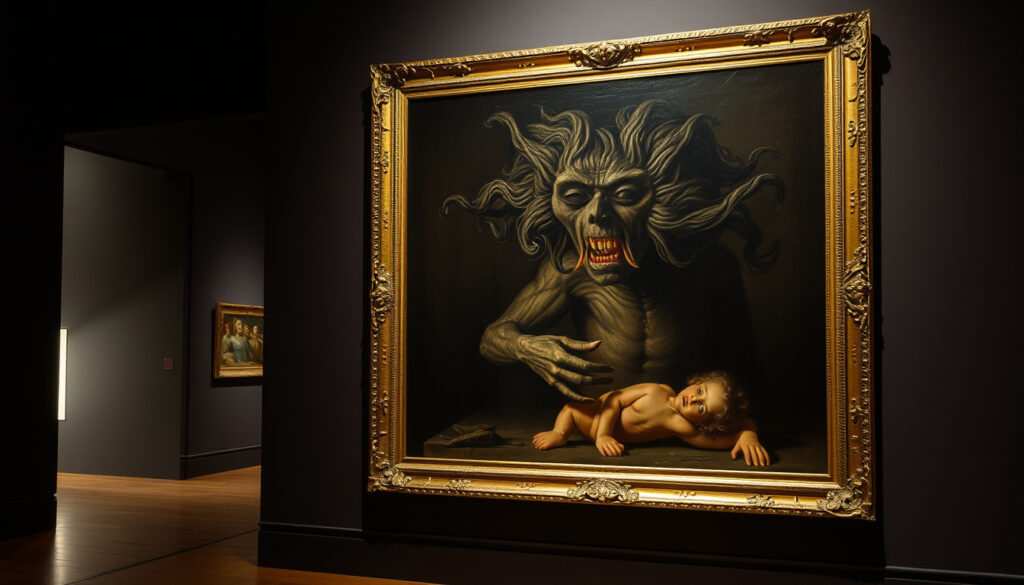
Francisco Goya Saturn Devouring His Son: Artwork Analysis & Meaning
Goya’s Saturn Devouring His Son grabs you before you know its story: painted in the 1820s directly onto the walls of his villa, it is the most famous of the Black Paintings and has hung in Madrid’s Museo del Prado for over a century. The documented record is thin, the resistance to explanation richer — and that tension is why a private mural still haunts anyone who meets its eyes.
Artist: Francisco Goya ·
Year: 1820–1823 ·
Medium: Oil on plaster transferred to canvas ·
Dimensions: 143 × 81 cm ·
Location: Museo del Prado, Madrid
Quick snapshot
- Goya painted the Black Paintings directly onto the walls of his house outside Madrid (Khan Academy (art history education)).
- The Prado catalog records the work as oil on plaster transferred to canvas, accession number P000763 (Museo del Prado (museum that owns the work)).
- One of the 14 Black Paintings, according to Wikipedia’s survey (Wikipedia (community encyclopedia)).
- The exact date still varies: 1820–1823 in most references, 1821–23 in Britannica (Britannica (encyclopedia)).
- Whether the title was Goya’s own or added later — no original record survives (Museo del Prado (museum that owns the work)). (Britannica (encyclopedia))
- Whether the image is a political allegory, a personal confession, or a meditation on time (Britannica (encyclopedia), artnet News (art market reporting)). (Britannica (encyclopedia))
- 1792–1793 — Goya loses his hearing after an unknown illness (Britannica (encyclopedia)).
- 1819 — Goya buys la Quinta del Sordo, the house where the Black Paintings were painted (Khan Academy (art history education)).
- 1873 — Baron Émile d’Erlanger buys the house and the murals begin their transfer to canvas (Khan Academy (art history education)).
- See it in person: the painting is on display at the Museo del Prado, Madrid (Museo del Prado (museum that owns the work)).
- Check the Prado’s collection page for current conservation and room details (accession P000763) (Museo del Prado (museum that owns the work)).
Ten lines from the museum catalog identify the painting, but one pattern cuts through them: this was a wall painting that became a canvas, and every stage of that journey left visible scars.
| Field | Value |
|---|---|
| Full Title | Saturn Devouring His Son |
| Artist | Francisco Goya (1746–1828) |
| Series | Black Paintings |
| Movement | Romanticism |
| Date | 1820–1823 |
| Medium | Oil on plaster, transferred to canvas |
| Dimensions | 143 × 81 cm |
| Subject | The god Saturn (Cronus) devouring one of his children |
| Current Location | Museo del Prado, Madrid |
| Accession Number | P000763 |
Who is the original artist of the artwork ‘Saturn Devouring His Son’?
The artist is Francisco Goya, the Spanish Romantic painter who served as first court painter to Charles IV before the Peninsular War redrew his life. The authorship itself is not disputed; the debates start with the date, the title, and the intention.
The story behind Goya’s Black Paintings
The Black Paintings were never commissioned. Goya made them for himself, with no patron and no public — and that changes the weight of every stroke.
After the Peninsular War and the restoration of Ferdinand VII, Goya bought a country house outside Madrid and covered its walls with a private cycle of murals. Wikipedia’s summary of the series counts 14 works and dates the cycle to 1820–1823, noting that the pictures were transferred to canvas after Goya’s death (Wikipedia (community encyclopedia)). They were not shown publicly in his lifetime. Saturn Devouring His Son belonged to that cycle, painted for the same walls where he lived. Goya was in his mid-70s by the time the mural cycle was complete. He had been profoundly deaf since an illness in 1792–93, and the isolation that followed runs through everything he made afterward.
Britannica’s entry dates the painting specifically to 1821–23 (Britannica (encyclopedia)), while artnet’s report places it in the broader 1820–1823 frame and describes the subject as drawn from ancient mythology (artnet News (art market reporting)). The two dates matter less than the shared conclusion: this is a late work, made in retreat, not in servitude.
- The mural was on the lower floor of the house, part of the original ground-floor decoration (Khan Academy (art history education)).
- Baron Émile d’Erlanger bought the house in 1873; the transfer of the murals to canvas followed soon after.
- Goya left Spain for voluntary exile in Bordeaux in 1824, a year after the house was decorated.
Khan Academy’s account notes that the Black Paintings suffered significant damage and loss in their original location. The transfer to canvas, carried out after d’Erlanger took ownership, saved the images but also scarred them.
The political context matters here. Goya had lived through the French invasion, the brutal guerrilla war, and the return of a monarchy that persecuted the liberals he sympathized with. By 1824 he had had enough and left Spain for Bordeaux. A man who painted a god devouring his own child was also watching his country devour itself. The implication: the artist behind Saturn is not an abstraction. He is a former court painter, deaf, isolated, painting on his own walls at the precise moment Spanish liberalism collapsed — and the image becomes far harder to file away as “just mythology.”
The pattern: the biography does not solve the painting; it makes the mystery more specific.
What is the saddest painting ever painted?
This question has cycled through search engines for years, and Goya’s Saturn keeps appearing near the top of the results. The fame of the image now outruns its history: most people who ask the question have never stood in front of the canvas, yet they know exactly what it looks like.
Why Saturn Devouring His Son is considered one of the most disturbing paintings
- The composition isolates one action — a father destroying his child — with no crowd, no landscape, no moral commentary.
- Goya paints the god with adult features and a child’s body; the horror is anatomical, not symbolic.
- Commentators reach for “disquieting” rather than “sad” — the image disturbs before it moves.
The Prado’s curatorial reading is blunt: the mythological god who devours his children could be a personification of the fear of losing power (Museo del Prado (museum that owns the work)). The myth itself is about succession, not appetite. Cronus swallowed each newborn because a prophecy said one would dethrone him, as artnet’s retelling of the story notes (artnet News (art market reporting)).
Britannica lists three readings of the painting: the wrath of God, the conflict between old age and youth, or Saturn as Time devouring all things (Britannica (encyclopedia)). None of these readings softens the image. Goya engineered maximum visceral discomfort — oversized eyes, an open jaw, a child’s body reduced to a meal.
The image that makes visitors recoil was once the decoration of Goya’s own ground-floor wall, seen by almost no one. What feels like a public scream was originally a private one.
Other contenders for the saddest painting
- “Sad” asks you to feel for the subject.
- “Disturbing” asks you to survive the image.
- Saturn triggers the second far more reliably than the first.
This is why the painting keeps being cited as one of the most disturbing — and saddest — in art history. It is also why the “saddest painting” label fits it awkwardly. The work refuses melancholy; it is closer to dread, a reaction the Prado itself acknowledges when it describes the painting as one of the most disquieting works of all time. Sadness implies distance; this painting gives you none. If you search for the saddest painting, you will find lists. But the act of ranking misery empties the paintings of what makes them unbearable — and Saturn is unbearable in a category of its own.
The pattern: the “saddest painting” question is a proxy for something deeper — the search for an image that makes mortality feel physical. Saturn wins because it shows the end of the line from the inside.
The takeaway: this is a painting aimed at your nerves before your sympathies, and that order is the reason it keeps winning the search.
What are some of Goya’s most famous paintings?
Goya has two reputations, and both are justified. The first belongs to the court painter who produced official portraits and grand history scenes. The second belongs to the hermit who covered his house with nightmares. Saturn sits at the hinge between them.
The Black Paintings: Goya’s dark period
- Fourteen murals, painted directly onto the plaster walls of la Quinta del Sordo.
- Dark pigments and darker subjects; the name “Black Paintings” comes from both.
- The cycle was not exhibited; the murals reached public collections only after the 1873 transfer to canvas, as Khan Academy recounts.
Inside the cycle, Saturn is the most famous image. But the series’ fame depends on intensity, not on a single title; Saturn simply condensed the mood of the whole group into one unforgettable frame.
The Black Paintings were private by design. Goya was no longer painting for the court; he was painting for a wall in his own house, at a moment when public speech in Spain was dangerous. The darkness of the series is not only emotional — it is political.
Goya’s earlier masterpieces
- The Third of May 1808 — his account of French executions during the Peninsular War.
- The Naked Maja — the nude portrait that still carries an aura of scandal.
- The Sleep of Reason Produces Monsters — the etching that announced his dark turn.
Set those works against Saturn and you can measure the distance Goya traveled. The Third of May is public art — a war crime painted for everyone to see. Saturn is private myth, painted for a wall at home. In between lie the Napoleonic invasion, the restoration of the monarchy, and Goya’s decision that he no longer owed the establishment a public face.
Why did Van Gogh have a sad life?
If you arrived here through a search about Goya, this question may look out of place. Search engines, however, keep pairing the two: the “saddest painting” query pulls in both names, and Van Gogh’s biography has become the standard example of an artist who failed in life and triumphed after death.
Van Gogh’s mental health struggles
- Van Gogh suffered from severe mental illness, including episodes of psychosis and depression.
- He sold only one painting during his lifetime, The Red Vineyard.
- His troubled life ended in suicide at age 37.
The known outline is brutal enough without embellishment. One sale. Decades of obscurity. A death by suicide at 37. The gap between the work he produced and the reward he received is the reason his story keeps being told — and it is the same gap people project onto Goya when they call Saturn a “sad painting.”
The Red Vineyard is the single canvas Van Gogh is known to have sold while alive. The rest of his fame arrived after death — a lag of decades that still shapes how the public reads artists like Goya.
Financial hardship and lack of recognition
The contrast with Goya is sharp. Goya was a salaried court painter with patrons, commissions, and a titled position decades before he painted Saturn. Van Gogh had none of that security at any stage of his career. Both died far from the recognition they later earned, but from opposite starting points.
Which famous painter had schizophrenia?
This question follows the same trail, and it matters here because Goya is often swept into the “mad artist” myth. The documented evidence tells a different story, and the difference changes how you read Saturn.
The debate over Van Gogh’s diagnosis
- Van Gogh’s specific diagnosis was never settled; modern experts often suggest bipolar disorder or epilepsy rather than schizophrenia.
- Goya’s documented condition was physical: severe deafness from 1792–93 onward.
- The Black Paintings look shocking by choice, not by delusion.
The conflation of artistic intensity with mental illness is one of art history’s laziest habits. Van Gogh’s doctors left incomplete records, and every diagnosis offered since is an inference. Goya’s case is different: the condition that reshaped his life was deafness, not madness. Treating the two the same way distorts the deliberate intelligence of the Black Paintings.
For another example of a serious artist whose output was shaped by a health condition, our profile of Henri Matisse: Life, Art Style, Famous Works & Disability documents how disability redirected an entire modern style.
Other artists with schizophrenia
- Richard Dadd — Victorian painter, documented case.
- Louis Wain — another documented case.
These clinical histories make the contrast with Goya sharper. Dadd and Wain’s styles changed in recognizable relation to their illnesses. Goya’s late style changed in relation to history — the Peninsular War, the collapse of the Spanish Enlightenment, the return of a repressive court. Saturn is a political painting wearing a mythological mask, not a medical chart.
The implication: keep the “mad painter” label away from Goya. The Black Paintings are deliberate, sourced from myth, and composed with cold intent — the work of a political artist in retreat, not a mind unraveling.
What’s confirmed, what’s still open
A quick audit of the record: what holds up, and what remains a gap in the evidence.
Confirmed facts
- Francisco Goya painted Saturn Devouring His Son on the walls of his house; the work is part of the Black Paintings cycle identified by the Museo del Prado and by Wikipedia’s survey (Museo del Prado (museum that owns the work), Wikipedia (community encyclopedia)).
- The Prado’s catalog records the work under accession number P000763 as oil on plaster, later transferred to canvas (Museo del Prado (museum that owns the work)).
- Baron Émile d’Erlanger’s purchase of the house in 1873 set off the transfer that saved the mural (Khan Academy (art history education)).
What’s unclear
- The exact date: Britannica narrows it to 1821–23, while other sources say 1820–1823 (Britannica (encyclopedia)).
- Whether Goya himself gave the mural the title we use today; no contemporary document records it (Museo del Prado (museum that owns the work)).
- Whether the image is primarily a political allegory, a personal confession, or a meditation on time — the strongest interpretations all remain speculative (Britannica (encyclopedia)).
The pattern is honest enough: the confirmed facts are physical (walls, paint, accession number), while the open questions are interpretive. What Saturn means was unresolved in Goya’s lifetime and is unresolved now — and that ambiguity is part of its power.
What the experts say
Two voices frame the debate: the institution that owns the painting, and the critic who did most to re-establish Goya’s late works as modern art.
“One of the most disquieting works of all time.”
Museo del Prado, collection catalog
“The first truly modern works of art.”
Robert Hughes, Goya (2003)
Hughes’s claim is the more radical one. If the Black Paintings are the first modern works, then Saturn is not a historical curiosity — it is the start of something that still hasn’t ended. The Prado’s word “disquieting” describes the effect; Hughes’s word “modern” describes the consequence.
Why Saturn Devouring His Son still matters
Nearly two centuries after Goya painted it, the image has outgrown its wall, its house, and even its author. It is now a shorthand for power’s willingness to consume its own heirs — a reading that works whether you apply it to Spanish history, to family dynasties, or to any institution that eats its young. For the Prado, the responsibility is constant: keep the painting visible, keep its history honest, and let visitors decide whether they are looking at a myth or at a mirror. For the visitor, the choice is simpler — look at Saturn as a confession, as a curse, or as a warning, and accept that the painting was right either way.
Related reading
If the lives behind famous canvases interest you, two profiles show how other artists worked through disability, myth, and public misunderstanding:
- Henri Matisse: Life, Art Style, Famous Works & Disability
- Bob Ross: Life, Death, Paintings, and Estate Facts
The pattern: every famous canvas carries a backstory that changes what the viewer sees; Saturn’s backstory is simply darker than most.
museodelprado.es, artmajeur.com, bridgemanimages.com, lareviewofbooks.org, earticle.net, en.wikipedia.org
Frequently asked questions
Where is Saturn Devouring His Son located?
The painting is in the Museo del Prado in Madrid, under accession number P000763. The Prado’s own catalog entry is the authoritative source for current room and conservation details.
What is the story behind Saturn Devouring His Son?
In Roman myth, Saturn (the Greek Cronus) devoured his children because a prophecy said one would overthrow him. Goya painted the moment of consumption directly on the wall of his house, and the Prado suggests the god may embody the fear of losing power.
Is Saturn Devouring His Son part of a series?
Yes. It is one of the 14 Black Paintings Goya made on the walls of la Quinta del Sordo between 1819 and 1823. The series was never intended for public display and became known only after the murals were transferred to canvas.
How did Goya’s deafness affect his art?
Goya lost his hearing in 1792–93 after an illness, and his later work grew darker and more private. The Black Paintings belong to that late period, made in a house nicknamed after deafness and in a mood of deep withdrawal from court society.
What materials did Goya use for the Black Paintings?
According to the Prado’s catalog, Goya painted directly on the plaster walls of his house in a mixed technique; chemical analysis has confirmed the presence of oils. The murals were later transferred to canvas, which is why the medium is often listed as oil on plaster transferred to canvas.
When was Saturn Devouring His Son transferred to canvas?
The transfer happened after Baron Émile d’Erlanger bought the house in 1873. Khan Academy notes that the Black Paintings also suffered significant damage and loss in the process, and the canvases we see today carry the marks of that rescue.
Is Goya’s Saturn Devouring His Son based on Rubens’ painting?
No. The Prado also holds an earlier treatment of the same myth by Peter Paul Rubens, dated 1636–1638 (Museo del Prado (museum that owns the work)), but Goya’s version is an original reinterpretation rather than a copy. Where Rubens dramatizes, Goya internalizes: the later painting is flatter, darker, and far more uncomfortable.
More related posts
 Are Pandora Rings Good Quality? Price, Gold & Durability
 Rachael Blackmore Retirement, Net Worth & Family
 Sally Dynevor: Biography, Children, Husband, and Net Worth
 Freya Allan: Age, Ethnicity, Reaction to Henry Cavill’s Exit
 Bar Bar Stool: IKEA Options, Backs & Clearance Deals
 Kate Bush: Biography, Net Worth, Comeback & Personal Life
 How Much Have I Cost the NHS? Lifetime Calculators
 Jimmy White: Biography, Career, Health & Net Worth Facts