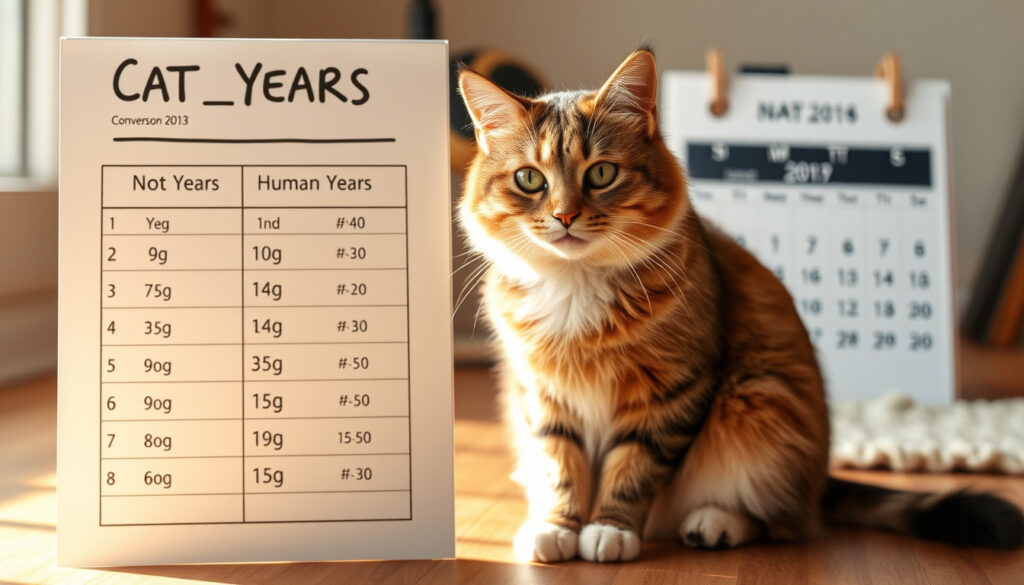
Cat Years to Human Years: Complete Conversion Chart
If you’ve ever wondered how old your cat is in human years, the answer is more precise than the old “one cat year equals seven human years” myth. This guide walks through the veterinary-backed conversion model, a full age chart, and what each life stage means for your cat’s care.
First cat year: 15 human years ·
Second cat year: 24 human years total ·
Each additional year: 4 human years ·
Average lifespan (indoor cat): 13–17 years ·
Senior cat threshold: 11 years (approx 60 human) ·
Oldest recorded cat: 38 years (Creme Puff)
Quick snapshot
- Reduced activity (Whiskas UK)
- Weight changes (Agriapet UK)
- Dental disease (PetMD)
- Vision/hearing loss (Chewy)
- Annual wellness exam (AVMA)
- Bloodwork after age 7 (PetMD)
- Dental cleaning (Purina)
- Joint health assessment (Whiskas UK)
- Exact aging rate varies by breed and individual health (PetMD)
- No universal standard; different organizations use slightly different multipliers (Purina)
The conversion table below shows seven common cat ages mapped to their human-year equivalents using the standard formula. One pattern emerges quickly: the first two years carry the steepest jump.
| Cat age (years) | Human age equivalent |
|---|---|
| 1 | 15 |
| 2 | 24 |
| 3 | 28 |
| 7 | 44 |
| 10 | 56 |
| 17 | 84 |
| 20 | 96 |
The implication: a cat’s early life rushes ahead — by age 2 your cat is already a young adult in human terms, while the next 15 years stretch at a slower, steadier pace.
How old is 7 in cat years?
A 7-year-old cat has already crossed into human middle age. That means annual vet checks are no longer optional — they’re the baseline for catching age-related issues early.
A 7-year-old cat is approximately 44 human years old. The math: the first 2 years total 24 human years, plus 5 additional years × 4 = 20, for a total of 44. This formula comes from the PetMD veterinary editorial team, and it matches the conversion used by Purina and the American Veterinary Medical Association (AVMA). The consensus across these sources is consistent: seven is not old, but it’s the age when most vets start recommending baseline bloodwork and senior wellness screening.
The catch: while the formula is standard, a cat’s actual biological age can vary. Breed, weight, and whether the cat lives indoors or outdoors all influence how quickly they show signs of aging.
Do cat years equal human years?
No, because cats age much faster than humans in the first two years of life, then settle into a slower annual rate. The PetMD veterinary team explains that the first year equals about 15 human years — roughly the equivalent of a human teenager reaching sexual maturity. The second year adds 9 more, putting a 2-year-old cat at 24 human years. From year 3 onward, each calendar year adds roughly 4 human years, according to the conversion formula from Purina and Whiskas UK.
“The first two years of a cat’s life are roughly equivalent to the first 25 years of a human’s life.”
— Purina
Why this matters: the non-linear pattern means you cannot multiply your cat’s age by seven or any single number. The conversion is a two-phase model — accelerated early growth followed by a slower, stable decline — and it directly affects when you should start preventive health interventions.
How to tell your cat’s age in human years
Cat years to human years chart
- 1 cat year → 15 human years (PetMD)
- 2 cat years → 24 human years
- 3 cat years → 28 human years
- 4 cat years → 32 human years
- 5 cat years → 36 human years
- 6 cat years → 40 human years
- 7 cat years → 44 human years
- 8 cat years → 48 human years
- 9 cat years → 52 human years
- 10 cat years → 56 human years (Purina)
- 11 cat years → 60 human years
- 12 cat years → 64 human years
- 13 cat years → 68 human years (Agriapet UK guide)
- 14 cat years → 72 human years
- 15 cat years → 76 human years
- 17 cat years → 84 human years
- 20 cat years → 96 human years
The pattern: after the steep two-year climb, every single cat year from age 3 onward adds exactly 4 human years. That regularity makes the chart easy to memorize and apply at a glance.
How to estimate age without records
Veterinarians use several physical markers to estimate a stray or rescue cat’s age when no birth date is known. The PetMD editorial team notes that dental condition is the most reliable single indicator: kittens have clean white teeth, while older cats show tartar buildup, gum recession, and tooth wear. Other signals include eye clarity (clear and bright in youth, cloudier with age), coat condition, and muscle tone. Muscle wasting over the spine and shoulders is common in senior cats. A cat’s activity level also shifts — a 7-year-old may still play but starts sleeping more, while a cat over 12 often shows reduced jumping ability. None of these methods is precise, but when combined they give a reasonable age range.
What this means: if you adopt an adult cat with unknown history, a vet’s age estimate — even within a 2-3 year window — still lets you apply the conversion chart and plan appropriate care, from diet to screening schedules.
Cat age calculator: convert your cat’s age to human years
You can calculate your cat’s human age in three steps.
- Take the first 2 years as 24 human years total.
- Subtract 2 from your cat’s current age.
- Multiply that number by 4 and add it to 24.
So for a 10-year-old cat: (10 – 2) × 4 + 24 = 56 human years. For a 5-year-old: (5 – 2) × 4 + 24 = 36 human years. This formula is the standard used by Purina, PetMD, Chewy, and Whiskas UK.
A handful of charts — including Chewy’s — show a slightly different pattern at certain ages, such as 6 years equaling 42 human years instead of 40. The margin is small (2 years), but it means no single chart is universal. If precision matters, stick with the Purina/AVMA formula.
The trade-off: the standard formula works well for the vast majority of mixed-breed indoor cats. Purebred cats with known longevity issues — such as Maine Coons or Siamese — may age at slightly different rates. Always cross-check with your veterinarian for breed-specific guidance.
How old is 100 years in cat years?
100 human years is a hypothetical — no cat has ever lived that long. The oldest verified cat on record, Creme Puff, lived 38 years, according to the PetMD editorial team. Using the formula, 38 cat years translates to about 168 human years. Reversing the calculation: 100 human years would correspond to roughly 21 cat years. While 21-year-old cats are rare, they do exist — some indoor cats with excellent care reach 20 or older. The Whiskas UK guide notes that a 15-year-old cat is about 76 human years, which means a cat reaching 20 is roughly equivalent to a human living past 95.
“Indoor cats typically live 13–17 years, while outdoor cats average much shorter lifespans due to accidents, disease, and predation.”
— PetMD
The consequence: if you want your cat to reach the equivalent of 100 human years (roughly 21 cat years), keep them indoors, maintain regular vet visits, and monitor for chronic conditions such as kidney disease and hyperthyroidism after age 10.
petmd.com, purina.com, petaginghub.com, indoorcats.space, 101computing.net, puppilot.co, disabled-world.com, carelogy-japan.com, furcalc.com, britishnewsdesk.co.uk, sakuratrends.com
The AVMA’s 15-9-4 method, explained in the AVMA conversion guide, provides a more accurate conversion than the old seven-year rule.
Frequently asked questions
How many human years is a cat’s first year?
15 human years, according to PetMD and Purina.
What is the average cat lifespan in human years?
Indoor cats average 13–17 years, which equals 68–88 human years. Outdoor cats live significantly shorter lives, typically 2–5 years.
Do indoor cats age slower than outdoor cats?
Indoor cats generally live longer and reach older biological ages because they face fewer risks such as traffic, predators, and infectious disease. Their aging rate per calendar year is the same, but they survive longer to experience the senior phase.
At what age do cats become seniors?
Most veterinary organizations — including the AVMA — classify cats as senior at 11 years (about 60 human years) and geriatric at 15+ years.
Can a cat live to 20 human years?
Yes. A 20-year-old cat would be approximately 96 human years under the standard formula. It’s uncommon but achievable with excellent indoor care, regular vet checks, and a high-quality diet.
How do vets estimate a stray cat’s age?
Vets look at teeth (clean vs. tartar), eyes (clear vs. cloudy), coat condition, muscle mass, and behavior. Dental condition is usually the most reliable marker, especially in cats under 6.
Why do cats age faster in the first two years?
Feline development is compressed: kittens reach sexual maturity by 6 months and full behavioral maturity by 2 years. That accelerated lifecycle is encoded in their biology, similar to how small mammals age faster than large ones.
Is 7 human years old for a cat?
Seven cat years equals about 44 human years — solidly middle-aged. It’s not old, but it’s the age when vets recommend starting senior preventive care, including annual bloodwork.
Related reading
- Emperor Penguins: Facts, Habitat, Diet, and Conservation — While not about cats, it offers insight into life-stage conversion models for long-lived animals.
- Peter Rabbit: Why He’s So Famous, Characters, Moral, and Age Guide — An age-guide framework that parallels how different species’ life stages are mapped.
More related posts
 Yung Gravy: Height, Relationships, Politics, and Net Worth
 Ridley Scott 2026: Latest Series, Movies, Career & Family
 Till Lindemann: Family, Physical Facts, and Career
 Bob Newhart: Deadpan Comedy Legend
 Steph Houghton: Captaincy, MND husband & retirement
 Sam Mendes Biography: Personal Life, Career & Ethnicity
 Twilight New Moon – Cast, Plot, Trailers and Where to Watch