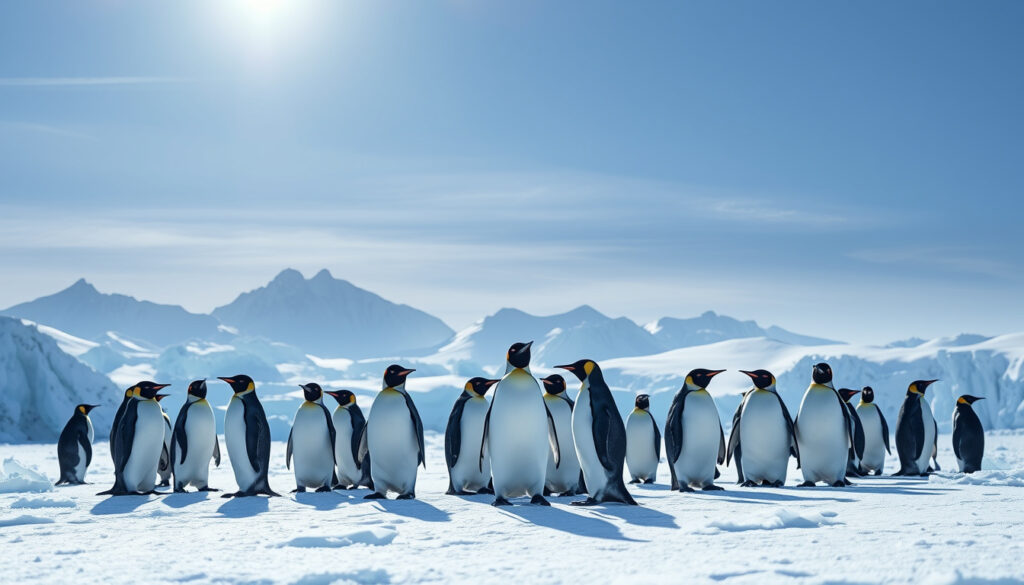
Emperor Penguins: Facts, Habitat, Diet, and Conservation
There’s a reason emperor penguins have become the poster bird for Antarctic survival: they breed in the most brutal conditions on the planet, enduring months of darkness and cold that would kill almost any other vertebrate. But their greatest asset—dependence on stable sea ice—has become their greatest liability.
Height: 100–122 cm (39–48 in) ·
Weight: 22–45 kg (49–99 lb) ·
Lifespan: 15–20 years in the wild ·
Population: ~600,000 adults ·
Max dive depth: Over 500 m (1,640 ft)
Quick snapshot
- Breeds during the Antarctic winter on sea ice (BirdLife Data Zone (scientific bird conservation database))
- Dives deeper than any other bird, exceeding 500 m (Pew Charitable Trusts (environmental policy nonprofit))
- Primary prey is Antarctic silverfish (Woods Hole Oceanographic Institution (marine science research center))
- Exact population trends due to remote colony monitoring challenges
- Future adaptation capacity to rapid sea ice loss
- 2026: Listed as Endangered by IUCN (IUCN (global conservation authority))
- 2009–2018: ~10% decline in global population (IUCN (global conservation authority))
- Projected 50–80% population decline by 2100 under current emissions (Pew Charitable Trusts)
- Proposed network of marine reserves in the Southern Ocean (Pew Charitable Trusts)
The snapshot above shows how ice dependency frames both the emperor’s strength and its vulnerability.
| Scientific name | Aptenodytes forsteri |
| Location | Antarctica |
| Population | ~600,000 adults |
| Diet | Fish, squid, crustaceans |
| Predators | Leopard seals, killer whales, skua (chicks) |
| Conservation status | Endangered (IUCN 2026) |
What is special about emperor penguins?
Size and appearance
- Emperor penguins are the largest living penguin species, standing 100–122 cm (Encyclopaedia Britannica (reference publisher)).
- They weigh between 22 and 45 kg, significantly more than any other penguin.
- Distinctive yellow-orange patches on the neck and chest differentiate them from the similar-looking king penguin.
Life cycle and breeding
- Emperor penguins are the only species that breeds during the Antarctic winter, laying eggs in May and June (BirdLife Data Zone (scientific bird conservation database)).
- Males fast for up to 4 months while incubating the egg on their feet, surviving on stored fat reserves.
- Females return from the sea in July or August to take over chick care while males trek back to open water to feed.
Unique adaptations
The emperor’s entire reproductive strategy is a gamble on ice stability. With the 2026 IUCN Endangered listing, the conservation world has officially clocked the threat: the species cannot adapt fast enough to outrun the warming.
Emperor penguins possess dense, waterproof feathers and a thick layer of blubber that allows them to withstand temperatures as low as -60°C. Their counter-current heat exchange system minimizes heat loss from the extremities, making them the most cold-tolerant bird species on Earth, a resilience akin to the endurance documented in Everest Peak: Height, Location, Climbing Duration & Deaths.
The implication: the same adaptations that make them the ultimate Antarctic survivor—winter breeding, deep diving, and fasting endurance—are precisely what lock them into a dependency on sea ice that is now vanishing.
Which penguin is bigger, emperor or king?
The size gap between these two cousins is the starting point for understanding their very different survival strategies.
Height and weight differences: a side-by-side comparison shows just how distinct these cousins really are.
| Feature | Emperor Penguin | King Penguin |
|---|---|---|
| Scientific name | Aptenodytes forsteri | Aptenodytes patagonicus |
| Height | 100–122 cm | 85–95 cm |
| Weight | 22–45 kg | 11–16 kg |
| Breeding range | Antarctica (sea ice) | Subantarctic islands |
| Conservation status | Endangered (IUCN 2026) | Least Concern (National Geographic (science and exploration media)) |
| Global population | ~600,000 adults | ~1.1 million breeding pairs |
The pattern: size and range are inversely linked. The emperor’s huge body helps it survive the Antarctic interior; the king’s smaller frame limits it to warmer subantarctic zones. Climate change hits the emperor’s edge far harder than the king’s.
Appearance compared
- Both species have yellow-orange patches on the neck, but the king’s markings are brighter and more extensive.
- The emperor’s body is more robust and tapered for deep diving; the king has a sleeker profile adapted for speed in the water.
Geographic range
- Emperor penguins live exclusively on the sea ice surrounding Antarctica (Encyclopaedia Britannica (reference publisher)).
- King penguins inhabit subantarctic islands such as South Georgia, the Falklands, and Crozet, where temperatures are milder and sea ice is absent.
Where can you see the emperor penguins?
Antarctic colonies
- Emperor penguins have the most southerly breeding range of any penguin species (Encyclopaedia Britannica (reference publisher)).
- Major colonies are located in the Ross Sea, Weddell Sea, Queen Maud Land, and along the Antarctic coastline.
- Seven active breeding sites are designated as Antarctic Specially Protected Areas (BirdLife Data Zone).
Tourist expeditions
- Expeditions typically depart from Ushuaia, Argentina, or Christchurch, New Zealand, and focus on the Antarctic Peninsula.
- Visits are limited to outer colony views; landing on colonies is strictly regulated to minimize disturbance.
- Costs range from $10,000 to $40,000 per person depending on the itinerary and duration.
Zoos with emperor penguins
- SeaWorld San Diego in the United States and Ueno Zoo in Tokyo are among the few facilities outside Antarctica that house emperor penguins.
- The species’ complex environmental needs—including specific temperature, humidity, and light cycles—make them one of the most difficult animals to maintain in captivity.
Emperor penguins have become iconic characters of the natural world, much like the beloved stories in Peter Rabbit: Why He’s So Famous, Characters, Moral, and Age Guide, but their reality is far more fragile.
The catch: most of us will never see an emperor penguin in the wild. The few zoos that keep them face immense logistical challenges, and even tourist expeditions to colonies are distant, brief, and expensive—underscoring how remote these birds truly are.
Why are emperor penguins disappearing?
Climate change impact
- Emperor penguins rely on stable sea ice from April to December for breeding and raising chicks.
- Earlier ice breakup and loss of sea ice due to climate change leave chicks without a stable platform to develop their waterproof feathers (Pew Charitable Trusts (environmental policy nonprofit)).
- WWF UK reports that one colony off the Antarctic Peninsula has disappeared completely (WWF UK (wildlife conservation organization)).
Declining populations
- Satellite imagery reveals a ~10% loss of the adult population between 2009 and 2018, amounting to over 20,000 birds (IUCN (global conservation authority)).
- WWF UK estimates an almost 25% decline in the west Antarctic region from Bellingshausen to Weddell Sea over the same period (WWF UK).
- One colony at Terre Adélie declined by 50% between 1950 and 2000 (Encyclopaedia Britannica (reference publisher)).
Conservation status
- The IUCN moved the species from Near Threatened to Endangered in April 2026 (IUCN (global conservation authority)).
- The US Fish and Wildlife Service has listed it as Threatened under the Endangered Species Act (Woods Hole Oceanographic Institution (marine science research center)).
- BirdLife International classifies the species as Near Threatened, noting that Antarctic sea ice is projected to disappear within the next few decades (BirdLife Data Zone).
Emperor penguins are the best-adapted birds on Earth for extreme cold, yet the very climate trend that is warming the planet is making their specialized habitat a trap. Their strength is their vulnerability.
The scale of the challenge is immense, rivaling the extremes detailed in Everest Peak: Height, Location, Climbing Duration & Deaths, but the stakes for the emperor penguin are existential.
What do emperor penguins eat?
Main diet: fish and squid
- Primary prey is Antarctic silverfish, supplemented by squid and crustaceans (Woods Hole Oceanographic Institution (marine science research center)).
Hunting techniques
- Emperor penguins dive to depths of over 500 meters to forage, deeper than any other bird (Pew Charitable Trusts (environmental policy nonprofit)).
- They can remain submerged for up to 20 minutes, relying on high levels of myoglobin in their muscles to store oxygen.
Feeding frequency and challenges
- Adults regurgitate food for their chicks, traveling long distances between the colony and open water feeding grounds.
- As sea ice shrinks, foraging trips grow longer, putting adults and chicks at risk of starvation.
- Industrial krill fishing overlaps with their foraging areas in coastal waters, adding pressure on the food web (Pew Charitable Trusts).
The trade-off: diving 500 meters for a meal gives emperors access to food no other bird can reach, but the energy cost is enormous. As sea ice shrinks, foraging trips grow longer, putting adults and chicks at risk of starvation.
Confirmed facts
- Breeding cycle involves winter incubation on sea ice (BirdLife Data Zone).
- Maximum dive depth exceeds 500 meters (Pew Charitable Trusts).
- Primary prey is Antarctic silverfish (Woods Hole Oceanographic Institution).
What’s unclear
- Exact population trends due to remote colony monitoring challenges.
- Future adaptation capacity to rapid sea ice loss.
- The rate of colony collapse in unreachable eastern regions.
“Emperor penguins are uniquely adapted to the Antarctic winter, but their future depends on our ability to reduce carbon emissions.”
— WWF Spokesperson
“If we lose sea ice, we lose the emperor penguin. It is that simple. Projections for the next century show a clear trajectory if we do not reverse current emission trends.”
— BirdLife International (scientific bird conservation database)
For the conservation community, the divergence between the already-stable king penguin and the imperiled emperor penguin is a powerful signal. Protecting penguins means protecting ice; without it, the largest penguin species on Earth becomes a cautionary tale written in satellite images. Like Peter Rabbit: Why He’s So Famous, Characters, Moral, and Age Guide, the story of the emperor penguin is one of perseverance, though its fate hinges on global environmental policy.
en.wikipedia.org, antarctica.gov.au, canadascope24.com, animalcompare.com, actueledag.nl
For a deeper look at their unique breeding cycle and the threats they face, see this detailed overview of emperor penguin facts and conservation.
Frequently asked questions
How do emperor penguins keep warm?
Emperor penguins have four layers of scale-like feathers, a thick layer of blubber, and huddle in large groups. Their counter-current heat exchange system minimizes heat loss from their flippers and feet.
How long do emperor penguins live?
In the wild, emperor penguins typically live 15–20 years. In captivity, some individuals have reached up to 30 years of age.
Do emperor penguins mate for life?
Emperor penguins are serially monogamous: they pair with a single mate for the breeding season but often choose a different partner the following year.
How deep can emperor penguins dive?
Emperor penguins are the deepest diving birds on Earth, regularly reaching depths of over 500 meters and holding their breath for up to 20 minutes.
What is the scientific name of the emperor penguin?
The scientific name is Aptenodytes forsteri, named after the naturalist Johann Reinhold Forster.
Are emperor penguins endangered?
Yes. The IUCN upgraded the emperor penguin from Near Threatened to Endangered in April 2026, driven by the loss of sea ice due to climate change. The US Fish and Wildlife Service also lists it as Threatened.
How many emperor penguins are left in the wild?
Current satellite-based estimates suggest approximately 600,000 adult emperor penguins remain in the wild. Their population is declining, with a roughly 10% drop recorded between 2009 and 2018.
More related posts
 Till Lindemann: Family, Physical Facts, and Career
 Valerie Singleton: Blue Peter Presenter’s Private Life & Legacy
 Bad Boy Carolina Herrera – Men’s Fragrance Essentials
 Francisco Goya Saturn Devouring His Son: Artwork Analysis & Meaning
 Mark Carney: Biography, Family, Criticisms, and Political Rise (2025)
 Light Switches Ireland: Types, Wiring & Buying Guide
 AI Chat: Free Options, Safety Risks, and Best Practices
 Cherie Blair: British Barrister, KC, and Philanthropist