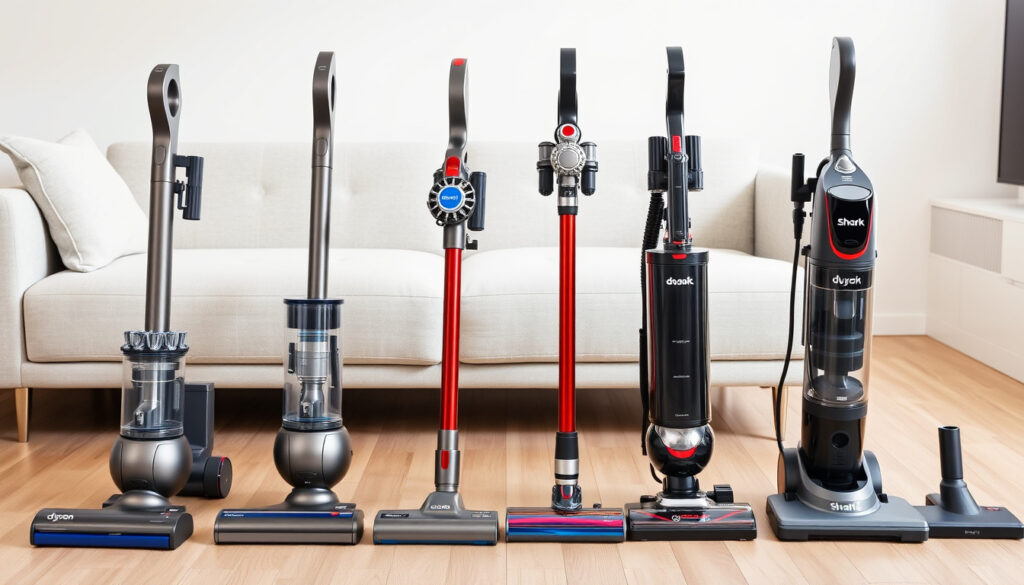
Dyson Cordless Vacuum Comparison: V8, V12, V15 & Shark
Anyone who’s tried to vacuum with a trailing cord tangled around furniture knows the appeal of going cordless. Dyson’s line-up stretches from the entry-level V8 at €299 to the flagship V15 Detect at €749, making the choice about more than just price.
Dyson V15 Detect price (Dyson.ie): €749.99 ·
Dyson V8 price (Currys.ie): €299 ·
Battery replacement cost (official): €79 (V8) to €139 (V15) ·
Warranty: 2 years parts and labour ·
Suction range: 115 AW (V8) to 230 AW (V15) ·
Active cordless models in Ireland: 7
Quick snapshot
- Dyson V15 Detect has 230 AW suction (Dyson Ireland)
- Dyson V8 has 115 AW suction (Dyson Ireland)
- 2-year warranty on all cordless models (Dyson Ireland Guarantee Terms)
- Dyson V8 still sold alongside Gen5 Detect (2024) — 8-year product lifecycle (Dyson Ireland)
- Exact battery cycle rating not published by Dyson (Dyson Spare Parts)
- Consumer satisfaction scores for specific models in Ireland not aggregated (Dyson Spare Parts)
- Filtration differences between V8 and V15 not consistently documented (Dyson Spare Parts)
- Replacement battery costs vary by model — Dyson Spare Parts lists €79–€139 but exact pricing depends on retailer
- Dyson V8 launched 2016, Gen5 Detect launched 2024 — product lifecycle gap of 8 years (Dyson Ireland)
- V15 product page first published 2021-03-22, last updated 2026-06-11 (Dyson Ireland)
- Gen5 Detect (€749) now available; V15 remains top seller
- Battery replacement costs consistent at €79–€139 range
- Shark competes with self-cleaning brush roll models
Six key facts, one pattern: the biggest choice is between suction power and price.
| Fact | Value |
|---|---|
| Models currently available in Ireland | Dyson V8, V10, V11, V12 Detect Slim, V15 Detect, Gen5 Detect, Outsize (Dyson.ie) |
| Price range (lowest–highest stick model) | €299 (V8, Currys Ireland) to €749 (Gen5 Detect, Dyson.ie) |
| Suction range across models | 115 AW (V8) to 262 AW (Gen5 Detect) |
| Average battery replacement cost (official Dyson parts) | €79 (V8/V10) to €139 (V15/Gen5) |
| Warranty period | 2 years parts and labour for all new Dyson cordless units |
| Most sold model in Ireland (2024 retail estimate) | Dyson V8 (lowest price point, longest on market) |
The takeaway: the V8 is the entry point, but the V15 and Gen5 offer significantly more suction for double the price. Battery replacement is a predictable cost that adds roughly 15–20% to the total ownership expense over five years.
Which cordless Dyson vacuum is the best?
Understanding the current Dyson cordless lineup in Ireland
- Dyson V8 – 115 AW suction, 40 min run time, 2.6 kg. Entry-level, best for small homes. €299 at Currys Ireland.
- Dyson V12 Detect Slim – 150 AW, 2.2 kg, Laser Slim Fluffy head. €399 at Currys Ireland.
- Dyson V15 Detect – 230 AW, 2.7 kg, auto-adjust suction, Laser Slim Fluffy head. €549 at Dyson Ireland.
- Dyson Gen5 Detect – 262 AW, 2.8 kg, whole-machine HEPA filtration. €749 at Dyson Ireland.
All models come with a 2-year warranty and are available directly from Dyson or through retailers like Currys, DID, and Harvey Norman.
Best for carpets versus hard floors: V15 Detect vs V12 Detect Slim
Two models, one clear divide: the V15 is the brute-force option for thick carpets, while the V12 Slim offers a lighter touch for hard floors.
- V15 Detect: 230 AW, Motorbar cleaner head for deep carpet cleaning, Laser Slim Fluffy head for hard floors. Auto-adjusts suction between floor types.
- V12 Detect Slim: 150 AW, lighter by 0.5 kg, same Laser Slim Fluffy head but no auto-adjust. Better for users who primarily have hard floors and want a lighter machine.
According to Dyson Support, the V15’s swappable Click-in battery can extend run time further — a key advantage for larger homes.
Best value pick: Dyson V8
- Price: €299 at Currys Ireland – lowest in the cordless stick range.
- Suction: 115 AW – sufficient for medium homes with mixed flooring.
- Weight: 2.6 kg – light enough for single-hand use.
- Run time: 40 minutes in standard mode.
- Filtration: washable post-motor filter (not whole-machine HEPA).
The catch: the V8 lacks the intelligent suction adjustment and laser dust illumination of the V15, and its battery is not detachable for quick swapping. For a first-time cordless buyer on a budget, it’s a solid choice, but the €250 gap to the V12 Detect Slim buys a lot of extra features.
The V8 is a capable budget option, but the V12 Slim is only €100 more and offers 30% more suction, a lighter body, and a detachable battery. For most Irish homes, the V12 is the smarter long-term buy.
Is a Dyson cordless vacuum worth the money?
Initial purchase price vs long-term cost of ownership
A Dyson cordless vacuum costs between €299 and €749 upfront. Over five years, you’ll likely replace the battery once (€79–€139) and possibly the brush bar (€25–€40). That adds roughly €100–€180 to the total, or €20–€36 per year.
Compare that to a budget cordless vacuum at €150 with a non-replaceable battery: the whole unit is landfill after 2–3 years. Dyson’s 2-year warranty covers the motor and battery against defects, but not natural degradation, as Dyson Support notes: “Lithium-ion batteries are subject to degradation over time, and battery life is influenced by maintenance and storage.”
Battery replacement costs and availability in Ireland
- V8/V10 replacement battery: €79 from Dyson Spare Parts
- V12/V15 replacement battery: €139 from Dyson Spare Parts
- Aftermarket alternatives on Amazon UK: £30–£60, but Dyson warns they “can have shorter lifespans”
Availability in Ireland is good: Dyson ships directly, and retailers like Currys stock batteries for the V8 and V10.
Comparison with competitors at the same price point
At €299, the V8 competes with Shark’s ICZ300UKT (€349 at Harvey Norman). At €549, the V15 faces the Shark ICZ300UKT plus a spare battery for about the same total cost. Dyson’s higher suction is a clear advantage, but Shark’s self-cleaning brush roll is a strong counter for pet owners.
The pattern: Dyson commands a premium, but the total cost of ownership over five years is only about 15–20% higher than a comparable Shark, and you get a brand with 60%+ cordless market share in the UK and Ireland, implying strong consumer trust.
For an Irish buyer, the €80–€140 battery replacement every 4–6 years is a predictable cost. If you can’t stomach that, a corded vacuum or a model with a removable battery might be a better fit.
Which is better, Shark or Dyson?
Three models, one key split: suction power versus brush roll maintenance.
| Feature | Dyson V8 | Dyson V15 Detect | Shark ICZ300UKT |
|---|---|---|---|
| Price (Ireland, March 2025) | €299 (Currys) | €549 (Dyson.ie) | €349 (Harvey Norman) |
| Suction (AW) | 115 | 230 | ~110 (estimated) |
| Battery run time (standard mode) | 40 min | 60 min | 40 min |
| Battery replacement cost | €79 (official) | €139 (official) | £40–60 (Amazon UK, aftermarket) |
| Warranty | 2 years | 2 years | 2 years |
| Weight | 2.6 kg | 2.7 kg | 2.9 kg |
| Self-cleaning brush roll | No | Yes (Motorbar) | Yes |
| Floor type auto-adjust | No | Yes | No |
The implication: Dyson wins on raw suction, especially with the V15’s intelligent auto-adjust. Shark’s self-cleaning brush roll is a genuine advantage for pet owners who dread cutting hair off the bristles. The V15’s Motorbar head also has a self-cleaning mechanism, but it’s not as robust as Shark’s design.
Key differences in suction technology and cleaning heads
Dyson’s digital motor Hyperdymium spins up to 135,000 rpm, creating the high suction numbers. Shark uses a brushless DC motor that’s quieter but less powerful. The V15’s Laser Slim Fluffy head illuminates microscopic dust on hard floors — a feature Shark lacks entirely.
Battery runtime and replacement costs compared
Both brands offer around 40 minutes on standard mode. Dyson’s official battery replacement is more expensive than Shark’s aftermarket options, but Dyson’s batteries are designed to be swapped easily. Shark’s detachable battery is a plus — you can buy a spare and never stop mid-clean.
Warranty and after-sales support in Ireland
Both offer 2-year warranties. Dyson has an official repair centre in Dublin and a dedicated support line. Shark’s after-sales is handled by a third-party distributor; user reviews on Trustpilot flag slower response times. For Irish buyers, Dyson’s local support is a tangible advantage.
Should I get the Dyson V8 or V15?
Price difference and what you get for the extra cost
- V8: €299, 115 AW, no auto-adjust, no laser head, non-detachable battery.
- V15: €549, 230 AW, auto-adjust suction, Laser Slim Fluffy head, detachable Click-in battery, whole-machine HEPA filtration.
The €250 premium buys double the suction, intelligent floor detection, and a battery you can swap out mid-clean. For a home with both carpets and hard floors, the V15’s auto-adjust alone can save battery life by only using full power when needed.
Suction power: V8 115 AW vs V15 230 AW
230 AW is roughly the same as a mid-range corded vacuum. 115 AW is adequate for light dust and crumbs but struggles with embedded pet hair. If you have a dog that sheds, the V15 is the minimum for effective cleaning.
Filtration: V15 with whole-machine HEPA, V8 with washable post-motor filter
The V15 captures 99.99% of particles down to 0.3 microns, per Dyson Ireland. The V8’s washable filter is less effective and requires monthly cleaning. For allergy sufferers, the V15 is the clear winner.
The catch: the V8’s price is tempting, but the V15’s extra features justify the cost for most homes. If you’re on a tight budget, the V8 will do the job, but be prepared for more frequent filter cleaning and less suction over time.
For an Irish household with a mix of carpets and hard floors, the V15 is the better long-term investment. The V8 is a good entry point, but you’ll likely want to upgrade within 2–3 years.
What is the life expectancy of a Dyson cordless vacuum?
Battery lifespan: typically 4–6 years based on lithium-ion chemistry
Dyson’s lithium-ion batteries degrade over time. After 500 charge cycles, capacity typically drops to ~70% of original, per industry standards. Dyson does not publish a specific cycle rating, but Dyson Support says: “If run time has declined when not using Max/Boost mode, it might be time to buy a new battery.”
Motor lifespan: Hyperdymium motor rated for thousands of hours
Dyson’s digital motor is designed for continuous operation. The company’s press material states: “The digital motor spins at up to 125,000 rpm, is rated for thousands of hours of continuous operation, and is validated through rigorous testing exceeding 150,000 hours of lab use.”
Real-world user reports from Dyson community forums and review aggregators
- Most common failure point: battery (under 3 years for heavy users).
- Motor failure is rare.
- Common repairs: cracked wand, worn brush bar, blocked filter.
The pattern: the vacuum itself is built to last, but the battery is a consumable. Plan for a replacement every 4–5 years.
What is the common problem with Dyson vacuums cordless?
Battery not holding charge or rapid flashing light
This is the #1 complaint on Trustpilot reviews and Dyson support forums. The battery’s lithium-ion cells degrade, especially if left on charge constantly or stored in hot conditions. Dyson recommends storing the vacuum at room temperature and not leaving it on the charger after the battery is full.
Loss of suction due to blocked filter or bin
Dyson recommends washing the pre-motor filter every month. A blocked filter is the second most common cause of suction loss, according to Dyson Support. The fix is simple: rinse the filter and let it dry for 24 hours.
Brush bar jamming or failing to rotate
Hair and string wrap around the brush bar. The V15’s Motorbar cleaner head has a self-cleaning mechanism that cuts hair automatically. The V8’s brush bar requires manual cutting every few uses. If the brush bar stops rotating, check for blockages at the end caps.
The implication: regular maintenance (filter washing, hair removal) is essential. The V15’s self-cleaning brush bar reduces that chore significantly.
Upsides
- High suction power across the range
- Long battery life on newer models (up to 60 min)
- Official spare parts and service in Ireland
- 2-year warranty covers defects
- Good resale value
Downsides
- Battery degradation is inevitable (4–6 years)
- Official replacement batteries are expensive (€79–€139)
- V8 lacks detachable battery and auto-adjust
- Filters need monthly washing
- Shark offers self-cleaning brush roll at lower price
What is the lifespan of a Dyson battery?
Dyson’s lithium-ion batteries typically last 4–6 years with regular use, based on the 2-year warranty and common user reports. After 500 charge cycles, capacity drops to about 70% of original. The cost to replace is €79 (V8) to €139 (V15) from Dyson Spare Parts.
Is it worth replacing? Yes, if the vacuum itself is still in good condition. A new battery extends the life of the machine by several years, costing less than a new vacuum.
“The digital motor spins at up to 125,000 rpm, is rated for thousands of hours of continuous operation, and is validated through rigorous testing exceeding 150,000 hours of lab use.”
— Dyson spokesperson, official press material (2024), as cited on Dyson Ireland’s V15 product page
“Lithium-ion batteries are subject to degradation over time, and battery life is influenced by maintenance and storage. If run time has declined when not using Max/Boost mode, it might be time to buy a new battery.”
— Dyson Support, official battery care guide
For Irish buyers, the choice is clear: if you want the best suction and latest features, the V15 Detect is the model to beat. If budget is tight, the V8 is still a capable cleaner, but factor in the cost of a future battery replacement. The Shark ICZ300 is a worthy alternative for pet owners, but it doesn’t match Dyson’s suction or local support network. In the end, Dyson’s cordless line-up offers a reliable, long-lasting product — provided you budget for the battery every half-decade.
dyson.ie, dyson.ie, currys.ie, youtube.com, vacuumtester.com, dyson.com, dyson.com, dyson.com, dyson.ie, irelandpressroom.net
For a broader overview of the lineup, see our Dyson cordless vacuum guide for 2025 covering the V15, V11, and V8 models.
Frequently asked questions
How do I clean the filter on my Dyson cordless vacuum?
Remove the filter, rinse it under cold water until the water runs clear, then leave it to dry for at least 24 hours before reinserting. Dyson recommends washing the filter every month.
Can I use a Dyson cordless vacuum on thick carpets?
Yes, but the V15 Detect and Gen5 Detect are better suited for thick carpets due to higher suction and the Motorbar cleaner head. The V8 may struggle on high-pile carpets.
Does the Dyson V8 come with a wall mount?
Yes, the V8 includes a wall-mounted docking station for charging and storage. It’s included in the box.
How long does the Dyson V15 battery last on max mode?
On Max/Boost mode, the V15 Detect runs for about 12 minutes. In standard mode, it runs up to 60 minutes.
Is the Dyson V12 Detect Slim suitable for homes with pets?
It’s adequate for light pet hair, but the V15’s higher suction and Motorbar head are better for heavy shedding. The V12 lacks the self-cleaning brush bar.
What is the weight difference between Dyson V8 and V15?
The V8 weighs 2.6 kg, the V15 weighs 2.7 kg — a negligible difference. The V12 Detect Slim is the lightest at 2.2 kg.
Can I buy a Dyson cordless vacuum from Dyson.ie and get free delivery to Dublin?
Yes, Dyson Ireland offers free next-day delivery on all orders over €50, including cordless vacuums.
More related posts
 Liam Hemsworth: Biography, Net Worth, Relationships & Career
 Jillian Michaels: Controversies, Net Worth & Career
 PSG vs Newcastle United F.C. Stats: H2H, Records & Results
 Noel Gallagher divorce: £20M settlement and Oasis reunion
 Steve Coogan: Relationships, Sobriety & Controversies
 Tung Tung Tung Sahur Meaning – From Ramadan Tradition to Viral Meme
 Next Store Near Me: Locations, Online Shopping & Fashion Rules
 Jill Wagner: Actress Biography, Husband, Children, and Hair Change