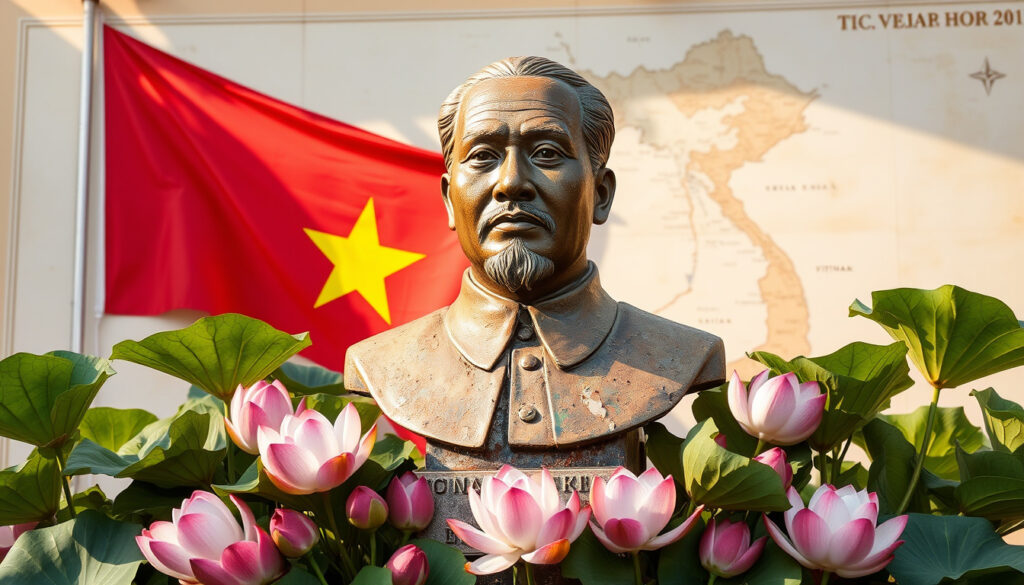
Ho Chi Minh: The Man, the Name, and How He Shaped Vietnam
For a country that only ended its most recent armed conflict in 1975, the speed of change has been astonishing: today, motorbikes outnumber cars, the internet economy is booming, and foreign visitors come for a street food scene that barely pauses. At the center of this, from official portraits and street names to the very name of the country’s largest city, stands the figure of Ho Chi Minh.
Founded: Democratic Republic of Vietnam in 1945 · Died: September 2, 1969 · Renamed: Saigon to Ho Chi Minh City in 1976 · Population (HCMC): over 9 million · Political system: single-party socialist republic
Quick snapshot
- One-party state [U.S. Department of State]
- Communist Party dominance [U.S. Department of State]
- No legal opposition [GOV.UK]
- Socialist-oriented market economy [Britannica]
- Since Doi Moi 1986 [Britannica]
- Major growth but state control remains [Britannica]
- Restrictions on free speech [Human Rights Watch]
- Limits on assembly [Human Rights Watch]
- Limited press freedom [Human Rights Watch]
- Common petty crime [OSAC]
- Scams in tourist areas [OSAC]
- Road safety concerns [Is It Safe To Visit]
The following table summarizes key attributes of Vietnam.
| Attribute | Detail |
|---|---|
| Official name | Socialist Republic of Vietnam |
| Capital | Hanoi |
| Largest city | Ho Chi Minh City (Saigon) |
| Government | Marxist-Leninist one-party state |
| Leader | General Secretary of the Communist Party (currently Nguyen Phu Trong) |
Is Vietnam Still Communist, Yes or No?
Yes. Vietnam is officially a one-party socialist republic, and the U.S. Department of State confirms the Communist Party of Vietnam holds all power. The government structure places the party’s general secretary as the top leader, a position more influential than the presidency or prime minister.
Official party role
- The party controls the state apparatus, the judiciary, and the military.
- Political opposition is not legal; no other party may contest power.
The pattern: the 2018 Cybersecurity Law further criminalizes criticism that the state deems “insulting” or “false.” GOV.UK Foreign Travel Advice advises travelers that political dissent is not tolerated, and protests are rare.
“Nothing is more precious than independence and freedom.” — Ho Chi Minh, Declaration of Independence, 1945 (Britannica)
The implication: the party’s legal monopoly creates a stable authoritarian environment that discourages dissent.
Why Did They Rename Saigon?
After the Fall of Saigon in 1975, the new government, led by the Communist Party of Vietnam, renamed the city to Ho Chi Minh City in 1976. The decision honored the late leader who had died in 1969.
Historical context
- The renaming was part of a broader re-founding of the nation’s geography to reflect revolutionary legitimacy after reunification.
- Saigon remains the common spoken name, especially among older residents and for the city center’s historic district.
Ho Chi Minh’s government travel guidance emphasizes that official names carry political weight, but the local usage shows a culture that prizes proximity to the past.
The pattern: the name’s duality mirrors the tension between government narrative and everyday life.
How Did Ho Chi Minh Transform Indochina?
Ho Chi Minh was the central figure in Vietnam’s anti-colonial struggle, but his impact extends beyond independence. His strategy combined military mobilization, political diplomacy, and mass mobilization that fundamentally redrew the map of French Indochina.
From colony to independence (1890-1954)
- 1890 — Born Nguyen Sinh Cung in central Vietnam. [Britannica]
- 1919 — PETITION: Led a delegation to the Versailles Peace Conference demanding self-determination. [Britannica]
- 1930 — Founded the Indochinese Communist Party. [Britannica]
- 1941 — Created the Viet Minh to fight French and Japanese occupation. [Britannica]
- 1945 — Declared independence from France after the August Revolution. [Britannica]
- 1954 — Victory at Dien Bien Phu ended French rule. [Britannica]
Ho’s diplomatic tightrope—accepting aid from both the Soviet Union and China while managing nationalist credentials—allowed North Vietnam to win the First Indochina War, but it sowed tensions that later fueled the Sino-Soviet split and influenced Vietnam’s turn to the USSR.
The catch: his balancing act created long-term strategic dependencies that still affect Vietnam’s foreign policy.
What Does ‘Ho Chi Minh’ Mean in English?
Before he became the iconic leader, he adopted many names. His birth name was Nguyen Sinh Cung. Later, as a revolutionary, he used aliases like Nguyen Van Ba, but the name that stuck was Ho Chi Minh. Its translation is debated, but the most accepted interpretation is “He Who Seeks Enlightenment” or “Bringer of Light.”
Literal translation
The name breaks down as: Ho ( ) is the family name, but it is rarely used alone in conversation. Chi ( ) means “will” or “purpose,” and Minh ( ) means “bright” or “enlightened.” The most common translation in English is “Enlightened Will” or “He Who Enlightens.” Some scholars note that Ho borrowed the surname of a benefactor while abroad, but the name is now inseparable from the leader himself.
The name’s exact meaning is a political Rorschach test: Western texts often emphasize “he who brings light,” while Vietnamese sources stress “will” and “purpose.” The difference is not academic—it shapes how his legacy is framed.
The underlying debate: the translation itself becomes a proxy for competing narratives about his role.
Is Vietnam a Dictatorship Today?
Most political scientists classify Vietnam as a one-party authoritarian state. The U.S. State Department OSAC notes that Vietnam’s political system is a communist one-party state, and GOV.UK notes that the party does not welcome dissent.
Political opposition
- No legal opposition party exists.
- Elections are held, but candidates are vetted by the party-controlled front.
Independent political activity is often met with repression. OSAC and other watchdogs report that activists are frequently detained. This is not a country where a change of government is possible through the ballot box.
Elections
The National Assembly elections are held every five years. Yet, candidates must belong to the Fatherland Front, a coalition controlled by the party. The result is a body that rarely votes against party leadership.
Civil liberties
The regime severely restricts free speech, assembly, and association, a position that is OSAC and GOV.UK.
Is Free Speech Allowed in Vietnam?
Technically, the constitution guarantees freedom of speech. In practice, the 2018 Cybersecurity Law and other decrees restrict content that the state considers “insulting” to the party or spreading “false news.”
Constitutional guarantees
The 2013 Constitution states that citizens have the right to free speech, but this is superseded by criminal law, which prohibits criticism of the state.
Legal limits
Social media users in Vietnam can face arrest for posting content that officials deem critical. Human Rights Watch has documented the arrest of activists and bloggers.
Self-censorship is widespread. Travelers should not assume that offline conversations are illegal, but they should be aware that public critiques of the state are risky for citizens—and that the same laws apply to foreigners who are physically present.
“Vietnam’s government frequently arrests activists for peaceful expression.” — Human Rights Watch, 2024 World Report ([Human Rights Watch])
The consequence: free speech is constitutionally protected but legally circumscribed, creating a culture of caution.
What Are Some Problems in Vietnam?
Beyond political restrictions, Vietnam faces several challenges that affect residents and travelers. These include environmental pollution, corruption, and human rights concerns.
Environmental pollution
- Air pollution is severe in cities like Hanoi and Ho Chi Minh City.
- Plastic waste and water pollution are growing problems.
Corruption
Corruption is a concern in government and business. The ruling party has launched anti-corruption campaigns, but critics say they are often used as a tool to purge rivals, rather than to create transparency.
Human rights
Human rights groups, including Human Rights Watch, report that dissidents are jailed for peaceful expression. Religious freedom is also restricted, with state control over organized religion.
The pattern: the most immediate problems for visitors are practical, yet the political backdrop colors the experience.
How Does Ho Chi Minh’s Ideology Shape Modern Vietnam?
Ho Chi Minh’s writings and thought remain the official ideology. The party promotes “Ho Chi Minh Thought” as a guide for modern policy.
Economic reforms
The Doi Moi reforms of 1986 were inspired by the need to address economic stagnation. They introduced market mechanisms, but the party retains control of the “commanding heights” of the economy. Vietnam Airlines travel guidance states that the city is safe for tourists, but the U.S. State Department says that petty crime is a concern.
Ho Chi Minh’s commitment to national unity has been used to justify both a state-led economy and opening to foreign investment. The result is a hybrid system that is neither purely communist nor a free market.
The implication: his ideology provides the rhetorical cover for pragmatic policy shifts.
Is Ho Chi Minh City Safe for Tourists?
Safety in Ho Chi Minh City requires navigating two different realities: low violent crime and high petty crime. The U.S. State Department OSAC assesses Hanoi and Ho Chi Minh City as low-threat for political violence but high-threat for crime affecting U.S. government interests.
Top safety concerns
- Petty theft: Phone and bag snatching from motorbikes is a leading risk.
- Scams: Taxi overcharging, “helpful” diversion tactics, and counterfeit goods.
- Road safety: Traffic accidents are common; crossing the street requires constant alertness.
- Petty crime: Pickpocketing is common around landmarks like Ben Thanh Market.
Official advisory sources like the UK FCDO (GOV.UK) and the U.S. State Department (U.S. Department of State) say violent crime is rare. The bigger risk is losing your passport to a snatch-and-grab, which is why the Consulate General of Malaysia advises keeping documents safe.
The catch: violent crime is low, but vigilance against theft is essential.
Is Vietnam Safer Than Thailand?
Comparing safety between Thailand and Vietnam is tricky. According to the Vietnam Airlines travel guide, Ho Chi Minh City is considered safe for tourists, and Is It Safe To Visit notes the city is generally safe compared to other Southeast Asian cities.
| Factor | Vietnam (HCMC) | Thailand (Bangkok) |
|---|---|---|
| Political violence | Low | Moderate (drugs, security) |
| Violent crime against tourists | Low | Low |
| Nonviolent crime | Medium to High | Medium |
| Additional risks | Scams, motorbike theft | Scams, taxi overcharging |
The U.S. State Department’s Travel Advisory for Vietnam notes no unusual threats to safety that differ significantly from those in Thailand, but the stats on the ground often feel different.
The pattern: individual precautions matter more than country-level comparisons.
What Are the Most Common Crimes in Ho Chi Minh City?
- Scams (taxi overcharging, “fake shop” schemes)
- Theft (mugging, pickpocketing)
- Rarely reported: armed robbery
Crime in Ho Chi Minh City is rarely violent. Travel Warning Check ranks the city as moderate-risk, with a category rating of 3 out of 5, but this is highly subjective.
How Has Ho Chi Minh City’s Reputation Changed Over Time?
Timeline signal
- 1890 — Ho Chi Minh born. [Britannica]
- 1945 — Declares independence. [Britannica]
- 1954 — Victory over France. [Britannica]
- 1969 — Dies in Hanoi. [Britannica]
- 1976 — Saigon renamed Ho Chi Minh City. [Britannica]
- 1986 — Doi Moi economic reforms. [Britannica]
Understanding the timeline clarifies the city’s modern priorities: a war legacy that has been converted into a narrative of resilience, followed by rapid economic liberalization.
Although the past is present, the city’s current identity is decidedly forward-looking, focusing on tech startups, nightlife, and tourism. The government encourages this shift, seeing it as a way to build soft power and economic gains.
ismytripsafe.com, visithcmc.net, osac.gov, townandtourist.com, vietnamwithme.com
Frequently Asked Questions
Are bed bugs common in Vietnam?
Bed bugs are present, but not widespread in modern hotels. Reports are anecdotal. It’s safer to check recent hotel reviews and use a portable mattress cover if you are concerned.
What is the most common crime in Vietnam?
Scams and petty theft are the most common. The U.S. OSAC report notes that street-level crime, especially snatch-and-grab theft, is the primary threat to foreigners.
What should I be careful of in Vietnam?
Be careful with your phone and bag in public—motorbike snatching is common. Also, avoid “war memorial” museums that may employ aggressive touts. Follow the GOV.UK advice to avoid protests, and never bring replica weapons or war memorabilia.
What not to bring to Vietnam?
Do not bring drone batteries over a certain capacity (check airlines), any literature that could be seen as anti-party, or more than 200 cigarettes per person. The U.S. U.S. Department of State notes that Vietnamese customs enforces strict rules on religious materials.
What are Vietnamese girls known for?
This is a problematic question because it assumes a single identity. Vietnamese women are known for their resilience, often highlighted in historical contexts—the “Long Hair Army” and the Trung Sisters—and in modern times, for their strong participation in the workforce and entrepreneurship.
What’s Confirmed
- Vietnam is a one-party state. [U.S. Department of State]
- The U.S. State Dept rates crime in HCMC as a concern. [OSAC]
- Ho Chi Minh died in 1969; Saigon was renamed in 1976. [Britannica]
What’s Unclear
- The exact translation of “Ho Chi Minh” is debated.
- Whether his birth name was Cung or Thanh is unclear.
- His role in the Communist Party’s founding is contested.
- Ho Chi Minh’s exact relationship with the Soviet Union is contested by historians.
Sources
For official advisories, travelers should check the U.S. Department of State (official travel advisory), GOV.UK Foreign Travel Advice (official UK guidance), and the U.S. State Department OSAC (crime and safety report).
For human rights issues, refer to Human Rights Watch (independent oversight organization).
For safety comparisons, see Is It Safe To Visit (travel safety aggregator) and Vietnam Airlines (national carrier’s travel guide).
For regional guidance, refer to the Consulate General of Malaysia in Ho Chi Minh City (consular advisory) and Travel Warning Check (independent safety index).
Related reading
Overall, Vietnam’s trajectory under Ho Chi Minh’s ideology presents a unique blend of authoritarian control and economic openness, a combination that continues to shape the country’s identity and its appeal to travelers and investors alike. The consequence is a nation that balances rigid political control with pragmatic market reforms, creating both opportunities and constraints for those who visit or do business there.