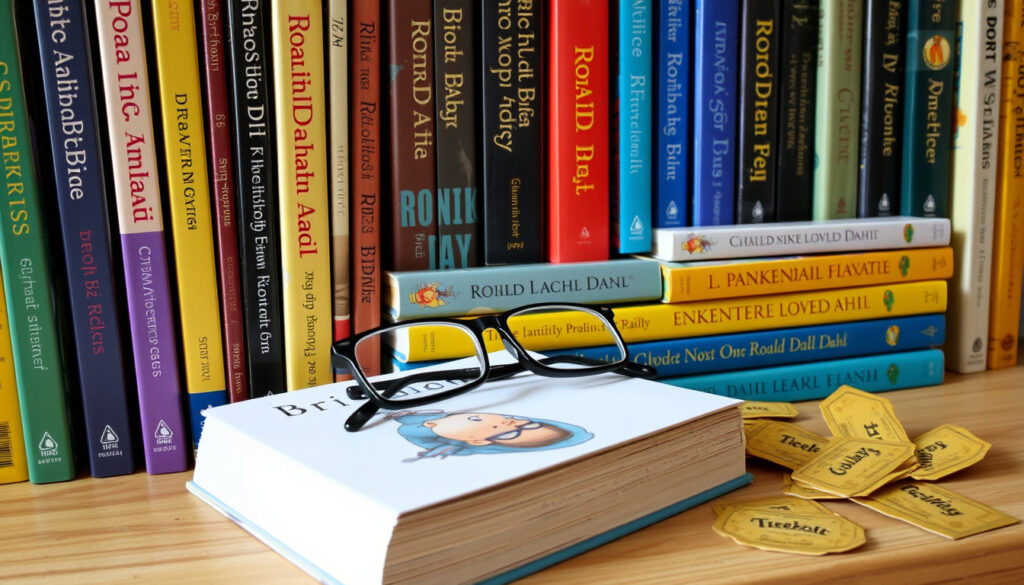
Roald Dahl Books: Reading Order & Age Guide
Few children’s authors stir up as much pure admiration—and honest controversy—as Roald Dahl. His books, from the mischievous Matilda to the deliciously dark The Witches, have sold tens of millions of copies worldwide. This guide offers a practical, source-backed map of his entire canon, organized by reading difficulty, age suitability, and thematic intensity.
Total children’s books: 19 · Best-selling title: Charlie and the Chocolate Factory (over 20 million copies) · First children’s book: 1961 (James and the Giant Peach) · Primary readership age: 7–12 years
Quick snapshot
- Matilda (1988) (Britannica biography)
- Charlie and the Chocolate Factory (1964) (Roald Dahl bibliography — Wikipedia)
- The BFG (1982) (Britannica biography)
- The Enormous Crocodile (Tutor Doctor recommendation)
- The Twits (Reading Quests age guide)
- Esio Trot (Tutor Doctor recommendation)
- The Witches (child endangerment, violent themes) (Britannica notes on themes)
- Matilda (severe child abuse) (Britannica notes on themes)
- The Enormous Crocodile (picture book) (Roald Dahl Museum archive)
- The Twits (short novel) (Reading Quests listing)
- Esio Trot (short novel) (Roald Dahl Museum archive)
Six facts, one picture: Dahl’s biography and output in a nutshell.
| Label | Value |
|---|---|
| Full name | Roald Dahl (Wikipedia) |
| Born | 13 September 1916, Llandaff, Wales (Wikipedia) |
| Died | 23 November 1990, Oxford, England (Wikipedia) |
| First children’s book | James and the Giant Peach (1961) (Roald Dahl bibliography — Wikipedia) |
| Most sold book | Charlie and the Chocolate Factory (over 20 million copies) (Roald Dahl bibliography — Wikipedia) |
| Total children’s books published | 19 (Roald Dahl Museum archive) |
What are some of Roald Dahl’s most famous books?
Dahl’s reputation rests on a small cluster of titles that have become modern classics. Each one blends a child’s perspective with an adult’s sense of consequence.
Matilda
- Published: 1988 (Britannica biography)
- Core theme: A gifted girl with telekinetic powers overcomes neglect and tyrannical authority.
- Global sales: Over 17 million copies (Roald Dahl bibliography — Wikipedia)
Charlie and the Chocolate Factory
- Published: 1964 (Roald Dahl bibliography — Wikipedia)
- Core theme: A poor boy wins a tour of a mysterious confectionery empire.
- Global sales: Over 20 million copies — Dahl’s bestseller (Roald Dahl bibliography — Wikipedia)
The BFG
- Published: 1982 (Britannica biography)
- Core theme: An orphan girl befriends a gentle giant who refuses to eat children.
- Global sales: Reportedly over 10 million copies (Britannica biography)
James and the Giant Peach
- Published: 1961 (Roald Dahl bibliography — Wikipedia)
- Core theme: A boy escapes his abusive aunts by traveling inside a magical peach.
- Significance: Dahl’s first published children’s novel.
The Witches
- Published: 1983 (Britannica biography)
- Core theme: A boy and his grandmother battle a global conspiracy of child-hating witches.
- Tone: Frequently cited as Dahl’s darkest work.
Dahl’s five core novels — Matilda, Charlie and the Chocolate Factory, The BFG, James and the Giant Peach, and The Witches — account for the vast majority of his global sales and cultural footprint. They were all published between 1961 and 1988.
The pattern: each of these books places a resourceful child in serious danger, with adults who are either incompetent or malevolent. That formula proved unbeatable.
In what order should you read Roald Dahl books?
There is no single correct sequence, but three common approaches help different readers find their way in.
By publication date (chronological order)
- 1943: The Gremlins (for adults) (Roald Dahl bibliography — Wikipedia)
- 1961: James and the Giant Peach (Roald Dahl bibliography — Wikipedia)
- 1964: Charlie and the Chocolate Factory (Roald Dahl bibliography — Wikipedia)
- 1966: The Magic Finger (Roald Dahl bibliography — Wikipedia)
- 1970: Fantastic Mr. Fox (Britannica biography)
- 1972: Charlie and the Great Glass Elevator (Britannica biography)
- 1975: Danny, the Champion of the World (Britannica biography)
- 1981: George’s Marvellous Medicine (Roald Dahl Museum archive)
- 1982: The BFG (Britannica biography)
- 1983: The Witches (Britannica biography)
- 1988: Matilda (Britannica biography)
- 1990: Esio Trot (Roald Dahl Museum archive)
By reading difficulty (from easiest to hardest)
- Easiest: The Enormous Crocodile (picture book, simple sentences) (Roald Dahl Museum archive)
- Easy: Esio Trot and The Twits (short novels, accessible vocabulary) (Tutor Doctor recommendation)
- Moderate: Charlie and the Chocolate Factory, James and the Giant Peach, Fantastic Mr. Fox (Reading Quests listing)
- Harder: Matilda, The BFG (longer chapters, richer vocabulary) (Britannica biography)
- Most demanding: The Witches, Danny, the Champion of the World (complex themes, longer page count) (Britannica biography)
By age group recommendation
- Ages 5–7: The Enormous Crocodile, Esio Trot, The Magic Finger (Tutor Doctor recommendation)
- Ages 7–10: Charlie and the Chocolate Factory, Fantastic Mr. Fox, Charlie and the Great Glass Elevator (Tutor Doctor recommendation)
- Ages 10+: Matilda, The Witches, The BFG, Danny, the Champion of the World (Tutor Doctor recommendation)
What this means: there is no wrong order, but matching the book to the child’s reading stamina and emotional maturity matters more than publication sequence.
What age is best for Roald Dahl books?
The broad recommendation for Dahl’s core works is ages 7–12, but the range varies significantly by title.
Ages 5 to 7: picture books and early readers
- Book: The Enormous Crocodile — short, heavily illustrated, simple sentences (Tutor Doctor recommendation)
- Book: The Twits — short chapters, black-and-white illustrations, accessible vocabulary (Reading Quests listing)
- Book: Esio Trot — gentle romance, very short, manageable for early readers (Tutor Doctor recommendation)
Ages 7 to 10: middle-grade novels
- Book: Charlie and the Chocolate Factory — classic story, moderate length, clear moral arcs (Tutor Doctor recommendation)
- Book: Fantastic Mr. Fox — clever trickster narrative, short but engaging (Tutor Doctor recommendation)
- Book: The BFG — whimsical language, slightly longer, but very high engagement (Reading Quests listing)
Ages 10+: more complex themes and longer books
- Book: Matilda — themes of child abuse, telekinesis, longer narrative (Britannica themes)
- Book: The Witches — genuine menace, dark humor, complex plot (Britannica themes)
- Book: Danny, the Champion of the World — realistic fiction, longer, emotionally nuanced (Tutor Doctor recommendation)
The trade-off: a 6-year-old may love the plot of The BFG but miss the wordplay, while a 12-year-old might find The Twits too slight. The age labels are starting points, not limits.
What is Roald Dahl’s most sold book?
Charlie and the Chocolate Factory
- Sales: Over 20 million copies worldwide (Roald Dahl bibliography — Wikipedia)
- Why it leads: Two major film adaptations (1971, 2005) and universal name recognition.
Other high-sellers
- Matilda: Over 17 million copies (Roald Dahl bibliography — Wikipedia)
- The BFG: Sales figures vary, but widely reported above 10 million copies (Britannica biography)
- James and the Giant Peach: Strong perennial sales, exact figures not consistently reported.
Why this matters: Charlie and the Chocolate Factory is not just Dahl’s bestseller; it is a cultural anchor that has outsold every other title by a wide margin, driven by its universal premise and repeated adaptation.
What is Roald Dahl’s darkest book?
The books that most disturb adults are often the ones children find most exhilarating. Dahl understood that children can tolerate darkness when it is presented with moral clarity.
The Witches
- Darkness factor: Features child endangerment, graphic transformation, and a global conspiracy to exterminate children (Britannica themes)
- Commonly cited as: Dahl’s darkest children’s book by readers and critics.
Matilda
- Darkness factor: Severe child abuse (The Trunchbull), neglect from parents, isolation (Britannica themes)
- Mitigating factor: Empowering revenge fantasy softens the impact for most child readers.
The BFG (parts)
- Darkness factor: Child-eating giants, nightmarish settings (Britannica themes)
- Compared to others: Less intense than The Witches or Matilda, but still unsettling in places.
The catch: applying “darkest” is subjective. The Witches consistently tops reader polls for its unflinching treatment of evil, but Matilda’s realistic portrayal of abuse hits harder for some adults.
What is the easiest Roald Dahl book to read?
The Enormous Crocodile
- Length: Shortest of all, a picture book format (Roald Dahl Museum archive)
- Language: Simple sentences, heavy illustration support
- Best for: Ages 3–5, first exposure to Dahl
The Twits
- Length: Short novel, 80 pages (Reading Quests listing)
- Language: Accessible vocabulary, straightforward plot
- Best for: Ages 5–7, bridging picture books and chapter books
Esio Trot
- Length: Short novel, very concise (Tutor Doctor recommendation)
- Language: Simple, warm story, minimal conflict
- Best for: Ages 5–7, shy or reluctant readers
The pattern: Dahl’s easiest books are also his shortest and least menacing, making them ideal bridging texts for children moving from picture books to chapter books.
Are there Roald Dahl books for adults?
Yes. Dahl wrote extensively for adults, and his work for grown-ups reveals the same dark comic voice without a child-safe filter.
Adult short story collections
- Tales of the Unexpected: The most famous collection, published 1979 (Roald Dahl bibliography — Wikipedia)
- Kiss Kiss (1960): Eleven stories with macabre twists (Roald Dahl bibliography — Wikipedia)
- Switch Bitch (1974): Darkly comedic tales of adultery and revenge (Roald Dahl bibliography — Wikipedia)
Autobiographical works
- Boy: Tales of Childhood (1984): Memoir of Dahl’s early life (Britannica biography)
- Going Solo (1986): Memoir of his time in Africa and the RAF (Britannica biography)
The implication: Dahl’s adult work demonstrates that his dark comic voice was not a concession to children’s publishing but a core artistic stance.
Timeline signal
Six dates that trace Dahl’s arc from wartime writer to children’s icon.
- 1943 — Publishes first book, The Gremlins (for adults) (Roald Dahl bibliography — Wikipedia)
- 1961 — Publishes James and the Giant Peach, his first children’s novel (Roald Dahl bibliography — Wikipedia)
- 1964 — Charlie and the Chocolate Factory published (Roald Dahl bibliography — Wikipedia)
- 1982 — The BFG published (Britannica biography)
- 1988 — Matilda published (Britannica biography)
- 1990 — Roald Dahl dies; last children’s book Esio Trot published (Roald Dahl Museum archive)
What’s clear and what’s not about Roald Dahl books
Confirmed facts
- Charlie and the Chocolate Factory is Dahl’s best-selling book (Roald Dahl bibliography — Wikipedia)
- Matilda is one of his most famous works (Britannica biography)
- The Enormous Crocodile is a picture book suitable for age 5+ (Tutor Doctor recommendation)
- He wrote 19 children’s books in total (Roald Dahl Museum archive)
What’s unclear
- Exact sales figures for some titles (e.g., The BFG) vary between sources.
- Which book is considered “darkest” is subjective and depends on reader sensitivity.
- Reading level classifications differ between publishers, retail sites, and educational guides.
Quotes on Roald Dahl and his work
“A little nonsense now and then is relished by the wisest men.”
Roald Dahl (Roald Dahl — Wikipedia)
“He is considered one of the greatest children’s authors of the 20th century.”
Wikipedia biography (Roald Dahl — Wikipedia)
“Matilda remains one of the highest-rated children’s books on the platform.”
Goodreads popularity ranking (Reading Quests analysis)
For parents and educators building a home library, the choice is clear: start with The Enormous Crocodile for the youngest listeners, graduate to Charlie and the Chocolate Factory, and let the child’s curiosity guide them through the rest of Dahl’s wonderfully wicked world.
onemanbookclub.com, bookseriesinorder.com, books2door.com, schoolreadinglist.co.uk, facebook.com, roalddahlfans.com, offentligpanelen.se
For a comprehensive overview of his most famous works and recommended reading order, check out this Roald Dahl book guide.
Frequently asked questions
Do Roald Dahl books have pictures?
Yes. Most modern editions of Dahl’s children’s books are illustrated by Quentin Blake, whose distinctive line drawings have become inseparable from the stories themselves.
Are Roald Dahl books suitable for 10 year olds?
Generally yes. Books like Matilda, The BFG, and The Witches are ideal for ages 8–12. Parents may want to read The Witches first to gauge sensitivity.
What is the shortest Roald Dahl book?
The Enormous Crocodile (a picture book) and Esio Trot are the shortest. Both can be read in a single sitting.
How many Roald Dahl books are there in total?
Dahl published 19 children’s books and several collections of short stories and memoirs for adults, including Tales of the Unexpected.
Is the BFG suitable for 6 year olds?
The reading level is accessible, but the story is long and some themes (child-eating giants) may be intense. Many families read it aloud to children aged 6–7.
Did Roald Dahl write any books for teenagers?
He did not write specifically for teenagers, but his longer works like Matilda and The Witches are widely read by that age group. His adult collections are popular with older teens.
What is the reading level of Matilda?
It is classified as a middle-grade book, typically recommended for ages 8–12, with a reading level around 4th–5th grade.
More related posts
 Cute Pictures: Ideas, PFP Tips & What Makes Photos Cute
 RFK Jr.: Age, Brain Worm, Family, and HHS Secretary Role
 Define Estranged: Meaning, Legal Status, and How to Prove It
 Kate Garraway: Relationship, Career, and Latest News
 Mussolini Son of the Century – Streaming Guide and Key Facts
 New York Times Strands: Today’s Hints, Spangram & Answers
 Arsenal F.C. vs Man City – Final Highlights Stats Report
 Diana Dors: Death, Net Worth, and Secret Code