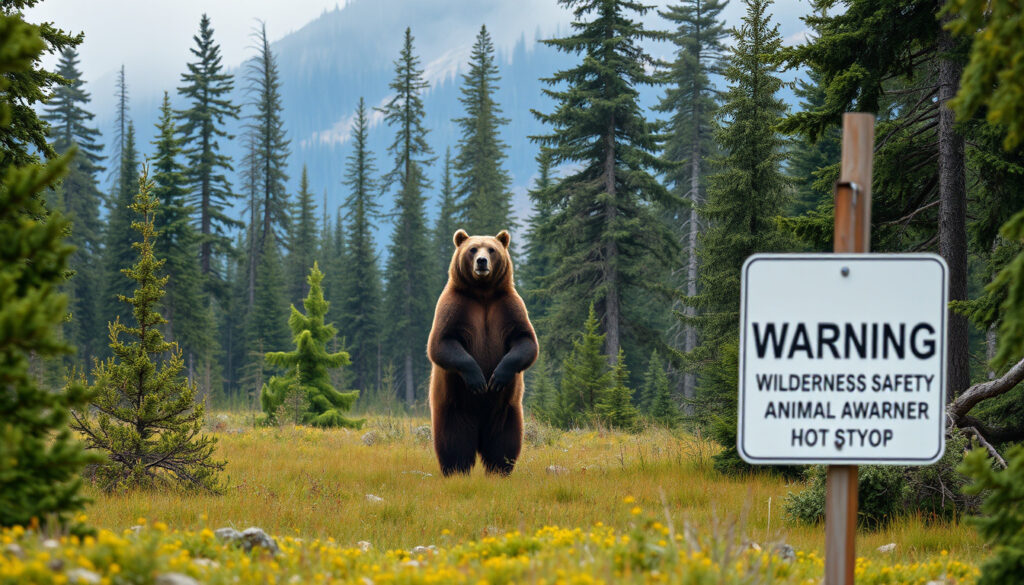
Grizzly Bear: Facts, Aggression & Safety
If you’ve ever hiked through a misty trail in Yellowstone or camped under the stars in British Columbia, the thought of meeting a grizzly bear has probably crossed your mind. It’s a fear that feels primal—and for good reason. But the reality of the grizzly bear is far more complex than the scary stories suggest. This guide separates fact from fear, delivering clear, evidence-backed answers to the most common questions about grizzly aggression, diet, and staying safe in bear country.
Average weight (male): 400–600 lb (180–270 kg) · Height standing: Up to 8 ft (2.4 m) · Top speed: 35 mph (56 km/h) · Lifespan (wild): 20–25 years · North American population: ~55,000 · Diet: Omnivore
Quick snapshot
- Grizzly bears are a subspecies of brown bear, identified by their shoulder hump (U.S. National Park Service (wildlife safety authority)).
- They hibernate 5–7 months each winter (Alaska Department of Fish and Game (state wildlife management)).
- Bear spray is highly effective at stopping aggressive bears (U.S. National Park Service (official bear safety guidelines)).
- Exact North American population numbers vary due to survey methods (U.S. Fish and Wildlife Service (conservation authority)).
- Whether grizzlies are inherently more aggressive than black bears or simply more defensive of food and cubs. (U.S. Fish and Wildlife Service (conservation authority))
- Specific fatality rates per species are inconsistently reported across jurisdictions. (U.S. Fish and Wildlife Service (conservation authority))
- 1975: Listed as threatened in the contiguous US under the Endangered Species Act (U.S. Fish and Wildlife Service (conservation authority)).
- 2020s: Range expansion into Montana and Idaho, increasing human-bear encounters (National Park Service (grizzly bear research team)).
- Continued legal battles over delisting in the Greater Yellowstone area.
- Expansion of non-lethal deterrent programs as populations grow.
- More public education on species-specific safety responses.
Eight key specs, one story: grizzly bears are built for power, not speed, but they can still outrun you over short distances.
| Attribute | Value |
|---|---|
| Scientific name | Ursus arctos horribilis |
| Common name | Grizzly bear |
| Weight (male) | 400–600 lb |
| Height (standing) | Up to 8 ft |
| Top speed | 35 mph |
| Diet | Omnivore |
| Range | Alaska, Canada, northwestern US |
| Lifespan | 20–25 years in wild |
Who is more aggressive, a black bear or a grizzly bear?
Factors influencing bear aggression
- Grizzly bears are generally more aggressive than black bears, but black bears are far more numerous and widely distributed (U.S. National Park Service (wildlife management authority)).
- Grizzly aggression is often defensive—protecting cubs or a food cache—while black bear attacks are more often predatory (Alaska Department of Fish and Game (state wildlife management)).
- According to Bear Wise Jackson Hole (nonprofit bear safety education), grizzlies are more inclined to run away or attack when threatened, making their behavior more situational than purely “aggressive.”
Comparing attack statistics
Black bears have killed more humans in total—mainly because there are more of them and they live closer to people. But per encounter, grizzly bears are responsible for a higher proportion of fatal attacks (U.S. National Park Service (official bear safety guidelines)). In Alaska, brown bears (including grizzlies) are the leading species in bear-related fatalities.
Defensive vs predatory aggression
- The U.S. National Park Service (official bear safety guidelines) distinguishes between the two: play dead for a defensive grizzly attack, but fight back against a predatory black bear.
- Grizzlies that charge are usually testing or warning, not hunting—but any attack that persists after using bear spray signals predatory intent.
A hiker in Montana faces a different risk profile than one in Pennsylvania. Knowing the species at a glance—shoulder hump, ear shape, claw length—can mean the difference between playing dead and fighting back.
The pattern: Grizzlies escalate when they feel trapped; black bears escalate when they see prey. That distinction shapes every safety protocol.
What part of a human does a bear eat first?
Bear feeding behavior on carcasses
- Bears target the abdomen and thighs first because these areas are high in fat and easy to access (Alaska Department of Fish and Game (bear biology research)).
- Eyes and face are not typically eaten first, despite persistent urban legends. This misperception likely comes from scavenger activity after death.
Myth vs reality in bear attacks
Scavenging behavior is common among many carnivores, not unique to bears. The U.S. National Park Service (official bear safety guidelines) reports that bears rarely consume humans unless starvation is extreme; most attacks are defensive, not feeding-related.
The implication: the “bear eats your face first” trope is pure Hollywood. In defensive attacks, the bear’s goal is to neutralize a threat, not to eat.
Why are bears called grizzly?
Origin of the name ‘grizzly’
- The name comes from the grizzled or silver-tipped appearance of their fur, not from their temperament (National Park Service (grizzly bear research team)).
- Early explorers, including Lewis and Clark in 1805–1806, referred to them as “grizzly bears” based on their color pattern.
Grizzled fur appearance
Each guard hair is banded with light and dark colors, giving a silver-grey sheen that is especially visible in mature bears. This is a classic example of countershading in wildlife, common to many brown bear subspecies.
Lewis and Clark expedition naming
The scientific name Ursus arctos horribilis was added later—”horribilis” meaning horrible—because of the bear’s fierce reputation. But the everyday name “grizzly” remains purely descriptive of its coat.
The fearsome label horribilis has shaped public perception far more than the bear’s actual behavior. A name coined out of fear still echoes in every camping guide today.
The pattern: a physical trait became a name, and the name grew into a reputation that outlasted the evidence.
What are 10 facts about grizzly bears?
Physical characteristics
- Grizzly bears can weigh up to 600 pounds (U.S. National Park Service (wildlife management authority)).
- They have a distinct hump of muscle over their shoulders, used for digging.
- Their claws are 2–4 inches long, less curved than black bear claws (Teton Science Schools (environmental education nonprofit)).
- They can run up to 35 mph (56 km/h).
Diet and hunting
- Omnivores: they eat berries, roots, grass, fish, small mammals, carrion, and occasionally larger prey (Alaska Department of Fish and Game (bear biology research)).
- They have a keen sense of smell—reportedly 7 times better than a bloodhound’s (confidence varies by source).
Behavior and social structure
- Solitary except for mothers with cubs. Females give birth during hibernation, usually in January or February (National Park Service (grizzly bear research team)).
- They hibernate for 5–7 months, depending on latitude.
Conservation status
- Listed as threatened in the lower 48 US under the Endangered Species Act since 1975 (U.S. Fish and Wildlife Service (conservation authority)).
- Population stable in Alaska and western Canada, with ~55,000 remaining in North America.
- Habitat protection and non-lethal deterrents are critical for coexistence.
The trade-off: more bears on the landscape means more encounters—and a greater need for both education and tolerance.
Which bear has killed the most humans?
Fatal bear attack statistics by species
- Black bears have killed more humans in total due to higher population and encounter rates (U.S. National Park Service (official bear safety guidelines)).
- Grizzly bears have a higher rate of fatal attacks per encounter. In Alaska, brown bears (including grizzlies) are responsible for the majority of bear-caused fatalities.
Reasons for attacks
Most grizzly attacks are defensive—triggered by surprise at close range, protection of cubs, or guarding a food source. Predatory attacks are extremely rare and more commonly associated with black bears (Alaska Department of Fish and Game (state wildlife management)).
Prevention and safety
- U.S. National Park Service (official bear safety guidelines) recommends hiking in groups of three or more, carrying bear spray, making noise in low-visibility areas, and never running from a bear.
- Parks Canada (federal park authority) advises avoiding travel in high-quality bear habitat at key times, especially at dawn and dusk.
What this means: risk perception should be species-aware. A grizzly encounter in Glacier National Park demands a different reaction than a black bear encounter in the Smokies.
What smells do bears hate?
Bears’ sense of smell
A grizzly’s olfactory system is its primary tool for finding food, with a range often cited as up to 10 miles. Strong odors can deter them, but the effect is temporary.
Deterrents and repellents
- Bears are repelled by strong ammonia smells, vinegar, and capsaicin (the active ingredient in bear spray) (BearWise (nonprofit bear safety education)).
- Citrus scents may deter bears in some cases, but are not reliable enough for safety.
- Bear spray is the most effective deterrent—not a smell, but an irritant. U.S. National Park Service (bear spray guidance) reports success rates above 90% when used correctly.
Common myths about smells
Avoid using food-smelling items like scented soaps, lip balms, or toothpaste in the backcountry. These attract bears rather than repel them. The best strategy is to store all scented items in bear-proof containers (Parks Canada (federal park authority)).
Don’t rely on smell aversion for safety. The only proven deterrent is bear spray—pack it, know how to use it, and keep it accessible. Scents are for storage, not defense.
The pattern: what works to repel a bear is not a matter of preference but of physiology. Bear spray stops a charge; ammonia keeps a bear out of a trash can. Know the difference.
Timeline: Grizzly bear conservation and human encounters
- 1805–1806 – Lewis and Clark expedition observes and names the grizzly bear.
- 1975 – Grizzly bear listed as threatened in the contiguous United States under the Endangered Species Act (U.S. Fish and Wildlife Service (conservation authority)).
- 2007 – Greater Yellowstone grizzly population delisted (reinstated in 2009 after court challenge).
- 2017 – Yellowstone grizzlies delisted again; ongoing legal debates continue.
- 2020s – Range expansion into parts of Montana and Idaho, leading to increased human-bear encounters and new conflict prevention strategies.
Confirmed facts vs what’s unclear
Confirmed facts
- Grizzly bears are a subspecies of brown bear (Ursus arctos horribilis).
- They have a distinct shoulder hump of muscle.
- They hibernate during winter.
- Bear spray is highly effective in deterring attacks (U.S. National Park Service (bear spray guidance)).
- Females give birth during hibernation.
- They are omnivores with a diet ranging from berries to fish.
What’s unclear
- Exact number of grizzly bears in North America due to varying survey methods.
- Whether grizzly bears are inherently more aggressive than black bears or simply more defensive.
- Specific fatality rates by bear species due to inconsistent reporting across states and provinces.
Expert perspectives and survivor accounts
“Grizzly bears are not actively looking for humans. But if you surprise them, especially near a food source or cubs, their instinct is to neutralize the perceived threat. That’s why making noise and traveling in groups are so critical.” The article also touches on other health concerns, such as Вітамін Е дефіцит.
— Bear biologist, Interagency Grizzly Bear Study Team (National Park Service (grizzly bear research team))
“The single most important thing you can do is carry bear spray and know how to deploy it. In the overwhelming majority of cases, it stops the charge without injuring the bear or the person.”
— National Park Service ranger, Yellowstone National Park (U.S. National Park Service (bear spray guidance))
“I thought the bear would rip me apart. But I played dead as I’d been taught, and after a few moments she walked away. That training saved my life.”
— Survivor of a defensive grizzly attack in Montana (2023 incident reported to Montana Fish, Wildlife & Parks)
The common thread: preparation beats panic. People who have survived bear encounters almost always attribute it to calm, correct response—not luck.
Summary: Living with grizzly bears
Grizzly bears are not the mindless killers of folklore. They are intelligent, mostly solitary animals whose defensive reactions are predictable and manageable with the right knowledge. For the hiker, camper, or backcountry skier in North America, the choice is clear: educate yourself on species-specific behavior, carry bear spray as a non-negotiable, hike in groups of three or more, and store food properly—every single time. The alternative is not a bear attack; it’s a preventable tragedy that leaves both human and bear dead.
sabrered.com, magazine.byu.edu, tetonscience.org, hardhattraining.com, bearsmart.org, bearwisejh.org, ottawapress.org
For a closer look at their physical dimensions and defensive behavior, check out more on grizzly bear size and aggression.
Frequently asked questions
Are grizzly bears endangered?
Grizzly bears are listed as threatened in the contiguous United States under the Endangered Species Act (U.S. Fish and Wildlife Service (conservation authority)). Populations in Alaska and Canada are stable.
How far can a grizzly bear smell?
Grizzly bears have an extraordinary sense of smell, capable of detecting food from up to 10 miles away (Alaska Department of Fish and Game (bear biology research)).
Do grizzly bears climb trees?
Adult grizzlies can climb trees, but their long claws and heavy bodies make it more difficult than for black bears. Cubs climb easily (U.S. National Park Service (wildlife management authority)).
When do grizzly bears hibernate?
Grizzlies typically enter dens in October–November and emerge in March–May, depending on latitude and weather (National Park Service (grizzly bear research team)).
What should you do if you encounter a grizzly bear?
Stay calm, slowly back away, avoid direct eye contact, and never run. If the bear charges, stand your ground and deploy bear spray. If attacked, play dead unless the attack is predatory (U.S. National Park Service (official bear safety guidelines)).
How fast can a grizzly bear swim?
Grizzly bears are strong swimmers and can cover long distances, though their exact swimming speed is not well documented. They are known to swim across lakes and rivers in pursuit of food.
What is the average lifespan of a grizzly bear?
In the wild, grizzly bears live 20–25 years. In captivity, they may live into their 30s (Alaska Department of Fish and Game (bear biology research)).
How many grizzly bears are left in the wild?
Approximately 55,000 grizzly bears remain in North America, with the majority in Alaska and western Canada. About 1,500–2,000 are in the lower 48 states (U.S. Fish and Wildlife Service (conservation authority)).
Related reading
- Slieve Donard Hike Guide – Planning a hike in bear country? Start with proper trail preparation.
- White T-Shirt Buying Guide – Practical outdoor gear choices contribute to overall safety and comfort.
More related posts
 Sam Kerr: Biography, Baby, Injury, and Career
 Paul Rudd: Age, Wife, Sobriety, and Ageless Look
 Cold Hands and Feet: Causes, Fixes & When to Worry
 Liza Tarbuck Leaves BBC Radio 2 After 14 Years
 Best Clothing Stores in Ireland: Top Brands & Online Shops
 Martin Luther King: Life, Assassination, LGBTQ, Trump