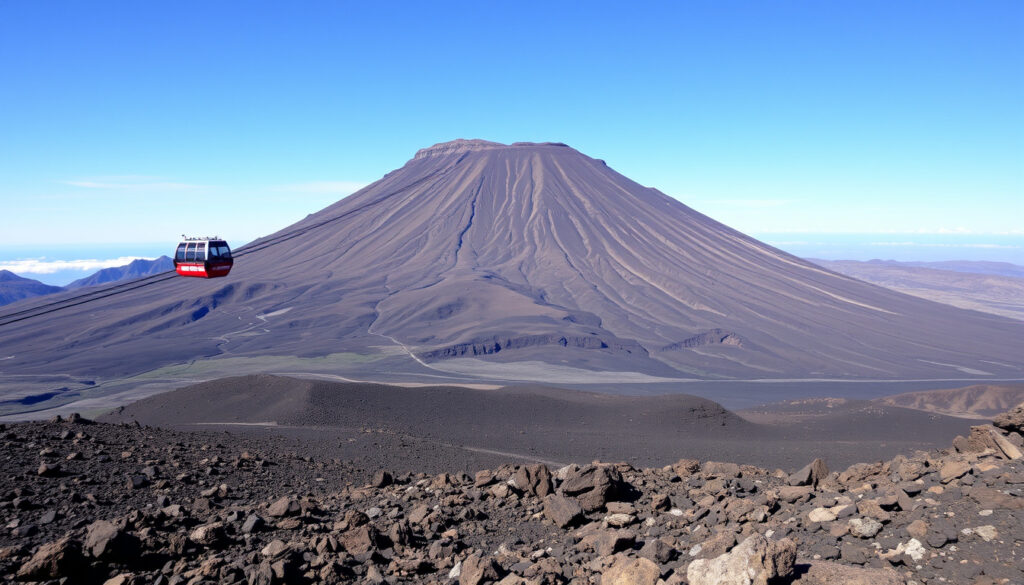
Mount Teide Guide: Cable Car Cost, Hiking Permits & Weather
From the resort beaches of Tenerife, Mount Teide looks like a postcard prop — a smooth volcanic cone that seems too calm to cause trouble. But the summit is a protected crater with a free permit system, the cable car runs on the weather’s schedule, and the top sits at 3,718 meters above the sea — Spain’s highest point, according to Volcano Teide’s official summit data — so plan it right and the peak is a day trip that delivers, plan it wrong and you’ll be watching clouds from the base.
Height: 3,718 m (12,198 ft) · Location: Tenerife, Canary Islands, Spain · Last eruption: 1909 · Cable car fare: €23.50 one-way / from €42 return · Highest point in Spain: Yes · Park status: UNESCO World Heritage
Quick snapshot
- The summit sits at 3,718 m (12,198 ft), the highest point in Spain (Volcano Teide (official price page)).
- A free permit is required for Trail 10, the route from the upper cable-car station to the summit crater (Volcano Teide (visitor planning guide)).
- The last major eruption was in 1909 (Volcano Teide (permit guidance)).
- Exactly when the next eruption could happen — monitoring is continuous, but precise prediction isn’t possible.
- How seasonal demand will affect permit availability in peak holiday weeks.
- How long-term volcanic activity could affect the cable car’s operations.
- 1909 — last major eruption, at the Chinyero vent (Volcano Teide (permit guidance)).
- 2007 — Teide National Park becomes a UNESCO World Heritage site (Volcano Teide (visitor planning guide)).
- 2026 — winter cable-car schedules run 09:00–17:00 (last ascent 16:00); from 28 March they extend to 18:40 (last ascent 17:40) (Volcano Teide (official price page)).
- Request the free summit permit well in advance — it’s separate from the cable-car ticket (Volcano Teide (permit guidance)).
- Confirm the day’s last ascent before booking: 16:00 in winter, 17:40 after 28 March 2026 (Volcano Teide (official price page)).
- Pick your final trail: Trail 10 to the crater, or Trails 11/12 to the viewpoints without a permit (Volcano Teide (visitor planning guide)).
Ten facts, one pattern: the park is free, the lift is not, and the summit requires a separate permit however you get there — with figures from Volcano Teide (official price page) and Volcano Teide (visitor planning guide).
| Fact | Value |
|---|---|
| Official name | Mount Teide (El Teide) |
| Location | Tenerife, Canary Islands, Spain |
| Elevation | 3,718 m (12,198 ft) — Volcano Teide (official price page) |
| Type | Stratovolcano |
| Last eruption | 1909 — Volcano Teide (permit guidance) |
| Protected area | Teide National Park, UNESCO World Heritage |
| Upper cable-car station | about 3,550 m — Wonderful Tenerife (local permit guide) |
| Summit access | Trail 10 (Telesforo Bravo) from La Rambleta; free permit required — Volcano Teide (visitor planning guide) |
| Cable car, non-resident adult | €23.50 one-way; from €42 return — Volcano Teide (official price page) |
| Cable car, resident adult | €5.88 one-way; from €10.50 return — Volcano Teide (official price page) |
Which Spanish island is Mount Teide on?
Mount Teide rises on the island of Tenerife, in Spain’s Canary Islands, and it holds a simple superlative: at 3,718 m it is the highest point in the country, which is why the national park carries UNESCO World Heritage status and the summit carries a permit requirement (Volcano Teide (official price page)).
That status shapes the visitor experience before you even arrive. The mountain is not a lone cone in an empty landscape — it sits inside the Las Cañadas caldera, a collapsed volcanic basin whose dark lava fields and rock walls are as much of the draw as the peak itself.
How tall is Mount Teide?
Summit: 3,718 m (12,198 ft) · Cable-car upper station: about 3,550 m · Height gap to the summit: roughly 170 m
The numbers explain the design of the visit: the cable car stops at La Rambleta, the upper station, and the only authorized route from there to the crater is Trail 10, Telesforo Bravo — a short, steep finale that sits behind the permit gate (Volcano Teide (visitor planning guide)). Most first-timers assume the lift reaches the top; it doesn’t, and that missing final segment is exactly what the park protects.
What is the geological significance of Mount Teide?
- Teide is an active stratovolcano, built by repeated eruptions rather than a single blast (Volcano Teide (permit guidance)).
- It sits inside the Las Cañadas caldera, formed by a prehistoric collapse (Volcano Teide (visitor planning guide)).
- The last major eruption was in 1909, at the Chinyero vent — recent enough that monitoring is treated as a live responsibility (Volcano Teide (permit guidance)).
Can you walk up Mount Teide?
Yes — but “walking up” means two different things, and the rules treat them differently. You can ride the cable car to about 3,550 m, or you can hike from the park’s base; either way, entering the summit crater, the uppermost stretch of Trail 10, requires the free park permit (Volcano Teide (visitor planning guide)).
Do you need a permit to hike Mount Teide?
The cable-car ticket and the summit permit are separate things. You need both to stand at 3,718 m — unless you stick to the viewpoint trails below the crater.
A cable-car ticket alone gets you to La Rambleta, not to the crater. The operator is blunt about it: buying the lift does not include the permit, and riding the lift without a permit is allowed only if you stay on the non-summit viewpoints from the upper station (Volcano Teide (permit guidance)).
The same permit applies if you hike the whole way from the base. It’s free, it’s issued online by the park, and the operator advises requesting it considerably in advance because daily numbers are limited (Volcano Teide (visitor planning guide)).
What are the best hiking trails to the summit?
- Montaña Blanca trail — the classic route from the park base; figure on about six hours to the upper-station area (Volcano Teide (visitor planning guide)).
- Trail 10 (Telesforo Bravo) — the final stretch from La Rambleta to the crater; permit required (Volcano Teide (visitor planning guide)).
- Trail 11 (La Fortaleza) and Trail 12 (Pico Viejo) — viewpoint walks from the upper station that need no summit permit (Volcano Teide (cable-car route guide)).
Most hikers combine two of these: climb from Montaña Blanca and ride the cable car down, or ride up and take Trail 10 for the final push. The choice is about time and fitness as much as money — a full climb from the base is a serious mountain day, not a morning stroll.
The classic compromise is the one-way ticket: hike up, then pay €23.50 for the descent ride instead of €42 for a return (Volcano Teide (official price page)).
How long does it take to climb Mount Teide?
Montaña Blanca route: about 6 hours up · Cable car ride: 8 minutes · Hiking time saved by the cable car: 3–4 hours
The cable car is the shortcut the park practically assumes you’ll take: an 8-minute ride replaces most of the ascent, leaving Trail 10 as a short finale. For hikers who skip the lift, the six-hour estimate for Montaña Blanca assumes good weather, decent fitness, and a permit already in the backpack.
What this means: the permit is the single planning step that separates a successful summit visit from a wasted morning. Book the pass first, then decide between the lift and the trail — the mountain cares about your permit, not your mode of transport.
How much does it cost to go up Mount Teide?
Entry to Teide National Park is free; the mountain charges you through options — the cable car, a guided tour, or transport to the base. The prices that matter are the official ones from the operator, and they’re the numbers to plan around (Volcano Teide (official price page)).
What is the cable car price?
- Non-resident adult: €23.50 one-way; from €42 return (Volcano Teide (official price page)).
- Non-resident child: from €21 return (Volcano Teide (official price page)).
- Resident adult (Canary Islands): €5.88 one-way; from €10.50 return (Volcano Teide (official price page)).
- Resident child: from €5.25 return (Volcano Teide (official price page)).
Yes, the resident discount is that steep. The fare difference reflects the park’s dual role: a tourist attraction for visitors, a public transport link for islanders. One-way tickets make sense if you plan to hike down, which is the usual way to see the landscape twice without paying for both directions.
One local guide quoted €27 for the one-way ride, a number that matches older price lists. The operator’s current official page lists €23.50 one-way and from €42 return, so treat the official page as the reference before you book (Volcano Teide (official price page)).
Are there any discounts or free options?
The discount is where the Canary Islands’ residents get their own mountain back: €10.50 return instead of €42 — about 75% less — children’s fares are half the adult rate, and the summit permit itself is free.
The “free” part of a Teide day is easy to miss: the park entry and the permit are free, but everything that moves you toward the summit has a price tag. For a hiker who skips the lift, the remaining costs are transport to the base, food, and a guide — which is exactly why the hiking option is dramatically cheaper, at the price of your time and legs.
The permit being free is the part that surprises people; the catch is scarcity rather than price. The operator says permits should be requested considerably in advance, and the daily limit is what makes last-minute plans fail (Volcano Teide (permit guidance)).
What do guided tours cost?
- Typical guided excursion: roughly €50–€100 per person, based on current island operator packages.
- Most packages include transport from the resort areas, a guide, and often the cable-car ticket.
- A guide does not bypass the permit — the park issues summit permits directly, and no tour operator can override that (Volcano Teide (permit guidance)).
The package math is rarely worthwhile for a single traveler — the cable car plus a guided ride is a full excursion-day cost. It earns its price when you don’t want to drive the mountain roads or read the weather yourself; the trade-off is flexibility.
Why it matters: the price structure quietly steers you toward a decision. At tourist fares the cable car is a splurge; at resident fares it’s pocket change; for hikers it’s avoidable entirely. The smart move is to decide which of those you are before the booking page opens.
How cold is it at the top of Teide?
The easy answer: much colder than the coast, with wind making it feel worse. The useful answer: the summit range runs from about 15°C in summer down to -10°C in winter, and most visitors arrive dressed for the beach rather than the crater.
What is the average temperature in summer?
Summer summit highs: up to 15°C · Winter summit lows: down to -10°C · Coast-to-summit difference: 10–15°C cooler
Even on a bright July day, the summit rarely feels warm. The 3,718 m altitude leaves the top 10–15°C cooler than the coast, and the thin air makes the sun feel harsher while the wind pulls heat away. The upper station’s exposed position means clear skies and cold air arrive together.
What is the temperature in winter?
Winter at the summit means -10°C lows, strong winds, and sudden changes that can close the cable car. The mountain looks different in December — that’s the draw and the risk.
The schedule is built around that risk: in the winter window (1 January to 27 March 2026), the last ascent is 16:00 and the last descent is 16:50, leaving a thin margin before the mountain cools down (Volcano Teide (official price page)). From 28 March 2026, the last ascent shifts to 17:40 and the last descent to 18:30.
Winter visitors double as weather spotters: a clear morning can collapse into cloud within an hour, and the operator can pause the ride with little notice. The reward is a snow-dusted crater for the hikers who planned for it.
What should you wear to the summit?
- Layers, because the summit is 10–15°C colder than the coast.
- A windproof shell, because strong winds and sudden temperature drops are common on the exposed caldera.
- Sturdy footwear, because Trail 10 and the viewpoint paths are volcanic terrain, not pavement.
- Sun protection, because clear-day UV at altitude is deceptive — you can burn while you’re cold.
The combination is what catches people: cold air, bright sun, and wind. Dressing for all three turns the upper station into a viewpoint instead of a wind tunnel, and it makes Trail 10 a short adventure instead of a shivering trudge.
The takeaway: temperature is rarely the real problem at the top of Teide — cold plus wind plus altitude is. Treat the sky as part of your equipment list, and check it the night before.
Is a Teide cable car worth it?
At €42 return for a non-resident adult, the cable car is a serious line in the holiday budget, and the fair answer is: it depends on what you came for. The lift buys altitude and views, not the summit — that distinction drives the decision.
What are the pros and cons of taking the cable car?
The pros are access and time: an 8-minute ride puts you at about 3,550 m, with the caldera views and the upper-station viewpoint trails waiting at the top. The cons are money, weather, and the missing summit — €42 return does not include the final 170 m to the crater, and the operator can pause the ride on short notice.
What do you actually get on the cable car?
Ride time: 8 minutes · Top altitude: about 3,550 m · Summit still above: roughly 170 m · Viewpoint trails without a permit: 2 (La Fortaleza, Pico Viejo)
The ride delivers the caldera panorama in eight minutes and drops you at the door of the park’s best short walks: Trail 11 to La Fortaleza and Trail 12 toward Pico Viejo, both reachable without a summit permit (Volcano Teide (cable-car route guide)). What it does not deliver is the peak itself — the final 170 m up Trail 10 stays behind the permit gate (Volcano Teide (permit guidance)).
How does the cable car compare to hiking?
The cable car buys you an 8-minute ride to 3,550 m, not the summit. The hike buys you the summit, but the price is six hours, a weather window, and a permit that can be gone by Monday.
If time is short, the cable car is the rational choice: €42 beats losing a full day to an uncertain ascent. If the summit itself is the goal, the classic compromise is hiking up from Montaña Blanca and riding down — €23.50 for the descent instead of €42 for the return (Volcano Teide (official price page)).
Here’s the pattern worth seeing: the cable car’s value tracks the weather forecast. Clear skies make it worth every euro; a cloudy day turns it into an expensive way to see mist. The hike, by contrast, pays out in the summit itself — if the weather cooperates, which is a bigger “if” in winter.
The honest upsides and downsides of a Teide visit
Before you decide between the lift and the trail, here’s the short version of the trade-offs — drawn from official prices, the permit rules, and the weather’s habit of rewriting plans.
Upsides
- The 8-minute ride puts non-hikers at about 3,550 m — the caldera view is extraordinary without a fitness test.
- Trails 11 and 12 from the upper station are open with a cable-car ticket, no summit permit needed (Volcano Teide (cable-car route guide)).
- Resident fares keep the mountain accessible to locals: €10.50 return for Canary Islands residents (Volcano Teide (official price page)).
- The national park entry is free — the landscape itself costs nothing.
Downsides
- Non-resident adult fares add up: €23.50 one-way and from €42 return (Volcano Teide (official price page)).
- The ticket does not include the summit permit — you can ride the lift and still not reach the crater (Volcano Teide (permit guidance)).
- In winter the last ascent is 16:00, so late birds miss the view (Volcano Teide (official price page)).
- Weather cancellations are possible, and the operator can pause the service with little notice.
What the balance shows: the downsides are mostly money and weather; the upsides are access. The cable car is the only way most visitors will ever see the inside of the caldera, and it does that job well — the frustration comes when the summit is the goal and the lift is treated as the whole journey.
How to plan a Mount Teide visit, step by step
The order of operations matters more than any single booking. Follow this sequence and you’ll avoid the classic mistake — arriving at the cable car with a ticket but no summit permit.
- Request the summit permit first. It’s free, it’s online, and the operator says to request it considerably in advance because daily numbers are limited (Volcano Teide (visitor planning guide)).
- Buy the cable-car ticket separately. A ticket and a permit are two different things; you need both for the crater (Volcano Teide (permit guidance)).
- Match your plan to the schedule. Winter last ascent: 16:00. From 28 March 2026: 17:40, with the last descent at 18:30 (Volcano Teide (official price page)).
- Choose your final trail. Trail 10 to the crater (permit required) or Trails 11/12 to the viewpoints (no permit) (Volcano Teide (cable-car route guide)).
- Pack for the 10–15°C gap. The summit runs colder than the coast, with wind on top of that.
- Set a weather fallback. If the cable car closes, the caldera’s lower viewpoints and trails still deliver the landscape.
The pattern in the steps: the permit is the gate, the ticket is the cost, the schedule is the constraint, and the weather is the unknown. Control the first three early, and the fourth becomes the only risk left.
What’s confirmed about Teide and what’s still unclear
Confirmed facts
- Teide is an active stratovolcano; the last major eruption was in 1909 (Volcano Teide (permit guidance)).
- The summit at 3,718 m is the highest point in Spain (Volcano Teide (official price page)).
- A free park permit is required for Trail 10 to the summit crater (Volcano Teide (visitor planning guide)).
- The cable-car ticket does not include the permit (Volcano Teide (permit guidance)).
- Non-resident adult fares are €23.50 one-way and from €42 return (Volcano Teide (official price page)).
- The upper station opens La Fortaleza and Pico Viejo viewpoint trails without a summit permit (Volcano Teide (cable-car route guide)).
What’s still unclear
- Exactly when the next eruption could happen — monitoring is continuous, but precise prediction isn’t possible.
- How seasonal demand will affect permit availability during peak holiday weeks.
- How long-term volcanic activity could affect the cable car’s operations and the park’s infrastructure.
- Whether the cable car will run on any given day — wind and visibility dictate the schedule.
- How far ahead permits run out during the 2026 season — the operator says to book considerably in advance, which is a hint, not a calendar.
- The upper station’s precise elevation: official operator materials cite 3,555 m, while some local guides round it to about 3,550 m.
Notice the asymmetry: the confirmed list is long on rules and prices, the unclear list is long on timing. That’s the honest state of planning a Teide trip — the access system is transparent, and the mountain’s decisions are not.
What guides and travelers say about Teide
Teide is a stratovolcano capped by a large caldera — that combination is what makes the landscape so dramatic, and it’s why the summit access is managed so carefully.
— Volcanologist, Oregon State University
The cable car runs daily from 9 am and costs 27 euros.
— Local guide, Active Traveller (Tenerife)
The drive up is breathtaking, but the cafe at the top is overpriced.
— TripAdvisor reviewer
One contrast stands out. The volcanologist frames Teide as an active system under management; the local guide’s €27 matches an older price list, while the official page now shows €23.50 one-way and from €42 return (Volcano Teide (official price page)); and the traveler’s complaint is the classic “the view was free, everything around it wasn’t.” The consensus: the mountain earns the trip — the planning is the price of entry.
The verdict for your trip
Teide rewards planning and punishes assumptions. The summit permit is free but limited; the cable car is efficient but weather-dependent; and the final 170 m from the upper station to the crater is where most plans fail, because the ticket alone doesn’t get you there. For a first-time visitor to Tenerife, the decision is clear: request the free permit early, treat the cable car as a morning decision rather than a fixed plan, and build a weather fallback into the day — or accept that Spain’s highest point may stay behind a cloud cap while you watch it from the base.
volcanoteide.com, volcanoteide.com, volcanoteide.com, volcanoteide.com, volcanoteide.com
Frequently asked questions
What was filmed at Mount Teide?
Several international productions have used Teide’s volcanic scenery as a stand-in for other worlds — the lava fields and caldera need little help to look alien. As with hiking, filming near the summit zone requires official permission, which is one more reason the park keeps its trails and permits under control.
Why is Tenerife on a warning list?
Tenerife appears on volcanic-risk maps because it hosts an active stratovolcano: Teide, whose last major eruption was in 1909 (Volcano Teide (permit guidance)). Monitoring is continuous, and the island’s alert level is green, which means no imminent eruption is expected. The warning list is about preparedness, not a forecast of activity.
Are there mosquitoes in Tenerife?
Mosquitoes are not a real issue at Teide — altitude, wind, and cool summit temperatures make the upper mountain inhospitable to them. On the coast, a few appear around dusk in humid spots, so standard repellent is reasonable; at the cable-car station, the bigger concerns are sun, wind, and cold.
Where is the nicest part of Tenerife to stay?
It depends on what you’re optimizing for. If Teide is the point of the trip, staying closer to the park’s side of the island shortens the mountain drive and makes an early cable-car slot easier. If beach time matters more, the southern resorts are the reliable choice and you budget a longer excursion day for the mountain. The ‘nicest’ part is whichever one keeps your Teide day relaxed.
What is the best month to go to Tenerife?
For the summit, late spring and early autumn offer the best balance of stable skies and milder temperatures at the top (up to 15°C in summer). Winter delivers clear air and occasional snow-dusted slopes, but temperatures can drop to -10°C and cable-car cancellations are more likely. The coast stays pleasant year-round, so the best month depends on whether the mountain or the beach leads the itinerary.
Can you see lava at Mount Teide?
Not flowing lava — the volcano last erupted in 1909 and the alert level is green. What you can see is a landscape built by lava: dark basalt slopes, pumice fields, and the enormous walls of the Las Cañadas caldera. The volcano is a museum of past eruptions, not a live show.
What would happen if the Tenerife volcano erupted?
The park’s monitoring system is designed to give early warning; the alert level would move from green well before any surface activity. In a worst-case eruption, the main risks near the summit would be ash fall and volcanic gas, plus cable-car closures and road access limits. The 1909 eruption was the last major event, and today’s monitoring network would provide much more warning than was possible then.
Visitors who answer these before booking will avoid the two most common failure modes: no permit and a washed-out weather window.
Related reading
These guides from Britain Daily use the same question-driven, cost-and-safety structure for their own destinations:
- Mount Everest: Location, Cost, Deaths — another towering destination where permits, costs, and weather decide the experience.
- Bearded Dragon Care: Cost, Bites, Bonding & Safety Questions — the same practical structure, applied to pet ownership.
Readers who want the same cost-and-safety breakdown on another high-altitude trip should start with the Mount Everest guide.
More related posts
 September 5 (film) True Story: Accuracy, Cast & Reviews
 James Bulger: Verified Facts, Latest Updates & Official Sources
 Jacob Murphy: Twin Brother Josh, Newcastle Salary & Transfer Fee
 Jon Bon Jovi: Biography, Health, Wife, Faith, and More
 Dan Ballard: Career, Stats, Brother, Height & Red Card
 Gustavo Hamer: €7m fee vs €14m market value gap explained
 Cast of Chicago Med: Actors, Characters & Real-Life Facts
 Regé-Jean Page: Why He Left Bridgerton and What’ Next