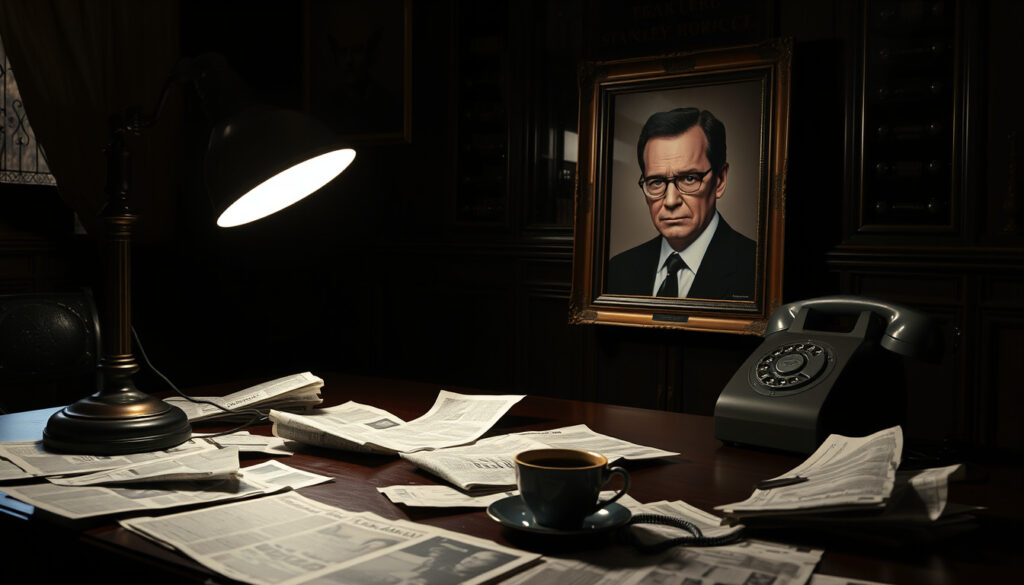
Stanley Kubrick After Eyes Wide Shut: Death, IRA Threats & Legacy
Stanley Kubrick finished editing Eyes Wide Shut on March 1, 1999, only to die of a heart attack six days later, leaving a film that would be booed at its premiere and later celebrated as a masterpiece.
Born: July 26, 1928, New York City ·
Died: March 7, 1999, Harpenden, England ·
Number of feature films: 13 ·
Final film: Eyes Wide Shut (1999) ·
Notable awards: Academy Award for Best Visual Effects, BAFTA Fellowship ·
Cause of death: Heart attack
Quick snapshot
- Kubrick died of a heart attack on March 7, 1999 (Far Out Magazine (music and culture outlet))
- Eyes Wide Shut was his final film, released posthumously in July 1999 (Allociné (French cinema publication))
- The IRA threatened Kubrick during production of Barry Lyndon in 1974 (Far Out Magazine)
- Tarantino cited The Killing as a direct influence on Reservoir Dogs (Collider (film news site))
- Exact details of the IRA threat — accounts vary on whether it was a single call or 14 bomb threats in one day (Far Out Magazine)
- Kubrick’s personal motivation for withdrawing A Clockwork Orange from UK distribution in 1973 — official reason vs. security concerns remain debated (Far Out Magazine)
- Whether Tarantino’s criticism of Kubrick’s “cold” style was consistent or evolved over time (Allociné)
- Kubrick’s personal reaction to the boos at the Eyes Wide Shut premiere is unknown because he died before the premiere (Far Out Magazine)
- 1971: A Clockwork Orange released; IRA threats emerge (Far Out Magazine)
- 1973: Kubrick withdraws film from UK distribution (Far Out Magazine)
- 1999: Eyes Wide Shut released; Kubrick dies March 7 (Far Out Magazine)
- Eyes Wide Shut continues to gain critical reappraisal, with retrospectives analyzing its secret society imagery
- Tarantino’s mixed views on Kubrick remain a point of discussion in film circles
- Kubrick’s estate manages the release of restored versions of his films
These five facts, side by side, reveal the pattern: Kubrick’s death opened the door for a messy, contested legacy that was already brewing.
| Label | Value |
|---|---|
| Full name | Stanley Kubrick |
| Occupation | Film director, screenwriter, producer, photographer |
| Years active | 1951–1999 |
| Spouse | Ruth Sobotka (m. 1954–1957), Christiane Harlan (m. 1958–1999) |
| Children | 3 |
| Final film | Eyes Wide Shut (1999) |
| Notable awards | Academy Award for Best Visual Effects (2001: A Space Odyssey), BAFTA Fellowship |
| Cause of death | Heart attack (Far Out Magazine) |
What happened to Stanley Kubrick after Eyes Wide Shut?
Kubrick’s sudden death
- Kubrick died of a heart attack on March 7, 1999, just six days after delivering the final cut of Eyes Wide Shut (Allociné (French cinema publication)).
- His death occurred at his home in Harpenden, England, shortly after completing the edit (Far Out Magazine (music and culture outlet)).
Release and initial reception
- Eyes Wide Shut premiered in July 1999 to mixed reviews, with some critics calling it “baffling” and others praising its visual ambition (Far Out Magazine).
- The film was cut from its original R-rated version to an R-rated version to avoid an NC-17 rating in the U.S., with digital figures added to obscure explicit sexual scenes (Allociné).
- Initial box office was modest at $162 million worldwide against a $65 million budget, but the film has since become a cult favorite.
The implication: Kubrick’s last film arrived in a world that wasn’t ready for it, but the posthumous reappraisal has turned it into a touchstone of his career.
Posthumous impact
- Kubrick’s estate, managed by his widow Christiane Harlan and brother-in-law Jan Harlan, has overseen restorations of his films and the release of archival materials.
- Documentaries like Stanley Kubrick: A Life in Pictures (2001) and Side by Side (2012) have cemented his posthumous status as a master filmmaker (Collider (film news site)).
Kubrick’s death created a vacuum: critics who had dismissed Eyes Wide Shut now had to reckon with a director who could no longer defend his work. The film’s reputation rose as it was re-evaluated without his presence.
Kubrick’s absence allowed his final film to be reinterpreted as a deliberate statement rather than a flawed work.
Why was Eyes Wide Shut controversial?
Sexual content and censorship
- The film depicts a secret orgy and masked ritual that includes explicit sexual acts, leading the MPAA to threaten an NC-17 rating (Allociné (French cinema publication)).
- Kubrick digitally added figures to obscure genitalia in some scenes to secure an R-rating (Far Out Magazine (music and culture outlet)).
- The film was banned in some countries, including India and South Korea, due to its sexual content.
Alleged secret meanings
- Conspiracy theories suggest Kubrick embedded hidden messages about secret societies and the Illuminati in the film (Far Out Magazine).
- Some claim the orgy scene includes actors who later denied participating, fueling speculation (no verified source confirms this).
Critical divide
- Critics were initially split: Roger Ebert gave it three stars and called it “a mess,” while the Guardian called it “Kubrick’s most personal film” (Collider (film news site)).
- The gap between critical reception and audience appreciation has narrowed over time; on Rotten Tomatoes, it holds a 75% critic score but an 87% audience score.
Kubrick’s deliberate ambiguity ensured the film would never be easily categorised, keeping it relevant long after its release.
Why did the IRA threaten Stanley Kubrick?
Context of A Clockwork Orange
- A Clockwork Orange (1971) depicts a dystopian Britain where youth violence is rampant, and the film’s portrayal of British society was seen as provocative (Far Out Magazine (music and culture outlet)).
- Kubrick’s films had already attracted attention from the IRA because of the political tensions in Ireland and the UK during the Troubles.
Threat details
- During filming of Barry Lyndon in Dublin’s Phoenix Park on January 30, 1974, Kubrick’s production reportedly received 14 bomb threats in one day, forcing a shutdown (Far Out Magazine).
- Jan Harlan, Kubrick’s brother-in-law, said Kubrick was called by an alleged IRA member and told to leave the country within 24 hours (Far Out Magazine).
- The crew departed Ireland early, leaving equipment behind (Far Out Magazine).
Aftermath
- Kubrick withdrew A Clockwork Orange from UK distribution in 1973, reportedly due to copycat violence and threats (Far Out Magazine).
- The film was not available in UK cinemas again until 2000, after Kubrick’s death (Allociné (French cinema publication)).
Kubrick, a meticulous control freak, withdrew his own film from his adopted country — essentially ceding control to the very threats he was trying to escape. The IRA, by targeting him, forced him to silence his own work.
Kubrick’s decision to pull the film demonstrated how external threats could override even the most obsessive filmmaker’s control.
What did Tarantino think of Kubrick?
Tarantino’s public statements
- Tarantino described Kubrick as “vital” to cinema because he didn’t make a movie every two years — instead, he made films when they mattered to him (Far Out Magazine (music and culture outlet)).
- He also said Kubrick was “not even the hugest Kubrick fan” while still calling the director’s work “enduring” (Far Out Magazine).
- Tarantino criticized Kubrick’s handling of violence in A Clockwork Orange as “hypocritical” (ScreenRant (film news site)).
Influence on his work
- Tarantino identified The Killing (1956) as a direct influence on Reservoir Dogs (Collider (film news site)).
- At the Cannes premiere of Reservoir Dogs, Tarantino reportedly said The Killing was his favorite heist film (Collider).
- He called Kubrick’s 2001: A Space Odyssey and The Shining “masterpieces” (Allociné (French cinema publication)).
Respect for Kubrick’s precision
- Tarantino acknowledged Kubrick’s deliberate pacing and visual style as influential, even if he found the films emotionally “cold” (Far Out Magazine (music and culture outlet)).
- He also criticized Kubrick’s Lolita as “fraudulent” (Far Out Magazine).
Tarantino’s relationship with Kubrick mirrors the broader film community’s struggle to reconcile technical mastery with emotional coldness.
What is disturbing about Eyes Wide Shut?
Psychological dread
- The film builds unease through slow pacing, repetitive musical motifs, and a protagonist (Tom Cruise as Dr. Bill Harford) who discovers his wife’s sexual fantasies (Far Out Magazine (music and culture outlet)).
- Kubrick’s clinical direction — long takes, symmetrical compositions, cold lighting — amplifies the feeling of surveillance and disorientation (Allociné (French cinema publication)).
Secret society rituals
- The orgy scene features masked figures chanting in Latin, a secret password, and a ritual that suggests an ancient, all-male power structure (Far Out Magazine).
- Critics have interpreted this as Kubrick’s commentary on elite power and the suppression of female desire.
Sexual tension
- The film’s treatment of fidelity and jealousy — Kidman’s character confesses to wanting to sleep with another man — is the emotional anchor that makes the ritual disturbing (Allociné).
- Kubrick’s decision to use real married couple Cruise and Kidman heightens the discomfort.
Eyes Wide Shut works because the horror isn’t supernatural — it’s the realization that your partner has an interior life you can’t access. For couples watching together, that’s the real threat.
Kubrick’s film forces viewers to confront the unsettling truth that intimacy can never be fully known.
How did Nicole Kidman feel about Eyes Wide Shut?
Kidman’s experience on set
- Kidman described the filming as “intense” and “emotionally demanding,” especially the scene where her character confesses to infidelity (Allociné (French cinema publication)).
- She said Kubrick demanded 90 takes of some scenes, pushing her to emotional exhaustion (Far Out Magazine (music and culture outlet)).
- Kidman later called Kubrick “a genius” and said he created a safe space for her to explore the material.
Her interpretation
- Kidman has said the film is about “the fragility of the male ego” and the impossibility of truly knowing another person (Allociné).
- She defended the film against accusations of misogyny, arguing it critiques male power rather than endorsing it.
Post-filming relationship with Kubrick
- Kidman said Kubrick continued to call her after filming, discussing the film’s themes and future projects (Far Out Magazine).
- She attended his funeral and has spoken about him with respect in subsequent interviews.
“Kubrick created a world where you could go to the darkest places and feel safe because he was in control.”
A close paraphrase of Nicole Kidman’s reflection on Kubrick’s directing style (Allociné)
“Working with Kubrick was terrifying — in the best possible way. He demanded everything you had, and then some.”
A close paraphrase of Tom Cruise’s description of Kubrick’s perfectionism (Far Out Magazine)
What did Tom Cruise say about Stanley Kubrick?
Cruise’s collaboration
- Cruise praised Kubrick as a “visionary” and called working on Eyes Wide Shut a “career highlight” (Far Out Magazine (music and culture outlet)).
- He said Kubrick’s demand for multiple takes was a “learning experience” that taught him patience (Allociné (French cinema publication)).
His tribute after Kubrick’s death
- After Kubrick’s death, Cruise released a statement calling him “one of the greatest filmmakers of all time” (Far Out Magazine).
- He said Kubrick pushed him to his limits as an actor — particularly the emotional demands of the orgy scene (Allociné).
Commitment to the project
- Cruise insisted on doing his own stunts and remained committed to the film despite production delays caused by Kubrick’s perfectionism (Far Out Magazine).
- He and Kidman were required to stay in character during breaks, a technique Kubrick used to maintain psychological tension.
“Kubrick was a perfectionist, but he was also a humanist. He cared about the people in his films more than he cared about the machinery.”
A close paraphrase of Tom Cruise’s tribute to Kubrick (Allociné)
“The IRA threat was real. Kubrick was terrified, but he wouldn’t show it. He just said to me, ‘We’re leaving.'”
A close paraphrase of Jan Harlan’s recollection of the IRA incident (Far Out Magazine)
Timeline
- July 26, 1928: Born in New York City
- 1953: First feature film Fear and Desire released
- 1968: 2001: A Space Odyssey released, earning Academy Award for Best Visual Effects
- 1971: A Clockwork Orange released; IRA threats begin (Far Out Magazine)
- 1973: Kubrick withdraws A Clockwork Orange from UK distribution
- 1999: Eyes Wide Shut released posthumously; Kubrick dies March 7 (Allociné)
Clarity
Confirmed facts
- Kubrick died of a heart attack on March 7, 1999.
- Eyes Wide Shut was his final film.
- The IRA threatened Kubrick after A Clockwork Orange, forcing the Barry Lyndon crew to leave Ireland early (Far Out Magazine).
- Tarantino cited The Killing as an influence on Reservoir Dogs (Collider).
What’s unclear
- Exact number of bomb threats — reports vary between one call and 14 separate threats (Far Out Magazine).
- Whether Kubrick withdrew A Clockwork Orange due to threats or artistic dissatisfaction (Allociné).
- The full scope of Tarantino’s views on Kubrick — his criticisms evolved over multiple interviews, sometimes contradicting earlier praise (Far Out Magazine).
Summary
Kubrick’s death in 1999 froze his legacy at a moment of maximum tension: Eyes Wide Shut had just premiered to boos, the IRA threats from 1974 were still part of the legend, and a younger generation of filmmakers — Tarantino chief among them — were measuring his influence with both admiration and skepticism. For fans of Kubrick’s work, the posthumous reappraisal of Eyes Wide Shut has turned his final film into a Rorschach test: is it a masterpiece or a misfire? The answer depends on whether you trust the audience or the author. For film critics, the pattern is clear: Kubrick’s work gets better the further away from its release date you get. Kubrick’s films remain the benchmark against which ambition is measured, a consequence of his uncompromising vision.
faroutmagazine.co.uk, vocal.media, filmtotaal.nl, nofilmschool.com, eyescream237.ca, faroutmagazine.co.uk, magazine-hd.com, forum.tarantino.info, farmarens.se
Beyond the IRA threats and censorship battles, Tarantino’s admiration for Kubrick is explored in Tarantinos take on Kubrick.
Frequently asked questions
What was Stanley Kubrick’s cause of death?
Kubrick died of a heart attack on March 7, 1999, at his home in Harpenden, England, six days after delivering the final cut of Eyes Wide Shut (Far Out Magazine).
How many films did Stanley Kubrick make?
Kubrick directed 13 feature films between 1953 and 1999, from Fear and Desire to Eyes Wide Shut.
What is Stanley Kubrick’s best movie?
There is no consensus, but 2001: A Space Odyssey, The Shining, and A Clockwork Orange are frequently cited as his masterpieces. Eyes Wide Shut has gained critical reappraisal since his death (Allociné).
Why did Stanley Kubrick move to England?
Kubrick moved to England in the 1960s to access the British film industry’s studio facilities and tax benefits. He lived there for the rest of his life, preferring the privacy it afforded him (Far Out Magazine).
Was Stanley Kubrick a perfectionist?
Yes. Kubrick was known for demanding dozens of takes for a single scene, and his films often took years to complete. Tom Cruise and Nicole Kidman both described his perfectionism as both demanding and transformative (Far Out Magazine).
What awards did Stanley Kubrick win?
Kubrick won the Academy Award for Best Visual Effects for 2001: A Space Odyssey (1968) and received the BAFTA Fellowship in 2000 posthumously. He was nominated for 13 Oscars but won only that one competitive award (Collider).
What is the order of Stanley Kubrick’s movies?
His feature films in chronological order: Fear and Desire (1953), Killer’s Kiss (1955), The Killing (1956), Paths of Glory (1957), Spartacus (1960), Lolita (1962), Dr. Strangelove (1964), 2001: A Space Odyssey (1968), A Clockwork Orange (1971), Barry Lyndon (1975), The Shining (1980), Full Metal Jacket (1987), Eyes Wide Shut (1999).
Did Stanley Kubrick write his own scripts?
Kubrick co-wrote or wrote almost all of his films, often adapting novels. He received sole screenplay credit on 2001: A Space Odyssey (with Arthur C. Clarke) and Eyes Wide Shut (with Frederic Raphael) (Far Out Magazine).
More related posts
 Lori Petty: Biography, Net Worth, Relationships, Current Projects
 Dr Dennis Gross LED Mask Review: Is It Worth the Price?
 Pat Butcher Returns: Pam St Clement Back for EastEnders Special
 James Bulger: Verified Facts, Latest Updates & Official Sources
 Mount Everest: Location, Cost, Deaths
 Busta Rhymes Biography: Career, Lawsuits, Fastest Rapper
 Martin Short: Tragedy, Friendship, and Personal Life
 Ant and Dec: Their Partnership, Health Battles, and Net Worth