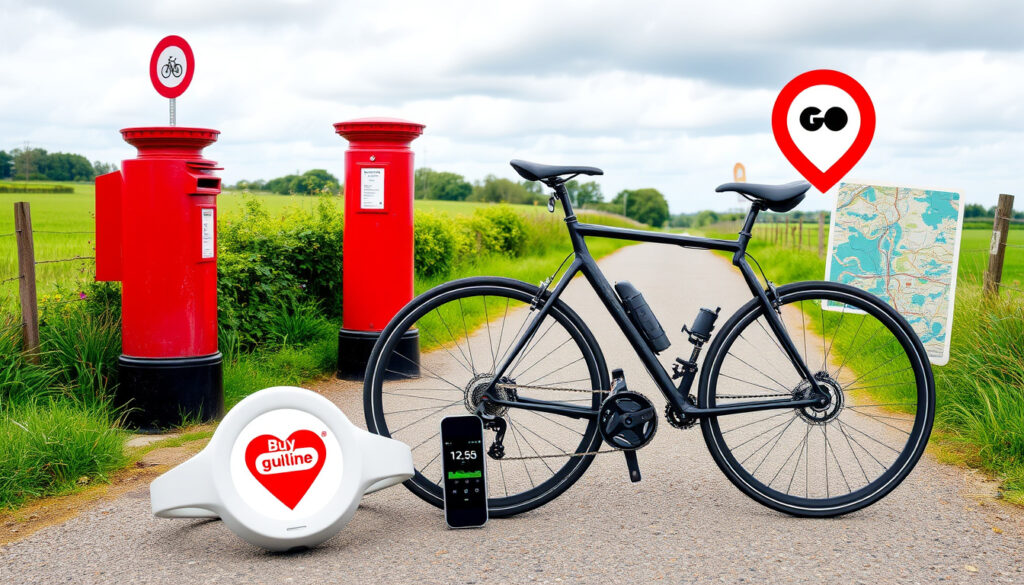
Road Bike Guide: Buying, UK Rules, and Fitness Facts
Few purchases blur the line between hobby, commute, and workout quite like a road bike – one day you’re comparing frame materials, the next you’re checking whether 20 minutes a day counts and whether the law lets you ride on the pavement. This guide treats the buying decision, the Highway Code, and the exercise science as one connected question — because in practice, they are.
WHO weekly aerobic target: 150–300 minutes of moderate-intensity activity · 20 minutes a day: 140 minutes a week — just under WHO target · 20 km: ≈ 12.4 miles · 10,000 steps: roughly 5 miles (8 km) · UK Highway Code Rule 64: no pavement cycling · UK night-riding equipment: front and rear lights plus a rear reflector
Quick snapshot
- Road bikes are built for paved roads, speed, and endurance, pairing a lightweight frame with narrow tyres — Cycling UK.
- Transport for London (city transport authority) advises riders not to cycle on pavements or against one-way streets.
- The World Health Organization (UN health agency) recommends 150–300 minutes of moderate-intensity aerobic activity per week for adults.
- Exact calorie burn on a road bike depends on body weight, speed, terrain, and wind.
- There is no universal conversion between 10,000 steps and cycling.
- Whether 20 minutes a day is “enough” depends on individual health goals and intensity.
- WHO adult target: 150–300 minutes of moderate-intensity activity per week — World Health Organization.
- 20 minutes a day = 140 minutes a week — just under the WHO target (computed from WHO guidelines). (World Health Organization)
- 20 km a day ≈ 12.4 miles. (World Health Organization)
- 10,000 steps ≈ roughly 5 miles (8 km). (World Health Organization)
- Get sized by inseam and reach before comparing carbon frames.
- Budget for legal night kit — front light, rear light, rear reflector.
- Plan routes around cycle lanes and quiet roads where practical.
Six numbers do most of the work in this guide, and they split into two types: legal fixed points from the UK Highway Code, and flexible fitness targets from the WHO’s physical activity guidance.
| Label | Value |
|---|---|
| Highway Code Rule 64 | Prohibits cycling on a pavement in the UK |
| UK night cycling | Front and rear lights plus rear reflector required |
| WHO aerobic target | 150–300 minutes of moderate-intensity activity per week |
| 20 minutes a day | 140 minutes per week — just under the WHO target |
| 20 km a day | ≈12.4 miles a day |
| 10,000 steps | roughly 5 miles (8 km) |
What’s a good road bicycle?
A road bike is built for one job: moving quickly and efficiently on paved roads. It usually pairs a lightweight frame with narrow tyres, drop handlebars, and a riding position that puts speed ahead of upright comfort. Cycling UK (national cycling charity) describes road bikes as designs for speed and endurance, and its guide makes the first buying rule simple: choose the bike type by how you will actually use it.
What are some bike brands that start with the letter “M”?
- Marin — an established name in road and gravel bikes.
- Merida — a major manufacturer whose road bikes appear across UK retail.
- Both show up regularly in UK road bike searches at competitive price points.
The brand matters less than the fit. Marin and Merida both make credible entry-to-mid level road bikes, but the frame size and geometry decide whether you keep riding or keep adjusting.
When should you choose a carbon road bike?
- Entry-level road bikes are usually aluminium — lighter on the wallet, a little heavier on the frame.
- Carbon frames are lighter and damp vibration better, but the price rises quickly.
- Choose carbon when weight and long-distance comfort matter more than budget.
Trek Bikes positions its UK road range across both materials, with carbon reserved for its lighter performance models — a practical signal that carbon is a performance upgrade, not a beginner requirement.
How can you finance or discount a road bike?
- Previous season models carry the biggest discounts.
- Retailer finance spreads the cost, but compare the APR, not just the monthly payment.
- Add the non-negotiables — helmet, lights, lock — into the same budget.
A discounted frame is only a bargain if the size is right. The cheapest bike on the page becomes expensive if it does not fit, because discomfort and poor handling will make you upgrade again within a season.
Fit beats carbon at every realistic beginner budget. A well-fitted aluminium bike with efficient brakes out-rides a carbon frame in the wrong size — the weight difference is measured in grams, the safety difference is not.
Eight checks, one pattern: the GOV.UK Highway Code annex (official bike checklist) lists maintenance before performance, because safety follows the checklist, not the price tag.
| Check | What “road-ready” means |
|---|---|
| Frame | Correct size and type for the rider |
| Tyres | Inflated to the pressure marked on the tyre |
| Brakes | Efficient |
| Wheels | Spin freely |
| Gears and chain | Correctly adjusted and lubricated |
| Saddle and handlebars | Set to the correct height |
| Night kit | White front light, red rear light, red rear reflector |
| Bell | Recommended by the Highway Code |
A five-step buying plan
- Set a ceiling that includes helmet, lights, and a lock.
- Start with aluminium; consider carbon only if weight is the priority.
- Get sized by inseam and reach, not just height.
- Test ride on the road surface you will actually cover.
- After the first few rides, book a service so cables and gears settle.
Endurance-geometry road bikes are usually the friendlier starting point than aggressive race geometry. The bike that feels natural on day one is the bike you will still be riding in year three.
The pattern: in road bikes, fit is not a detail; it is the specification that decides whether you ride or resell.
What are the rules for cycling on the road in the UK?
UK road rules apply equally to a weekday commuter and a weekend club rider. The Highway Code sets the legal baseline in plain language, and the GOV.UK Highway Code (official road rules) makes the essentials unambiguous: efficient brakes, working lights at night, cycle lanes where practical, and no pavement riding.
Where are you allowed to ride a road bike in the UK?
- On the road, in cycle lanes, and on cycle tracks when practicable.
- Not on the pavement — Rule 64 is explicit on this.
- On narrow roads, ride nearer the centre of the lane to deter unsafe overtaking.
- Leave roughly a door’s width from parked cars and stay well back from HGVs.
Transport for London puts the same advice in commuter language: stop at red lights, do not use pavements, and position yourself where drivers can see you. The last two points are what keep you alive on a road bike.
What are the key Highway Code rules for cyclists?
- Rule 59: brakes must be efficient, wheels must spin freely, and the chain must be correctly adjusted.
- Rule 60: at night, a white front light and a red rear light are required, plus a red rear reflector.
- Rule 61: use cycle routes and cycle lanes when practicable.
- Rule 64: pavement cycling is banned.
- Rule 163: drivers must leave at least 1.5 metres when overtaking cyclists at speeds up to 30 mph, per the GOV.UK Highway Code (official overtaking rules).
The 1.5-metre overtaking rule is aimed at drivers, but it shapes your riding decisions: position yourself so a driver can see you and pass safely, which on narrow roads means riding confidently away from the kerb.
Is road cycling a good workout?
Road cycling is aerobic exercise in its most accessible form: it raises the heart rate, lifts the breathing rate, and works the major leg muscles without putting your full weight through the joints. Cycling UK (national cycling charity) links regular cycling to the physical activity levels the NHS recommends. On the numbers, the World Health Organization sets the adult target at 150–300 minutes of moderate-intensity aerobic activity per week.
Does cycling tone belly fat?
- Spot reduction is a myth: fat loss follows an overall energy deficit, not targeted exercise.
- Cycling strengthens the legs, glutes, and core that create a toned look.
- Regular aerobic exercise contributes to overall body-fat loss over time — belly fat included.
What cycling cannot do is choose where fat leaves first. Toning is a two-part result: muscle built underneath, fat reduced overall.
How much biking is equal to 10,000 steps?
- 10,000 steps is roughly 5 miles (8 km) — a distance, not a fixed effort.
- Cycling has no universal steps conversion; a fast 10 km ride and a gentle 10 km ride are very different workloads.
- Compare minutes of moderate intensity instead, which is what the WHO target uses.
The honest answer: do not convert. The WHO counts minutes of activity, not steps, so a 20-minute ride at a decent pace is a legitimate aerobic block whether or not it matches a step count.
The implication: judge a ride by intensity and time, not step-count equivalents, which is why 20 minutes a day is a more useful fitness prompt than 10,000 steps.
Is 20 minutes of biking a day enough?
Twenty minutes a day is the most achievable fitness promise cycling makes: no kit bag, no gym booking, just a bike and a road. The arithmetic is clear — seven days of 20 minutes gives 140 minutes a week, which sits just under the World Health Organization’s 150-minute floor of moderate-intensity activity.
Is it okay to cycle 20km a day?
- 20 km is approximately 12.4 miles a day — a solid commuting distance or a short training loop.
- Time varies with speed, wind, terrain, and traffic lights.
- Daily riding is fine when intensity, recovery, and bike fit are managed.
For most riders, 20 km takes between 45 minutes and an hour at a moderate pace, which is a complete daily aerobic block on its own.
How many minutes of cycling should you do per day?
- The WHO’s 150–300 minute weekly target averages to roughly 22–43 minutes a day.
- Its vigorous-intensity alternative is 75–150 minutes per week.
- Beginners can start with three or four shorter rides and build up.
So 20 minutes a day is close to the target but not across the line. The practical fix is not more days — it is slightly longer rides, or one weekend ride that pushes the weekly total over 150 minutes.
140 minutes versus the WHO floor of 150: daily 20-minute riders are one moderate ride short of the recommended minimum. Add one 30-minute weekend ride and the target is cleared.
The trade-off: consistency beats intensity for beginners, but the last ten minutes a week are the difference between nearly meeting and actually meeting the global guideline.
Does cycling build more muscle than walking?
Cycling builds visible leg muscle because it works the quadriceps, hamstrings, and glutes against resistance — every pedal stroke is a mini leg press. Walking adds less resistance but carries a weight-bearing load, and Cycling UK (national cycling charity) notes that cycling places less weight through the legs than running, making it easier on the joints.
Four dimensions, one pattern: cycling stacks up where resistance and joint comfort matter; walking wins where weight-bearing counts.
| Dimension | Cycling | Walking |
|---|---|---|
| Muscle focus | Quadriceps, hamstrings, glutes under resistance | Calves, glutes, and core from balance and load |
| Joint impact | Low — easier on the joints than weight-bearing running | Higher impact, but weight-bearing |
| Bone density | Less stimulus | Better stimulus |
| Calorie burn | Varies with speed, wind, and terrain | Varies with pace and body weight |
Which is better, 1 hour of cycling or walking?
- Both count as aerobic activity toward the WHO target.
- An hour of cycling generally covers more distance and delivers more leg resistance.
- An hour of walking is lower in cost and requires no special gear.
Better depends on the constraint. With one hour available, a cyclist covers several times more ground than a walker, while the walker loads bones in a way the cyclist does not.
Is riding a bike 3 miles the same as walking 3 miles?
- Same distance, different work: riding is faster and lower-impact; walking takes longer and loads the bones.
- Muscle activation differs — cycling emphasizes the quads; walking emphasizes calves and glutes.
- Compare by time and intensity rather than distance.
Three miles on a bike is a 15–20 minute effort; three miles on foot is close to an hour. The bike wins on speed and leg resistance; the walk wins on weight-bearing and simplicity.
Cycling’s low joint impact is a double-edged sword: it spares the knees but asks less of the bones. Riders who never add weight-bearing work trade one health win for another.
What are the disadvantages of cycling?
Cycling has genuine downsides that sellers rarely mention. The road exposes you to traffic and weather, the bike demands money and maintenance, and a non-weight-bearing sport does comparatively little for bone density.
What are the risks of road cycling?
- Traffic: close overtakes and blind spots, especially around heavy goods vehicles — Transport for London warns riders to stay well back from HGVs.
- The pavement ban means you share the road rather than the footpath.
- Weather: rain, wind, and ice change the risk profile ride by ride.
How can you avoid common cycling injuries?
- Saddle soreness and knee pain are usually fit problems: adjust saddle height and reach before adding miles.
- Build weekly volume gradually instead of jumping straight to long weekend rides.
- Keep brakes and tyres in the condition the Highway Code expects.
Most cycling disadvantages are manageable with money and habit: a proper fit, decent lights, and regular maintenance remove the biggest sources of discomfort and danger.
Upsides
- Aerobic fitness and leg strength in one daily habit
- Low joint impact — kinder to knees than running
- Commuting counts as training
Downsides
- Traffic exposure and close passes
- Non-weight-bearing — less bone-density stimulus
- Upfront and running costs: bike, lights, lock, maintenance
- Fit problems cause discomfort if ignored
The trade-off: cycling builds a low-impact engine for the legs and heart, but it will not load the skeleton the way walking will. For most riders, the answer is not choosing between them; it is doing both in the same week.
Two voices frame the decision from the commercial side — one from a manufacturer, one from a UK retailer.
Trek’s performance road bikes are built for speed and efficiency, with carbon reserved for riders chasing lighter weight.
Trek Bikes (road bike manufacturer)
Tredz’s buyer’s guides describe road bikes as machines for the pavement or tarmac, not for trails or towpaths.
The road bike is best understood as one system: the purchase, the law, and the exercise science are connected, and riders who treat them separately end up with the wrong size, the wrong light setup, or the wrong weekly plan. The evidence points the same way for most people — a fitted bike, legal lights, and enough moderate minutes to cross the 150-minute weekly floor. For the UK commuter with a 20-minute ride each way, the decision is clear: ride it daily with proper lights and a fitted frame, or leave the health gain sitting on the pavement you are not allowed to use.
Related reading: Dart Board Distance: Official Setup & Maintenance Guide · Mount Teide Guide: Cable Car Cost, Hiking Permits & Weather
roadcyclinguk.com, roadsafety.scot, mydiabetesmyway.scot.nhs.uk
Frequently asked questions
Are road bikes comfortable for beginners?
Yes, once the frame size and saddle height are right. Drop bars look aggressive, but a correctly fitted road bike distributes weight between hands, saddle, and pedals, which is why the Highway Code treats correct size and setup as a safety issue.
Do I need special shoes for a road bike?
No. Flat pedals and ordinary trainers work for commuting and casual riding. Clipless shoes and pedals improve pedal efficiency on longer rides, but they are an upgrade, not a requirement.
How often should a road bike be serviced?
Check brakes, gears, chain, and tyre pressure every few weeks, and book a professional service at least once a year if you ride regularly. The Highway Code baseline is efficient brakes, freely spinning wheels, and a correctly adjusted chain.
What’s the difference between a road bike and a hybrid bike?
A road bike has drop bars, narrow tyres, and a lightweight frame for speed on paved roads. A hybrid has flat bars, wider tyres, and a more upright position, trading some speed for comfort and versatility.
Can a road bike be used as a commuter?
Yes, especially for paved commutes. Fit mudguards, racks, and lights if needed, and the same UK road rules apply whether you are commuting or training.
What size road bike do I need?
Size by inseam and reach, not height alone. Manufacturers label frames S, M, L, and XL, but a men’s XL is only right if your proportions justify it; a manufacturer’s sizing chart or a professional fit is the reliable route.
More related posts
 Picture Frames Ireland: Where to Buy & Choose the Right One
 Bob Newhart: Deadpan Comedy Legend
 Tyre Repair Near Me: Costs, Legality & Mobile Services
 Andy Robertson: Transfer, Religion, Net Worth & Career Facts
 Harry Aikines-Aryeetey: Age, Height, Injury & Strictly
 Tamsin Egerton Biography: Relationship, Children & Career
 AS Monaco FC vs PSG Lineups: Confirmed & Predicted XIs
 Nike Air VaporMax Plus Review: Is It Worth the Money?