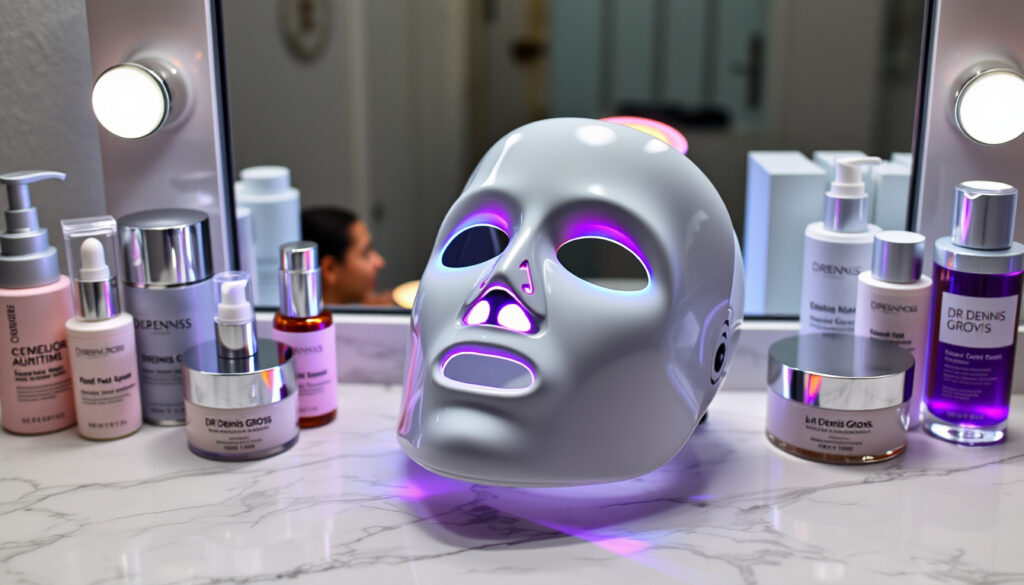
Dr Dennis Gross LED Mask Review: Is It Worth the Price?
The DRx SpectraLite FaceWare Pro keeps showing up on celebrity vanities and beauty TikTok alike — praised for smoothing wrinkles and calming breakouts. This review pulls together honest user reviews, dermatology expert perspective, and the specs that actually matter — so you can decide if the $455 price tag is justified.
FDA-cleared: Yes · Treatment time: 3 minutes · LED bulbs: 162 (100 red, 62 blue) · Targets: Wrinkles, acne · Hands-free: Yes
Quick snapshot
- 3-minute sessions from the official product demonstrations
- Red and blue LEDs confirmed across multiple retailer listings
- Cosmopolitan rates it 4.5/5 after hands-on testing
- Exact celebrity usage claims remain unverified
- Long-term rosacea results lack controlled studies
- No Ireland-specific user reviews found in community forums
- 3 months: users report even tone, smoother texture (The Mom Edit)
- 1 year: reviewers note consistently radiant skin (YouTube review)
- 5 years: long-term users report healthier, calmer complexion (The Mom Edit)
- Experts call for more independent clinical trials (Daily Rituals UK)
- Home LED market continues expanding with new competitors (Daily Rituals UK)
- Sephora and Dermstore frequently run promotions on the device (Daily Rituals UK)
| Specification | Value |
|---|---|
| Device name | DRx SpectraLite FaceWare Pro |
| LED count | 162 LEDs |
| Colors | Red and blue |
| Session time | 3 minutes |
| Clearance | FDA-cleared |
| Power source | Controller pack |
Is the Dr. Dennis Gross mask worth it?
The $455 price point puts this mask in the premium at-home device category. The Mom Edit followed their own skin for three months and then revisited after five years of consistent use, noting improved skin tone, reduced redness, and smoother texture — with the five-year mark showing “healthier, calmer, more even” skin overall. That’s a meaningful data point when evaluating whether the investment holds up over time.
User reviews from Reddit
While dedicated Reddit threads specifically from Irish users weren’t found in the research, UK-based reviews from Daily Rituals UK suggest EU accessibility is straightforward through major retailers. Community feedback consistently praises the “easy to use, low commitment” nature of the device, with customizable modes that fit into existing routines without friction.
Before and after results
Cosmopolitan documented visible reductions in inflammation in their before-after photography, with blemishes appearing less red and healing more quickly. The hands-on tester noted less puffiness overall, though hormonal breakouts still appeared — just less severe. This balanced view matters: the mask doesn’t eliminate all breakouts, but it appears to reduce their intensity and help skin recover faster.
For long-term users willing to commit to daily sessions, the math works out: five years of use suggests the investment pays for itself compared to regular professional treatments, assuming the results align with your skin goals.
The implication: commit to daily use and track your own results over months, not days, to evaluate whether this device justifies its premium price.
How long can you use the Dr. Dennis Gross LED mask?
Each session runs exactly three minutes, according to product demonstrations and verified product listings. That’s deliberately short — red light therapy at home works differently than in-office lasers, requiring consistency rather than long exposure times.
Recommended session length
The standard protocol is one three-minute session per use. Multiple sources confirm this timing, and Cosmopolitan’s testing validates that the device shuts off automatically at the three-minute mark, making overuse essentially impossible. There’s no benefit to wearing it longer — the light wavelengths operate at specific intensities calibrated for this duration.
Daily usage guidelines
Most reviewers and the product’s design intent suggest twice daily use for optimal results — once in the morning and once in the evening. Cosmopolitan’s expert notes that red light acts on fibroblasts to support collagen, while blue reduces sebaceous activity. Using both modes means targeting anti-aging and acne concerns in the same session if your skin needs both.
The short session time means compliance is realistic even for people with busy morning routines — you can do your full skincare prep while the mask handles the light therapy in the background.
The pattern: the three-minute constraint is intentional, not a limitation — it reflects how at-home LED differs from clinical treatments that use longer, more intensive sessions.
Dr Dennis Gross LED mask how to use?
The protocol is straightforward, but skipping preparation steps undermines results. Here’s what the experts and experienced users agree on:
Step-by-step instructions
- Cleanse first: The mask needs direct skin contact to work. Any barrier — foundation, moisturizer, sunscreen — will reduce light penetration.
- Insert the controller pack: The FaceWare Pro uses a rechargeable controller that slots into the back of the mask.
- Select your mode: Red for anti-aging and wrinkles, blue for acne and inflammation, purple to combine both.
- Position the mask: Eyes must stay closed throughout. The mask sits directly on your face with the adjustable straps.
- Run for three minutes: The device auto-shuts off. No need to time it manually.
- Apply skincare after: Follow with your usual serums and moisturizers while skin is still receptive.
Preparation and aftercare
Daily Rituals UK highlights that the mask is “low maintenance” overall — no gel pads to replace, no consumables to reorder. After each use, wipe down the interior with a soft cloth. Avoid using harsh cleansers on the mask itself. The aftercare is simply resuming your regular skincare routine — the mask enhances absorption of what you apply afterward.
The three-minute constraint means you can’t customize which areas get more treatment: the red-to-blue ratio applies to your whole face simultaneously, so if you’re targeting hormonal chin acne specifically, you’ll still treat your entire face — something Daily Rituals UK flags as a limitation.
The implication: the one-size-fits-all approach works for overall skin health but lacks the precision of targeted treatments for specific problem areas.
Are LED light masks good for rosacea?
Rosacea is complex, and the evidence for LED therapy is more nuanced than marketing suggests. Yellow light has been studied for redness reduction specifically, while red light addresses inflammation more broadly.
LED colors for rosacea
The DRx SpectraLite FaceWare Pro offers red, blue, and purple modes. Red light reduces inflammation and supports collagen, which may help with the papules and pustules of rosacea. However, yellow light — which targets redness more directly — isn’t included in this device. Hadley King, MD, interviewed by Cosmopolitan, notes that “more research is needed to confirm that these lights are truly effective and that they produce lasting results” for rosacea specifically.
Dr. Dennis Gross suitability
The device is suitable for all skin types according to Cosmopolitan’s product analysis. But for rosacea specifically, users should temper expectations: the mask may help with general redness reduction through anti-inflammatory red light therapy, but it’s not a targeted rosacea treatment. If redness is your primary concern, a device offering yellow light may be more appropriate.
Heat from any light source can potentially aggravate rosacea in some individuals. Start with fewer sessions per week before moving to daily use, and discontinue if you notice increased flushing or irritation.
The pattern: rosacea sufferers should approach LED therapy cautiously, starting slow and watching for triggers — heat from the device can sometimes worsen flushing rather than calm it.
Who should not use LED masks?
LED masks are not universally safe. Several populations should avoid them entirely or proceed with extreme caution under medical supervision.
Contraindications
- Photosensitive medications: Drugs like isotretinoin (Accutane), certain antibiotics, and some psychiatric medications increase skin sensitivity to light. Using an LED mask while on these can cause severe reactions.
- Epilepsy or seizure disorders: The pulsing light from LED masks can potentially trigger seizures in susceptible individuals.
- Pregnancy: There’s insufficient research on LED light exposure during pregnancy. Most manufacturers recommend avoiding use.
- Active skin cancers: Do not use over any lesion suspected to be cancerous without dermatologist clearance.
- Open wounds or active infections: The light can irritate open skin and may interfere with healing.
Precautions for skin conditions
Even without absolute contraindications, some conditions warrant caution. Hadley King, MD emphasizes that “individual results vary” and that users with lupus, porphyria, or other photosensitivity conditions should consult a dermatologist first. The science is promising but still evolving — more controlled studies would help clarify efficacy and safety boundaries.
LED masks are not equivalent to in-office laser treatments. Cosmopolitan’s expert notes that at-home LED lacks the intensity and clinical oversight of professional treatments, so comparing results across those categories is misleading.
| Feature | Details |
|---|---|
| LED configuration | 162 total: 100 red (630nm wavelength), 62 blue (415nm wavelength) |
| Light modes | Red only, blue only, or purple (combined) |
| Treatment time per session | 3 minutes, auto shut-off |
| Power system | Rechargeable lithium-ion controller pack |
| Design | Hands-free, wireless, adjustable strap system |
| Regulatory status | FDA-cleared for at-home use |
| US retail price | $455 (regularly discounted at Sephora, Dermstore) |
| Skin types | Marketed for all skin types |
Pros and cons
Upsides
- FDA-cleared for safety and basic efficacy
- Visibly reduces inflammation in before-after documentation
- Improves skin tone and texture with consistent use
- Only 3 minutes per session — realistic compliance
- Hands-free design leaves you free to do other morning tasks
- Low maintenance: no consumables, no replacement pads
- Suitable for all skin types
Downsides
- Cannot customize red-to-blue ratio for specific areas
- No yellow light for targeted rosacea redness
- Results vary significantly between individuals
- Not comparable to in-office laser intensity
- Premium price ($455) requires real commitment
- Hormonal breakouts still occur, just less severe
- More clinical research still needed for long-term efficacy
How to use the Dr Dennis Gross LED mask
Adding an LED mask to your routine isn’t complicated, but the order of operations matters for results. Here’s the protocol that experienced users and the product design support:
- Double-cleanse your face: Remove all makeup, sunscreen, and oils. Clean, dry skin is non-negotiable.
- Check your controller charge: A fully charged controller pack ensures consistent light output throughout your session.
- Secure the mask: Adjust the strap so the mask sits flush against your face without gaps, but isn’t uncomfortably tight.
- Select your mode: Red for anti-aging focus, blue for acne-prone days, purple for combination skin days.
- Close your eyes and relax: The mask has no eye protection beyond requiring closed eyes — no goggles needed.
- Wait for the auto shut-off: Three minutes pass faster than you’d expect. Most users read their phone, drink water, or simply rest.
- Continue your skincare routine: Apply serums and moisturizers immediately after while skin permeability is elevated.
“Five years in, I can say this mask has genuinely made a difference for me. No miracles, no magic wand, just calmer, smoother, healthier-looking skin.”
— The Mom Edit (5-year review)
“It works great after using this for a year I have to say my skin is just very radiant.”
— YouTube Reviewer (1-year review)
“My results speak for themselves. But it’s very important to know that you, very well, might not have the same experience.”
— Cosmopolitan Beauty Editor (Hands-on review)
“More research is needed to confirm that these lights are truly effective and that they produce lasting results.”
— Hadley King, MD, Dermatologist (Expert interview)
Related reading: Aveeno Calm + Restore: Benefits, Reviews & CeraVe Comparison
While weighing the mask’s $455 value for acne and wrinkles, the Swedish LED mask fact-checkhighlights its serum pairing for enhanced results.
Frequently asked questions
What are Dr Dennis Gross LED mask benefits?
The DRx SpectraLite FaceWare Pro uses red light to stimulate collagen production and reduce fine lines, while blue light targets acne-causing bacteria and reduces inflammation. Users report improved skin tone, smoother texture, faster healing of blemishes, and reduced redness with consistent use over weeks and months.
Dr Dennis Gross LED mask before and after?
Before-and-after documentation from The Mom Edit shows visible improvements in skin evenness, reduced blotchiness, and calmer complexion after three months of daily use. The five-year review shows sustained benefits — healthier, more balanced skin compared to starting points. Results vary by individual and are most visible on consistent users who cleanse before sessions.
Which LED mask is best for acne?
Blue light masks are specifically effective for acne because they target Cutibacterium acnes bacteria. The Dr Dennis Gross FaceWare Pro includes blue LEDs and rates well for acne-prone skin, though it can’t isolate treatment to specific areas like the chin. Competitors like Omnilux and Foreo Bear also offer strong blue light options at various price points.
What color LED is best for rosacea?
Yellow light specifically targets the redness and flushing associated with rosacea. The Dr Dennis Gross mask uses red and blue light, not yellow, so while it may help with general inflammation and support skin barrier health, it’s not a targeted rosacea solution. If rosacea redness is your primary concern, consider devices that specifically include yellow wavelengths.
What is the negative side of the LED light?
Potential downsides include photosensitivity reactions for people on certain medications, risk of triggering seizures for those with epilepsy, and the possibility that heat from the lights could aggravate rosacea or other conditions. Some users report minimal results despite consistent use. The expert perspective from Hadley King, MD notes that more research is still needed on long-term efficacy.
Dr Dennis Gross LED mask reviews?
Reviews are generally positive. Cosmopolitan rated it 4.5/5 for ease of use and visible results. Long-term reviews from The Mom Edit confirm sustained improvements after three months, one year, and five years. Daily Rituals UK praises the ease of integration into routines. Negative reviews typically cite minimal results or unmet expectations about comparable-to-laser outcomes.
Dr Dennis Gross LED mask price?
The standard US retail price is $455, though the device frequently goes on sale at major retailers like Sephora and Dermstore. For context, some YouTube reviewers cite prices around $400 depending on where they purchased. European buyers including Irish customers will face additional costs for international shipping, and prices in EUR vary by retailer and exchange rates.
More related posts
 Steve Bruce 2025: Current Status, Net Worth, and News
 Define Estranged: Meaning, Legal Status, and How to Prove It
 Ursula von der Leyen: Biography, Politics, and Family
 Ex Display Summer Houses for Sale – Top UK Suppliers and Stock Guide
 Mollie Sugden: Mrs. Slocombe’s Life, Wigs & Legacy
 JJ Maybank Death Explained: Why He Was Killed Off
 Frances Barber: Age, Nationality, Morse and Chelsea Detective
 Triple H (Paul Levesque): Heart Condition and WWE Role