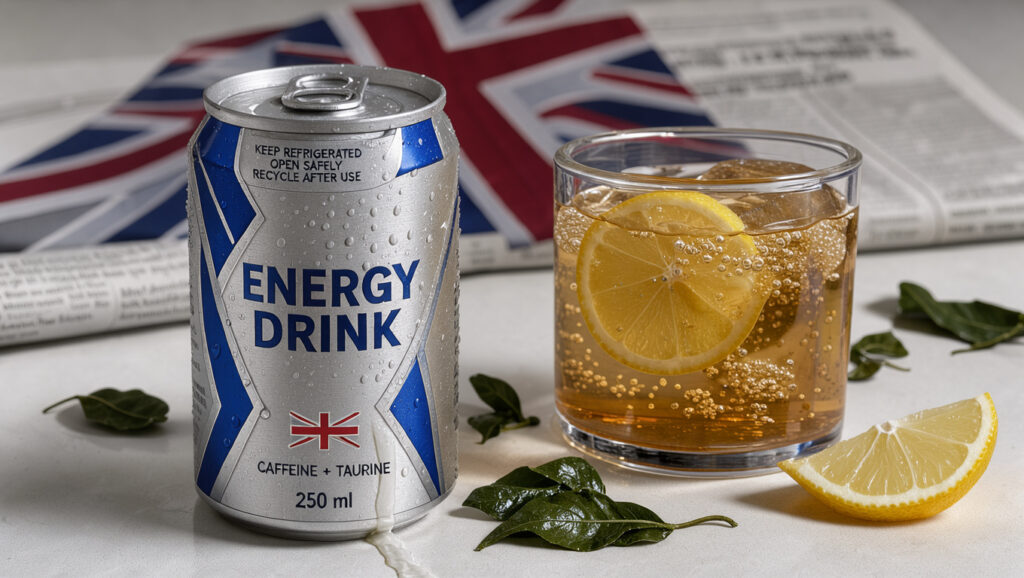
Red Bull Ingredients, UK Flavours, Caffeine and Safety
Most of us have grabbed a Red Bull without thinking much about what is inside the can. One 250 ml can of the Original holds 80 mg of caffeine and 27 g of sugars, according to Red Bull GB (brand’s UK ingredients page), and this guide separates the figures that rest on official labels from the rumors and dietary questions that do not.
Caffeine per 250 ml can: 80 mg · Sugars per 250 ml can (Original): 27 g · Energy per 100 ml (Original): 46 kcal
Quick snapshot
- One 250 ml Original can contains 80 mg of caffeine (Red Bull GB ingredients page)
- The same can holds 27 g of sugars (Red Bull GB ingredients page)
- Per 100 ml, the Original lists 46 kcal and 11 g of sugars (Sainsbury’s UK label)
- Whether any official report supports the dead rat claim; none appears in the sources reviewed (Eatcheck (automated halal check))
- Current UK prices for single cans and 12-packs, with no verified figure (Eatcheck (automated halal check))
- Halal status, which Eatcheck calls compatible through automated label analysis (Eatcheck (automated halal check))
- One Stop’s 355 ml product PDF was last updated on 2022-09-29 (One Stop (convenience retailer PDF))
- Several retailer pages carry dates that look like crawl dates, so none of them marks a formula change (One Stop (convenience retailer PDF))
- Halal verdicts need a certifying body, and the Henderson Foodservice sheet for the Green Edition cites none (Henderson Foodservice (supplier halal sheet))
- UK Edition availability should be checked against the official Red Bull channel (Red Bull GB ingredients page)
Eight figures carry most of the answers here, one pattern: the firmest numbers come from the brand and its retailers, not from independent testing.
| Label | Value |
|---|---|
| Caffeine per 250 ml can (Original) | 80 mg |
| Caffeine per 100 ml (warning label threshold) | 32 mg |
| Sugars per 250 ml can (Original) | 27 g |
| Energy per 100 ml (Original) | 46 kcal (195 kJ) |
| Energy per 100 ml (Sugar Free) | 3 kcal (13 kJ) |
| Energy per 100 ml (Zero) | 2 kcal (10 kJ) |
| Taurine (Original) | 0.4% |
| Gluten and dairy status | Free, per Red Bull Malaysia’s official FAQ |
| Halal status (Original) | Listed as halal on a 355 ml retailer listing; no certifying body verdict in the evidence |
Is a Red Bull a good energy drink?
Whether it counts as good depends on what you want from it, and the label figures make that choice clearer than most marketing does.
What does one 250 ml can contain?
- Caffeine: 80 mg, which Red Bull describes as about the same amount as a cup of coffee (Red Bull GB ingredients page)
- Sugars: 27 g per can (Red Bull GB ingredients page)
- Energy: 46 kcal per 100 ml on the 473 ml label (Sainsbury’s UK label)
The 27 g of sugar is the figure most likely to surprise readers, and it is the one the Sugar Free range removes.
Who should avoid it?
- Children, according to the label warning on the Sainsbury’s (UK Sugar Free label)
- Pregnant or breast-feeding women, under the same label warning (Sainsbury’s (UK Sugar Free label))
The label names groups to avoid but sets no daily number, so the per-can figure of 80 mg is the only fixed measure readers have.
The implication: a single can is a known quantity, but the label does not tell an adult how many cans is too many.
What Red Bull flavors are in the UK?
The range has four parts, and the sugar variants differ far more than their similar cans suggest.
- The Original Red Bull, the sugared 250 ml can (Red Bull GB ingredients page)
- Zero, marketed as zero calories and zero sugar (Sainsbury’s (UK Zero label))
- Sugarfree, sweetened with sucralose and acesulfame K (Sainsbury’s (UK Sugar Free label))
- Editions, such as the Green Edition sold as a 12 x 250 ml pack (Henderson Foodservice (supplier halal sheet))
An Amazon UK retailer listing, which counts as a secondary source, names Watermelon, Tropical and Apricot-Strawberry as Sugar Free flavour variants (Amazon UK (retailer listing)). Editions are where the evidence runs thinnest: the Red Bull GB range page names several, but no nutrition data is given for each one.
Sugar Free and Zero are the only variants here with energy under 5 kcal per 100 ml, at 3 kcal and 2 kcal according to Sainsbury’s (UK Sugar Free label), which makes them the realistic low-sugar choice.
The trade-off: the lower-sugar variants swap sugar for sweeteners, so buyers are choosing a different ingredient list, not only fewer calories.
Is 1 Red Bull a day unhealthy?
One can is a fixed, labelled amount, and the sources gathered for this guide do not show that a single can is harmful to a healthy adult.
- One can: 80 mg caffeine and 27 g sugar (Red Bull GB ingredients page)
- Three cans: 240 mg caffeine and 81 g sugar, from multiplying the single-can figures
The sources here do not include an official daily caffeine or sugar limit, so check the NHS website before setting a rule for yourself.
Three Originals multiply both numbers at once, while a Sugar Free can keeps the caffeine figure at 80 mg per can, according to an Amazon UK (retailer listing).
The implication: for the Original, the daily question is mainly about sugar, and for every variant it is about caffeine.
Can Muslims have Red Bull?
Halal status rests on the ingredient list and on a certifier’s verdict, and the evidence here contains plenty of the first and none of the second.
- Brake’s 355 ml listing says the ingredients list Halal (Brake (retailer 355 ml listing))
- Henderson Foodservice records the Green Edition 12 x 250 ml as Approved for a Halal Diet (Henderson Foodservice (supplier halal sheet))
- Eatcheck reports the drink as compatible with a halal diet, based on automated analysis of Open Food Facts label data (Eatcheck (automated halal check))
- Eatcheck could not reach a verdict on the 25 cl listing, because its ingredients appeared in French (Eatcheck (halal check on 25 cl listing))
The evidence does not address pork or alcohol content directly, so the printed ingredient list on the pack is the only source for those two questions.
Three sources point toward a halal-friendly answer, yet none names a certifying body, and one listing could not be checked at all.
Why this matters: a shopper relying on one automated check is relying on machine label reading, so the step that counts is checking the printed ingredients on the can itself.
Who is bigger, Red Bull or Coca-Cola?
The sources gathered here cannot answer this, because a size comparison needs one agreed metric and published figures for both companies.
- Volume: the can-level listings do not give company-wide volume
- Revenue and market share: no audited figures for either company appear in the sources
The trade-off: whichever metric is chosen decides the winner, so a headline that names one without its basis is repeating a claim rather than measuring a company.
Three variants, one pattern: the sugar-free swap cuts energy per 100 ml by more than 90 percent, and the sweetener list changes with it.
| Variant | Energy per 100 ml | Sweeteners |
|---|---|---|
| Original | 46 kcal (195 kJ) (Sainsbury’s UK label) | None; sugars are sucrose and glucose |
| Sugar Free | 3 kcal (13 kJ) (Sainsbury’s UK label) | Sucralose, acesulfame K |
| Zero | 2 kcal (10 kJ) (Sainsbury’s UK label) | Sucralose, cyclamate, saccharin |
Seven specification lines, one pattern: caffeine and taurine hold steady across the labels, while sugar and energy separate the variants.
| Specification | Value |
|---|---|
| Caffeine per 100 ml (warning label) | 32 mg (Sainsbury’s UK label) |
| Caffeine share, Original | 0.03% (Sainsbury’s UK label) |
| Taurine, Original | 0.4% |
| Carbohydrates per 100 ml, Original | 11 g, all of which are sugars |
| Salt per 100 ml, Original | 0.1 g |
| Sugar Free fat, carbohydrate, sugars and protein per 100 ml | Each under 0.1 g |
| Zero carbohydrates per 100 ml | 2 g, with sugars under 0.1 g |
Upsides
- Caffeine is a fixed, labelled figure of 80 mg per 250 ml can (Red Bull GB ingredients page)
- Sugar Free and Zero cut energy to 3 kcal and 2 kcal per 100 ml (Sainsbury’s UK label)
- Gluten-free and dairy-free status is stated in Red Bull Malaysia’s official FAQ (Red Bull Malaysia (official FAQ))
Downsides
- The Original carries 27 g of sugar per can (Red Bull GB ingredients page)
- The label reads “High caffeine content” and advises against use by children and by pregnant or breast-feeding women (Sainsbury’s UK label)
- Halal status rests on automated and supplier listings, with no certifying body verdict (Eatcheck (automated halal check))
Confirmed facts
- 80 mg of caffeine per 250 ml Original can (Red Bull GB ingredients page)
- 27 g of sugars per 250 ml Original can (Red Bull GB ingredients page)
- Sugar Free sweetened with sucralose and acesulfame K (Sainsbury’s UK label)
- Zero marketed as zero calories and zero sugar (Sainsbury’s UK label)
What’s unclear
- Whether any official report supports the dead rat claim; none appears in the sources reviewed
- Current UK retail prices for 250 ml singles and 12 packs
- Exact UK availability of each Edition at a given time
- The relative size of Red Bull and Coca-Cola on one agreed metric
- A certifying body’s halal verdict for the Original formula
High caffeine content. Not recommended for children or pregnant or breast-feeding women.
Sainsbury’s (UK Sugar Free label)
One 250 ml can of Red Bull Energy Drink contains 80 mg of caffeine, about the same amount as in a cup of coffee.
Red Bull GB (brand’s UK ingredients page)
The numbers that matter most here, 80 mg of caffeine and 27 g of sugar per Original can, come from the brand itself, while halal status and prices still rest on weaker listings. For UK buyers, the choice is clear: check the ingredient list on the pack in your hand, or switch to Sugar Free or Zero if sugar is the concern and accept the sweetener list that comes with them.
Related reading: Mount Kilimanjaro: Location, Height, Difficulty and Safety
sainsburys.co.uk, sainsburys.co.uk, sainsburys.co.uk, sainsburys.co.uk, eatcheck.org, sainsburys.co.uk, sainsburys.co.uk, sainsburys.co.uk
Frequently asked questions
What is the rarest Red Bull flavor?
The sources gathered for this guide do not rank Red Bull flavors by rarity, so no answer can be given without company or retailer sales figures.
Was there a dead rat found in Red Bull?
No official report of a dead rat in a can appears in the sources reviewed, so the claim remains unverified rather than confirmed.
What are the main ingredients in Red Bull?
Red Bull Malaysia’s official FAQ lists caffeine, taurine, B-group vitamins, sugars and water for the original formula (Red Bull Malaysia (official FAQ)).
How much does a 250ml Red Bull cost in the UK?
No verified current UK price for a 250 ml can or a 12-pack was found, so check a retailer’s live listing before budgeting.
Where can I buy Red Bull in the UK?
UK retailers including Sainsbury’s and One Stop list Red Bull products on their product pages (One Stop (convenience retailer PDF)).
Is Red Bull Zero sugar-free?
Yes, Sainsbury’s lists Zero as zero sugar, with sugars under 0.1 g per 100 ml (Sainsbury’s (UK Zero label)).
More related posts
 Unity Mitford: Her Life, Suicide, Brain Damage, and Death
 Things to Do in Singapore – Top Attractions and 2025 Tips
 Falcon and the Winter Soldier: MCU Guide, Cast & Season 2
 What Is Low Blood Pressure? Causes, Symptoms & Treatment
 Ray-Ban Sunglasses: Price, Authenticity, Worth It? Ireland
 Elliott Smith: Biography, Cause of Death, and Essential Songs
 Luke Macfarlane: Partner, Hallmark Movies & Personal Life
 Door Knobs Ireland: Interior & Exterior Options