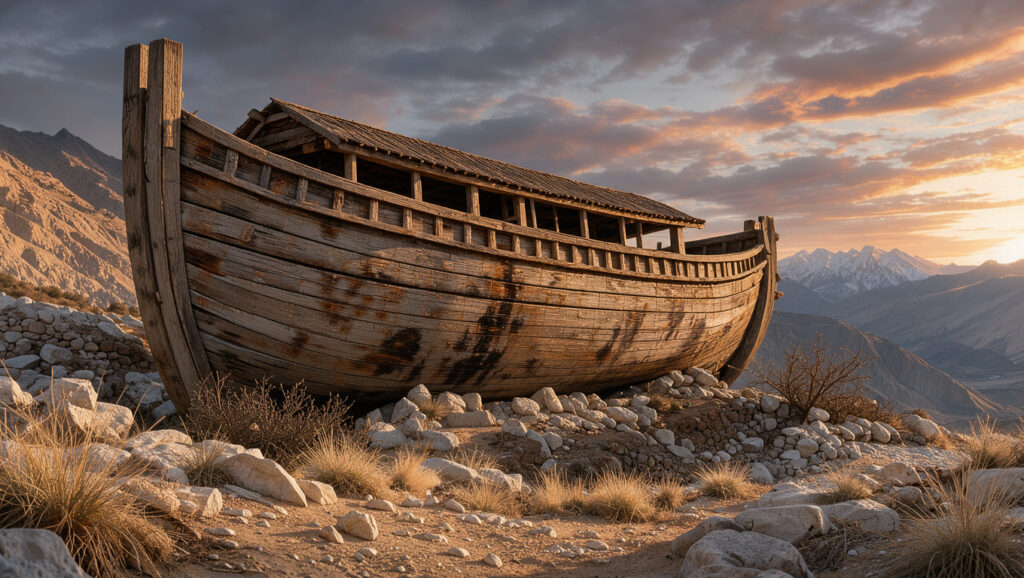
Noah’s Ark: Genesis Measurements, Location, and Claims
Most people meet Noah’s Ark in picture books, yet the Genesis account is stranger and more exact than any cartoon. It gives the ark precise proportions, and a boat-shaped mound in eastern Turkey, which a Turkish army captain identified from aerial photographs in 1959 according to Hebrew Explorer (archaeology reference site), has become the most-cited candidate.
Ark length (Genesis 6:15): 300 cubits, about 134 m · Ark width (Genesis 6:15): 50 cubits, about 22 m · Ark height (Genesis 6:15): 30 cubits, about 13 m · Noah’s age at death (Genesis 9:29): 950 years · Landing place (Genesis 8:4): mountains of Ararat
Quick snapshot
- Genesis 6:15 gives the ark as 300 × 50 × 30 cubits (Wikipedia (encyclopedia summarizing the scholarship))
- According to Christian Pure (Christian explainer site), Genesis 8:4 places the landing on “the mountains of Ararat”
- Whether the “ancient-appearing” charred wood cited in a preliminary release is ancient remains unresolved (Baptist Press (Christian news agency))
- According to Living Passages (explainer on Durupınar), the common cubit is about 18 inches and the Egyptian royal cubit about 20.6 inches, so the length match depends on the unit
- A team led by a Turkish professor began surveying in and drilled 12 core holes up to about 60 m deep (Forward (independent news outlet))
- A 1960 investigation by an American–Turkish team followed the 1959 identification, according to Hebrew Explorer (archaeology reference site) (Forward (independent news outlet))
- As of , the findings are preliminary, with no independently verified archaeological evidence (Conference Hebrew (report on the 2026 findings))
- The 2019–2025 scan results have not been published in peer-reviewed journals, according to Hebrew Explorer (archaeology reference site) (Conference Hebrew (report on the 2026 findings))
Six rows set the frame. Four describe what Genesis says, and two describe what the modern survey record shows, so the gap between the two columns is the story.
| Fact | Value |
|---|---|
| Biblical source | Genesis 6–9 |
| Landing place | Mountains of Ararat (Genesis 8:4) |
| Ark dimensions | 300 × 50 × 30 cubits |
| Durupınar length | About 157–164 m (515–538 ft), per Living Passages (explainer on Durupınar) |
| Discovery status | Preliminary; no independently verified evidence |
| Noah’s age at death | 950 years (Genesis 9:29) |
What is Noah’s ark?
The Genesis account treats the ark as a building job with a blueprint. God tells Noah to build it, and the story follows his family and the animals through the flood. The Hebrew word for the vessel, teva, appears in two contexts in the Hebrew Bible, according to Aaron Judkins (academic author, public statement): the flood narrative and the basket that carries the infant Moses.
Those two uses are the only word-level link between the flood story and the Moses story, which makes the term a useful test for anyone tracing how the text uses it.
- God instructs Noah to build the ark (Genesis 6:14)
- Rain falls for 40 days (Genesis 7:12)
- The ark rests on the mountains of Ararat (Genesis 8:4)
The implication: Genesis presents the ark as a measured object, so any physical claim has to answer to those measurements, not only to the story’s general outline.
How old was Noah when he died?
Genesis 9:29 gives Noah’s lifespan as 950 years (Wikipedia, encyclopedia summarizing the scholarship). The same book describes his character in two different ways.
- Genesis 6:9 calls Noah righteous in his generation
- Genesis 9:20–21 records his drunkenness after the flood
The catch: A lifespan is a number no excavation can recover, so the age question rests entirely on how a reader takes the text.
How big was Noah’s Ark?
Genesis 6:15 gives the proportions as 300 cubits long, 50 wide, and 30 high. Converting those figures at the most common estimate gives roughly 134 × 22 × 13 m, or 440 × 72 × 43 ft (Wikipedia, encyclopedia summarizing the scholarship).
300 royal cubits and 300 common cubits give different lengths, so a match depends on the unit a searcher picks, not on the mound.
What is a cubit in Noah’s Ark measurements?
- According to Living Passages (explainer on Durupınar), the common cubit is about 18 inches and the Egyptian royal cubit about 20.6 inches, so the same 300 cubits give very different lengths.
- Genesis does not name a cubit standard, so every metric figure is an estimate.
According to Historical Christian (rated analysis of Durupınar), the 538-ft length matches 300 cubits only with a long cubit of about 21.5 inches, a fit the analysis rates as weak.
The implication: The measurements are precise on paper and approximate on the ground, and that gap is where the Durupınar claims live.
Where is Noah’s Ark believed to be?
Genesis 8:4 places the landing on “the mountains of Ararat,” and according to Christian Pure (Christian explainer site), that phrase names a plural region rather than a single peak.
Mount Ararat lies in eastern Turkey, so a site near it fits the broad region the text names. The narrower question is whether one specific mound is the place the text means.
- Holy Land Site (promotional site) argues that the Ararat phrase covers a broad range, so the Durupınar mound qualifies (Holy Land Site (promotional site))
The trade-off: A broad region is easy to fit to the text and hard to test, because almost any peak in the range can be claimed.
Has Noah’s Ark been found?
The Durupınar formation remains the most-cited candidate, and Conference Hebrew (report on the 2026 findings) says the 2026 results are preliminary, with no independently verified archaeological evidence that the formation contains Noah’s Ark.
“We have not identified any material as ancient wood or established its age.”
Andrew Jones, leader of the Noah’s Ark Scans project, as reported by Christian Pure
The 1985 measurements came from David Fasold, who later recanted, according to Historical Christian (rated analysis of Durupınar).
Aaron Judkins’s 2026 public statement says Andrew Jones acknowledged it is too early to claim the ark is buried at Durupınar, while still believing the formation represents the remains of Noah’s Ark.
“A rough match in shape and size is not evidence.”
Aaron Judkins, academic author, public statement
Conference Hebrew reports that no independently verified evidence yet links the Durupınar formation to Noah’s Ark, so the claim rests on preliminary work that its promoters have not yet published in peer-reviewed form.
What is the Durupınar formation?
The Durupınar formation is a boat-shaped mound in Ağrı province, about 29 km south of Mount Ararat, according to Christian Pure. Captain İlhan Durupınar of the Turkish Army identified it in 1959 from aerial photographs, and a 1960 investigation by an American–Turkish team followed.
Geologists read the same shape differently. Lorence G. Collins’s 1996 paper in the Journal of Geoscience Education described a doubly plunging syncline shaped by erosion, and in 2007 Turkish geologist Murat Avcı described a large block of Miocene limestone that slumped downhill on weak clays.
A boat-shaped outline is easy to see in a mound and hard to prove as a ship. The shape alone settles nothing.
The pattern: Each new survey adds data, but the 2026 results still lack the published, dated evidence that would test the ship claim against the geology.
Related reading: Mount Kilimanjaro: Location, Height, Difficulty and Safety
en.wikipedia.org, youtube.com, heroisdabiblia.com.br, christianpure.com, youtube.com, aaronjudkins.substack.com, youtube.com
Frequently asked questions
Is Noah’s Ark mentioned in the Quran?
Yes. The Quran says the ark came to rest on al-Jūdī, which later tradition associates with Mount Judi in south-east Turkey, according to Christian Pure.
How long did the flood last in Genesis?
Genesis 7:12 gives 40 days of rain as the flood’s opening period.
Has any wood from Durupınar been dated?
No independently verified dating exists. Andrew Jones is quoted as saying the team has not identified any material as ancient wood or established its age.
Did Noah ever sin against God?
Genesis 6:9 calls Noah righteous in his generation, and Genesis 9:20–21 records his drunkenness after the flood. The text reports both, so readers differ on how to weigh them.
Who first identified the Durupınar formation?
Turkish Army Captain İlhan Durupınar identified the formation in 1959 from aerial photographs, according to Hebrew Explorer (archaeology reference site).
More related posts
 Jacinda Ardern: What Happened and Where She Is Now
 Nick Grimshaw: Career, Radio 1 Exit, Family and Net Worth
 Sally Hawkins: Biography, Facts, and Oscar Nominations
 Sophie Kinsella: Cause of Death, Books, and Legacy
 Leanne Morgan: Marriage, Daughter, Weight Loss, Net Worth
 Nadhim Zahawi: Biography, Tax Controversy, and Career
 Tom Felton: Wife, Relationships, Sobriety & Friendships
 Brigitte Macron: Children, Marriage, Age and Public Role