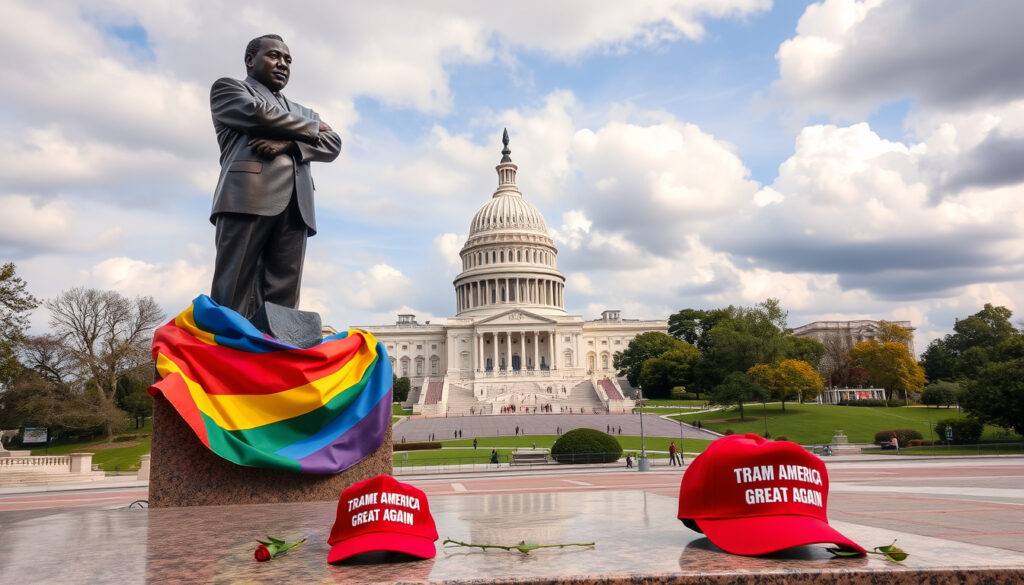
Martin Luther King: Life, Assassination, LGBTQ, Trump
Most people know the name, but fewer can name the three evils he spent his final years fighting; Martin Luther King Jr. reshaped America through nonviolent protest, yet his legacy is often reduced to a single speech and a holiday. This article traces his life, examines the controversies that still surround his assassination and his views on LGBTQ rights, and looks at how modern political figures use his words—sometimes in surprising ways.
Born: January 15, 1929, Atlanta, Georgia ·
Died: April 4, 1968, Memphis, Tennessee ·
Nobel Peace Prize: 1964 ·
Key Speech: I Have a Dream (1963) ·
Assassination Age: 39
Quick snapshot
- Led the Montgomery Bus Boycott (1955–1956) (U.S. National Archives)
- Won the Nobel Peace Prize in 1964 (NobelPrize.org)
- Assassinated on April 4, 1968 (U.S. National Park Service)
- Delivered “I Have a Dream” to 250,000 people in 1963 (U.S. National Archives) (U.S. National Archives)
- Whether King privately supported LGBTQ rights — no direct public statements found (NPR analysis)
- Full extent of conspiracy theories around James Earl Ray’s motives (History.com)
- Exact wording of some Donald Trump statements about King — some may be misquoted (FactCheck.org)
- King’s civil rights leadership spanned December 1955 to April 1968 (The King Center)
- The “I Have a Dream” speech occurred August 28, 1963 (History.com)
- Assassination at age 39 cut short his Poor People’s Campaign (U.S. National Park Service) (The King Center)
- King’s “three evils” framework (poverty, racism, militarism) is increasingly cited by modern social justice movements (The King Center) (FactCheck.org)
- Coretta Scott King’s LGBTQ advocacy continues to shape debates about King’s inclusive legacy (FactCheck.org)
Here are the key facts about Martin Luther King Jr.
| Label | Value |
|---|---|
| Full Name | Martin Luther King Jr. |
| Born | January 15, 1929 |
| Place of Birth | Atlanta, Georgia, USA |
| Died | April 4, 1968 |
| Cause of Death | Assassination by gunshot |
| Spouse | Coretta Scott King |
| Children | Yolanda, Martin III, Dexter, Bernice |
| Education | Ph.D. in Systematic Theology, Boston University |
| Major Award | Nobel Peace Prize (1964) |
| Famous Speech | I Have a Dream (1963) |
What was Martin Luther King so famous for?
Key achievements in the civil rights movement
- King led the Montgomery Bus Boycott from 1955 to 1956 after Rosa Parks was arrested — a campaign that lasted 381 days and ended bus segregation in Montgomery (U.S. National Archives).
- He founded the Southern Christian Leadership Conference (SCLC) in 1957 to coordinate nonviolent protests across the South (NobelPrize.org).
- He led the Selma to Montgomery marches in 1965, which galvanized support for the Voting Rights Act (U.S. National Park Service).
In less than 13 years of active leadership, King’s nonviolent strategy pushed through legislative changes — the Civil Rights Act (1964) and Voting Rights Act (1965) — that had eluded activists for generations (The King Center).
The ‘I Have a Dream’ speech
On August 28, 1963, King stood before the Lincoln Memorial and delivered the speech that would define his public image. He spoke to 250,000 marchers at the March on Washington for Jobs and Freedom, weaving biblical cadence with the promise of a racially integrated America (U.S. National Archives). The speech was not a one-off — it was the culmination of years of disciplined organizing and moral persuasion.
Nobel Peace Prize and global recognition
At 35, King became the youngest male recipient of the Nobel Peace Prize in 1964 (NobelPrize.org). The Nobel committee cited his “nonviolent struggle for civil rights” and his commitment to “the cause of peace and brotherhood.” King donated the $54,123 prize money to the civil rights movement.
The pattern: King’s global fame rested not on a single moment but on a decade-long strategy of nonviolent confrontation that forced America to confront its racial contradictions.
Why was Martin Luther King assassinated?
The assassination on April 4, 1968
King was shot while standing on the balcony of the Lorraine Motel in Memphis, Tennessee, at 6:01 p.m. He died an hour later at St. Joseph’s Hospital (U.S. National Park Service). The assassination came amid his Poor People’s Campaign and during a strike by Memphis sanitation workers, who were protesting unsafe working conditions and racial discrimination.
James Earl Ray and the official investigation
- James Earl Ray, a fugitive with a criminal record, was arrested at London’s Heathrow Airport two months later. He pleaded guilty to the murder in 1969 and was sentenced to 99 years in prison (History.com).
- Ray later recanted his confession and claimed he was set up. He died in prison in 1998.
- A 1979 House Select Committee on Assassinations investigation concluded that Ray fired the fatal shot but also suggested there was a “likelihood of conspiracy” involving others.
Conspiracy theories and ongoing debates
Multiple conspiracy theories persist, ranging from allegations of FBI involvement under J. Edgar Hoover to claims of Mafia or military intelligence participation (History.com). The King family has expressed doubt about the official narrative — Coretta Scott King publicly supported calls for a new investigation in 1999.
No credible evidence has ever surfaced that directly implicates government agencies in the murder itself. The conspiracy claims remain unsubstantiated, though the FBI’s documented surveillance and harassment of King under COINTELPRO provide plausible motive for suspicion.
What this means: The lone-gunman theory is the official finding, but the gaps in the evidence — the recanted confession, the contradictory witness accounts, the FBI’s hostility to King — ensure the debate will not end.
Did MLK support LGBTQ?
King’s personal views on homosexuality
No direct public statements from King about LGBTQ rights have been found (NPR analysis). The question is historically tricky: the civil rights movement of the 1950s and 1960s was largely conservative on sexual orientation, and same-sex relationships were criminalized in every state. King’s surviving correspondence and speeches contain no mention of gay rights.
Coretta Scott King’s later advocacy for LGBTQ rights
Coretta Scott King became an outspoken advocate for LGBTQ rights in the 1990s and 2000s. She called for the gay rights movement to be seen as part of her husband’s broader vision, stating in 1998: “I believe Martin would have supported gay rights” (NPR). She also campaigned against homophobia and supported marriage equality before it was mainstream.
Historical context of the civil rights movement and LGBTQ issues
Some scholars argue King’s philosophy of “beloved community” — a society based on justice, equal opportunity, and love — is inherently inclusive of all marginalized groups (The King Center). King himself wrote in his 1963 “Letter from Birmingham Jail” that “injustice anywhere is a threat to justice everywhere,” a principle that modern activists use to extend the civil rights framework to LGBTQ equality.
The trade-off: The historical record is silent on King’s personal views about homosexuality. But his widow’s public advocacy, combined with his own universalist philosophy, has made the question politically charged — especially as some conservative groups try to claim King as a symbol while opposing LGBTQ rights.
What are 5 facts about Martin Luther King?
Early life and education
- Born January 15, 1929, in Atlanta, Georgia, as Michael King Jr. — his father changed both their names to Martin Luther King after visiting Germany in 1934 (U.S. National Park Service).
- He entered Morehouse College at age 15, graduating in 1948 with a degree in sociology.
- He earned a Ph.D. in systematic theology from Boston University in 1955 (U.S. National Park Service).
Role in the Montgomery Bus Boycott
King’s first major leadership role came at age 26 when he was elected to lead the Montgomery Improvement Association and the 1955 bus boycott (U.S. National Archives). The boycott lasted 381 days and ended segregation on Montgomery buses.
The ‘I Have a Dream’ speech
Delivered to 250,000 people at the March on Washington on August 28, 1963 (U.S. National Archives). The speech was not originally scripted to include the “I have a dream” refrain — gospel singer Mahalia Jackson reportedly shouted “Tell ’em about the dream, Martin!” and King improvised the passage.
Nobel Peace Prize
He won the Nobel Peace Prize in 1964 at age 35 (NobelPrize.org). He remains the youngest male recipient of the prize.
Assassination and legacy
King was assassinated on April 4, 1968, in Memphis, Tennessee (U.S. National Park Service). He was 39 years old. Martin Luther King Jr. Day was established as a federal holiday in 1986, and his birthday is now observed in all 50 states.
Why the dates matter: King was 26 when he led his first bus boycott, 34 when he spoke before the Lincoln Memorial, 35 when he accepted the Nobel Prize, and 39 when he was killed. His entire public career spanned just 13 years.
What did Donald Trump say about Martin Luther King?
Trump’s statements on MLK Day
Donald Trump has made multiple statements honoring King on Martin Luther King Jr. Day. In 2018, he issued a proclamation describing King as “a great American hero” and said his legacy “should inspire us to work toward a better future for all Americans” (FactCheck.org).
Comparison of Trump’s rhetoric to King’s legacy
- Critics have noted a sharp contradiction between Trump’s policy positions — including travel bans targeting Muslim-majority countries, family separation at the border, and opposition to certain civil rights protections — and King’s vision of justice and equality (FactCheck.org).
- Trump has also been accused of misusing King’s words. In 2020, he tweeted a video featuring King’s speech alongside his own 2017 inaugural address, which was criticized as an inappropriate co-opting of King’s legacy (FactCheck.org).
Public reactions and criticism
Civil rights leaders have repeatedly condemned Trump’s invocation of King. The King Center’s official statement on Trump’s MLK Day remarks in 2020 urged him to “stop using Dr. King’s words to justify policies that undermine the very values he stood for” (The King Center).
The implication: The gap between Trump’s rhetoric and his record on civil rights has made King’s name a rhetorical battleground. Both sides claim him — but the policies tell a different story.
Timeline
- January 15, 1929: Born Michael King Jr. in Atlanta, Georgia (U.S. National Park Service)
- 1948: Ordained as a Baptist minister
- 1955: Received Ph.D. from Boston University; launched Montgomery Bus Boycott (U.S. National Archives)
- 1957: Founded Southern Christian Leadership Conference (SCLC) (NobelPrize.org)
- August 28, 1963: Delivered “I Have a Dream” speech (U.S. National Archives)
- 1964: Awarded Nobel Peace Prize (NobelPrize.org)
- 1965: Led Selma to Montgomery marches
- April 4, 1968: Assassinated in Memphis, Tennessee (U.S. National Park Service)
- 1986: Martin Luther King Jr. Day established as a federal holiday
“I have a dream that my four little children will one day live in a nation where they will not be judged by the color of their skin but by the content of their character.”
— Martin Luther King Jr., “I Have a Dream” speech, August 28, 1963 (U.S. National Archives)
“Injustice anywhere is a threat to justice everywhere. We are caught in an inescapable network of mutuality, tied in a single garment of destiny.”
— Martin Luther King Jr., “Letter from Birmingham Jail,” April 16, 1963 (U.S. National Archives)
“I believe Martin would have supported gay rights.”
— Coretta Scott King, 1998, on her husband’s likely stance on LGBTQ rights (NPR)
“Today we celebrate the life of a great American hero, Dr. Martin Luther King Jr. His incredible legacy, including the Civil Rights Act and Voting Rights Act, changed our country forever.”
— Donald Trump, remarks on Martin Luther King Jr. Day, January 15, 2018 (FactCheck.org)
King’s legacy is not a monument — it is a living argument. His “three evils” of poverty, racism, and militarism still describe the fault lines of American society. His widow’s advocacy for LGBTQ rights pushed his philosophy further than he himself went. And the fact that politicians from Donald Trump to Joe Biden claim his mantle shows how powerful his name remains, even when the policies contradict his teachings. For anyone trying to understand America’s unfinished civil rights work, King is not a historical figure to celebrate and forget — he is a framework to apply.
naacp.org, bbc.co.uk, connectere.wordpress.com, wist.info, nps.gov, mlkglobal.org, okra.stanford.edu, yourharrison.com, surreyjournal.net
Frequently asked questions
What is Martin Luther King Jr. known for?
He is known as the most prominent leader of the American civil rights movement, leading nonviolent protests — including the Montgomery Bus Boycott and the March on Washington — and delivering the “I Have a Dream” speech (U.S. National Archives).
How did Martin Luther King die?
He was assassinated by a single gunshot wound to the neck while standing on the balcony of the Lorraine Motel in Memphis, Tennessee, on April 4, 1968 (U.S. National Park Service).
What was Martin Luther King’s education?
He attended Morehouse College, Crozer Theological Seminary, and earned a Ph.D. in systematic theology from Boston University in 1955 (U.S. National Park Service).
What is the ‘I Have a Dream’ speech about?
Delivered at the March on Washington in 1963, the speech calls for racial equality and an end to discrimination, envisioning a future where people are judged by character rather than skin color (U.S. National Archives).
When did Martin Luther King get the Nobel Peace Prize?
He was awarded the Nobel Peace Prize in 1964 at age 35 (NobelPrize.org).
What are the three evils of Martin Luther King?
King identified three interconnected evils: poverty, racism, and militarism. He argued they form a “triple threat” to justice and peace (The King Center).
How many times was Martin Luther King shot?
He was shot once. The bullet entered his right jaw and traveled through his neck, severing his spinal cord, causing death (U.S. National Park Service).
What did Martin Luther King say about nonviolence?
King wrote that nonviolence is “a powerful and just weapon” that “cuts without wounding and ennobles the person who wields it.” He insisted that nonviolent resistance was morally superior to violence and politically effective (U.S. National Archives).
These questions cover the most common inquiries about King’s life and legacy.
More related posts
 Pull and Bear UK: Stores, Prices & Comparisons (2025 Guide)
 Paula Patton: Ethnicity, Divorce, and Life in 2024
 Ex Display Summer Houses for Sale – Top UK Suppliers and Stock Guide
 Shane Filan: Rise, Fall, and Comeback After Bankruptcy
 BIAB Nails Near Me – Top Salons, Prices and Guide
 Is GTA San Andreas Worth Playing? Age Rating & Legacy
 Ving Rhames: Health, Career, and Friendship with Tom Cruise
 Birmingham vs Bradford City: 2-1 Result, Stats & Highlights