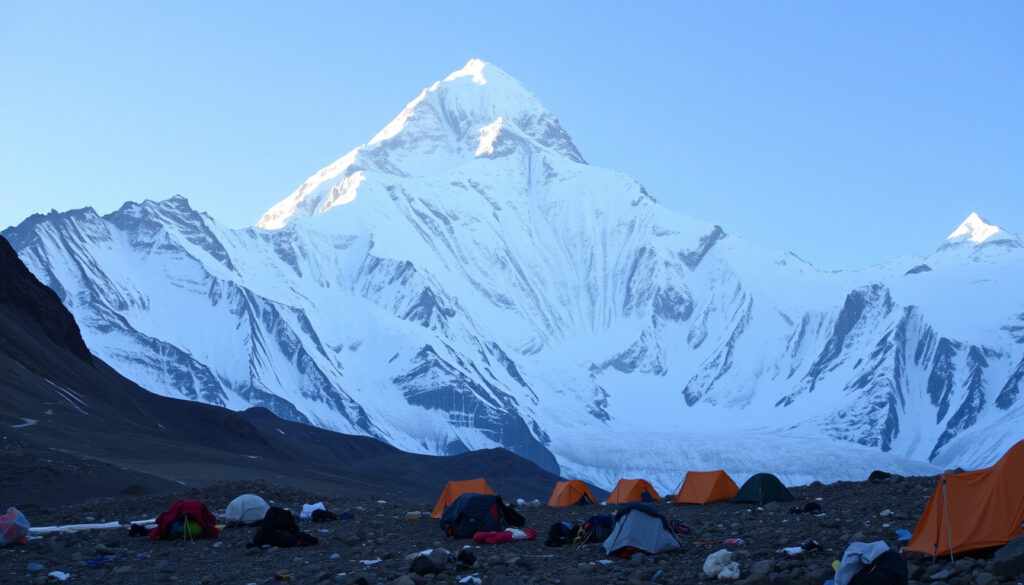
Mount Everest: Location, Cost, Deaths
Few places on Earth stir as much fascination—and danger—as the world’s tallest mountain. Every year, hundreds of climbers try to stand on the roof of the world, but the price of that dream is measured in dollars, hours, and sometimes lives.
Height: 8,848 m (29,029 ft) / 8,849 m (29,032 ft) ·
Location: Border of Nepal and Tibet (China) ·
First Ascent: May 29, 1953 (Edmund Hillary & Tenzing Norgay) ·
Climbing Permit Cost (Nepal): $11,000 per person ·
Annual Attempts: Approximately 800 ·
Total Deaths (1922–2023): Over 300
Quick snapshot
- Nepal-Tibet border (Southern Current (travel data site))
- 8,848.86 m (29,031.69 ft) (Southern Current)
- Permit: $11,000 (before 2025 increase) (The Kathmandu Post (Nepal news outlet))
- Full expedition: $30,000–$100,000 (Southern Current)
- 300+ deaths (TrendCurrent (outdoor trends site))
- Many bodies remain on mountain (TrendCurrent)
- 2 PM turnaround rule (Global Summit Guide (climbing advisory site))
- Ignoring the rule has contributed to many fatalities (Global Summit Guide)
Climbers pay premium prices for a shot at the summit, but the true cost is often measured in lives lost. The 2pm rule is one of the few safety buffers against the mountain’s deadliest hours.
The table below draws together the core data every climber and observer should know.
| Attribute | Value |
|---|---|
| Height | 8,848 m (29,029 ft) / 8,849 m (29,032 ft) (Southern Current) |
| Location | Nepal / Tibet (China) (The Kathmandu Post) |
| First Ascent | 1953 (Hillary & Norgay) (Britannica (encyclopedia)) |
| Permit Cost (Nepal) | $11,000 (The Kathmandu Post) |
| Annual Climbers | ~800 (TrendCurrent) |
| Total Deaths | >300 (TrendCurrent) |
| 2pm Rule | Turnaround if not at summit by 2 PM (Global Summit Guide) |
In which country is Mount Everest in?
Where is Everest located?
Mount Everest lies on the border between Nepal and the Tibet Autonomous Region of China. Its exact coordinates are 27°59′17″N 86°55′31″E (Britannica). This location places the peak in the Mahalangur Himal sub-range of the Himalayas.
Which countries border Everest?
The mountain straddles two sovereign states. The south side is within Nepal, while the north side falls under Chinese jurisdiction. Both countries require permits for climbers, and the route chosen—South Col from Nepal or North Ridge from Tibet—affects cost, difficulty, and regulations.
The implication: climbers must choose a side, and that choice determines which set of rules and fees they face.
Why does it cost $40,000 to climb Mount Everest?
How much does it cost to climb Everest?
Nepal charges a climbing permit fee of $11,000 per person for the spring season (The Kathmandu Post). But the permit is just the beginning. Full expeditions, including guides, gear, logistics, and Sherpa support, typically range from $30,000 to $100,000, with premium packages reaching $300,000 (CivicPost (UK news site)).
What does the permit fee cover?
The permit fee covers the right to attempt the summit, but not the services of guides, oxygen, or rescue. It also contributes to Nepal’s revenue from mountain tourism—a significant income stream for the country.
- Autumn 2025: the fee rises to $15,000 (The Kathmandu Post)
- Autumn permits increased from $5,500 to $7,500 (The Kathmandu Post)
- Winter permits rose from $2,750 to $3,750 (The Kathmandu Post)
How many attempts to climb Everest a year?
Approximately 800 climbers attempt to summit each year (TrendCurrent). The spring season sees the highest concentration, when weather windows are most favorable.
The trade-off: high demand drives up prices and also increases the risk of overcrowding in the death zone.
What are 5 facts about Mount Everest?
How tall is Mount Everest?
Everest’s height was measured as 8,848 m (29,029 ft) in 1955 and updated to 8,849 m (29,032 ft) in a joint survey by Nepal and China in 2020 (Southern Current).
When was Everest first climbed?
The first ascent was achieved on May 29, 1953 by Edmund Hillary and Tenzing Norgay (Britannica). Since then, thousands have summited.
How is Everest measured?
Modern surveys use GPS and ground-penetrating radar. The 2020 measurement used the Global Navigation Satellite System and set the official height at 8,848.86 m.
What is the temperature on Everest?
At the summit, temperatures may drop as low as –60°C in winter. Even in spring, daytime highs rarely exceed –15°C.
The pattern: each fact reveals a mountain that is extreme in every dimension—height, cold, and history.
What is the 2pm rule on Everest?
Why is the 2pm rule important?
The 2pm rule is a turnaround-time safety guideline: if climbers have not reached the summit by about 2:00 p.m., they must turn back regardless of how close they are (Global Summit Guide). Some operators use an even stricter 1:00 p.m. deadline (Global Summit Guide).
What happens if you don’t turn back by 2pm?
Ignoring the rule leaves climbers descending in darkness and high winds, often leading to exhaustion, accidents, and death. The rule is credited as a major safety measure, and its violation has contributed to many fatalities (Global Summit Guide).
“The 2pm rule is a descent-time rule, not a summit-time ambition rule.”
Global Summit Guide
The catch: climbers often find it psychologically difficult to abandon the summit when they are so close, making the rule as much a test of discipline as of navigation.
Are there human remains on Mount Everest?
What is the oldest body still on Everest?
Over 300 people have died on Everest since 1922, and many bodies remain on the mountain (TrendCurrent). The oldest known body is that of George Mallory, who died in 1924 and was discovered in 1999. His remains are still there.
Who is the famous body frozen on Everest?
Two well-known sets of remains are “Green Boots” (believed to be Tsewang Paljor) and “Sleeping Beauty” (Francys Arsentiev). These bodies have become grim landmarks on popular routes.
What was the worst death on Mount Everest?
The worst single incident was the 1996 storm, which killed 8 climbers in one day (Global Summit Guide). The 2014 avalanche killed 16 Sherpa guides. Many other deaths occur due to altitude sickness falls and exposure.
Who was the man found alive on Everest?
Lincoln Hall was left for dead at 8,700 m in 2006 but was found alive the next day. His survival is considered one of the mountain’s most remarkable stories.
The bodies on Everest are more than grim curiosities: they serve as urgent reminders of the mountain’s lethality. Each year, climbers pass these remains, a silent warning that the margin between triumph and tragedy is razor-thin.
What the numbers reveal
Everest is not just a geographical peak; it is a complex system of economics, risk, and human will. The permit fees, the 2pm rule, and the bodies left on the slopes all tell the same story: this mountain demands respect—and that respect often comes at a high price.
“It is not the mountain we conquer but ourselves.”
Edmund Hillary, first summiteer
“The permit fee increase aims to manage the growing number of climbers and fund rescue operations.”
Nepal Ministry of Tourism (via The Kathmandu Post)
For anyone dreaming of standing on top of the world, the decision is clear: prepare for extreme costs, strict rules, and the knowledge that the mountain keeps its own score.
Related reading: David Goggins: Diagnoses, 40% Rule, and Current Life · Polar Bear Facts, Size, and Conservation Status
ottawapress.org, storydistrict.co.uk, coommit.com, explore.com, aussiereport.net, highrouteadventure.com
Frequently asked questions
How tall is Mount Everest?
8,848 m (29,029 ft) officially updated to 8,849 m (29,032 ft) in 2020.
How many people have died on Mount Everest?
Over 300 deaths recorded since 1922, with many bodies still on the mountain.
What is the best season to climb Everest?
Spring (April-May) is the most popular, offering the longest weather windows. Autumn is also possible but less crowded.
Do climbers use supplemental oxygen?
Yes, most climbers use bottled oxygen above 8,000 m to reduce the risk of altitude sickness.
How long does a typical Everest expedition last?
About 60–70 days, including acclimatization rotations and waiting for a summit window.
What is the success rate of climbing Everest?
For commercial expeditions, the success rate is approximately 60% in spring, but varies by route and experience.
Why is it so dangerous to climb Everest?
Extreme altitude, unpredictable weather, avalanches, falls, and the death zone (above 8,000 m) where the body cannot sustain itself.
More related posts
 Skye Nicolson: Loss to Tiara Brown and What’s Next
 Owen Farrell: Biography, Family, Net Worth & Rugby Career
 Niko Omilana: Biography, Age, Net Worth, Mayoral Campaign & FAQs
 Jill Wagner: Actress Biography, Husband, Children, and Hair Change
 Sara Waisglass: Career, Lookalike Rumors & Personal Facts
 Foot Massage Near Me: Benefits, Costs, and When to Get One
 Ross King: Presenter, Marriages, Net Worth, Strictly Come Dancing
 Charlotte Tilbury: Ownership, Popularity, and Products Explained