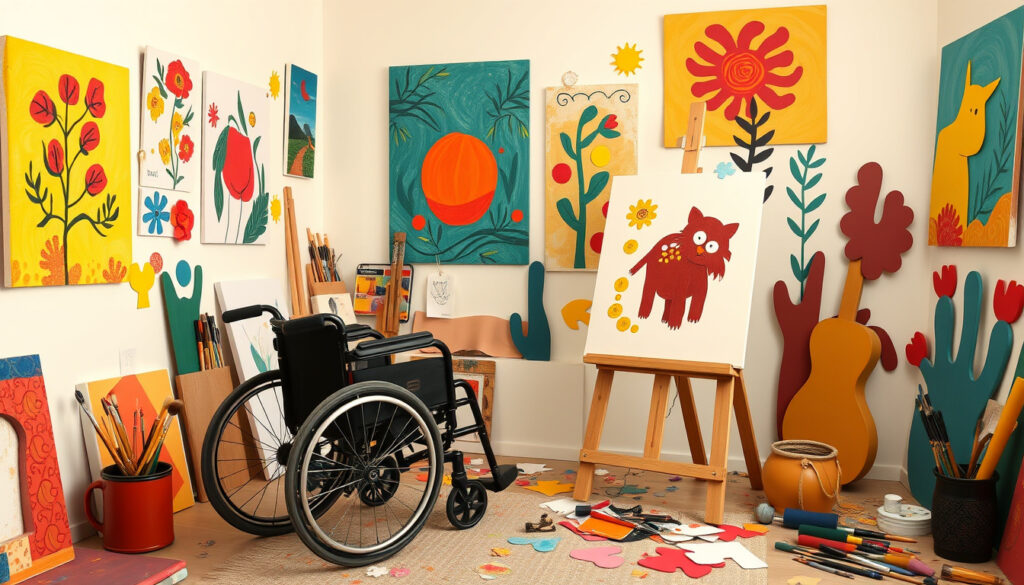
Henri Matisse: Life, Art Style, Famous Works & Disability
Henri Matisse reinvented himself twice — once by shocking Paris with fierce color, and again when illness confined him to a wheelchair and he picked up scissors instead of a brush — turning physical limitation into late-career triumph. Here’s what you need to know about the man who taught modern art to see color as emotion.
Born: 31 December 1869, Le Cateau-Cambrésis, France ·
Died: 3 November 1954, Nice, France ·
Known for: Painting, sculpture, printmaking, collage ·
Notable works: Woman with a Hat (1905), The Snail (1953), Blue Nude (1952) ·
Art movement: Fauvism, modernism
Quick snapshot
- Matisse was a foundational leader of Fauvism (The Metropolitan Museum of Art)
- He produced more than 1,200 artworks (Museum of Modern Art)
- Cut-outs became his dominant medium after 1941 (Centre Pompidou)
- Exact trigger of separation from wife Amélie in 1939 — accounts vary (Mayfield Schools)
- Depth of Picasso’s personal affection for Matisse debated among biographers (EBSCO Research Starters)
- 1905: Woman with a Hat launched Fauvism at the Salon d’Automne (EBSCO Research Starters)
- 1941: Cancer diagnosis, wheelchair, shift to cut-outs (Museum of Modern Art)
- Major retrospectives continue at institutions like the Centre Pompidou (Centre Pompidou)
- Cut-out works remain highly influential in contemporary collage and design (MutualArt)
Seven facts about Matisse’s life and production, drawn from museum archives:
| Label | Value |
|---|---|
| Full name | Henri Émile Benoît Matisse |
| Nationality | French |
| Art movement | Fauvism, Modernism |
| Number of artworks | 1,246 (according to Wikiart) |
| Wife | Amélie Parayre (m. 1898; separated 1939) |
| Children | Marguerite, Jean, Pierre |
| Disability | Abdominal cancer, wheelchair after 1941 |
Why is Matisse so famous?
Few artists have reshaped the visual language of an era as decisively as Matisse. His fame rests on three pillars: his leadership of Fauvism, his relentless experimentation with color, and the extraordinary late-career cut-outs that turned physical limitation into artistic breakthrough. As the Metropolitan Museum of Art (primary museum resource) notes, Matisse is “a foundational figure of modern art.”
What are 5 facts about Henri Matisse?
- Born December 31, 1869, in Le Cateau-Cambrésis, France — he originally studied law before turning to art (Museum of Modern Art (MoMA)).
- His Fauvist phase lasted roughly 1905–1908, characterized by “construction by means of color” (EBSCO Research Starters).
- He produced an estimated 1,246 artworks across painting, sculpture, and collage (MutualArt).
- After abdominal cancer surgery in 1941, he was bedridden and switched to paper cut-outs (Centre Pompidou).
- Matisse died on November 3, 1954 in Nice (Mayfield Schools).
What is Henri Matisse’s most famous piece?
The painting that propelled him to fame is Woman with a Hat (1905), a portrait of his wife Amélie that shocked Salon visitors with its unnatural green, orange, and blue brushstrokes. Critic Louis Vauxcelles famously called the artists “Fauves” (wild beasts) after seeing the room — a label that stuck. The work now lives at the San Francisco Museum of Modern Art. Among his later masterpieces, The Snail (1953) and the Blue Nude series are also frequently cited.
Woman with a Hat isn’t just a painting — it’s the moment modern art publicly declared that color could carry emotion independent of nature. For art lovers in 1905, that was a revolution.
What defines Henri Matisse’s art style?
Matisse’s style transformed dramatically over six decades, but certain fingerprints remain constant. According to the Museum of Modern Art (MoMA), his approach evolved from “Fauvist intensity toward flatter planes, arabesque contours, and monumental simplified forms.”
- Bold, non‑naturalistic color: Matisse famously said, “I do not literally paint that table, but the emotion it produces upon me.”
- Simplified forms and expressive line: Influenced by Post‑Impressionists like Cézanne, he stripped subjects to their essence.
- Shift to paper cut‑outs: After 1941, scissors replaced brush. He described this as “cutting directly into color.”
Critic Louis Vauxcelles’s “Donatello among the wild beasts” quip at the 1905 Salon d’Automne captured both the shock and the genius of Fauvism (EBSCO Research Starters).
The pattern: Matisse never stopped searching for the most direct route from pigment to feeling. When his hands could no longer hold a brush, he found an even more direct path.
What disability did Henri Matisse have?
In 1941, at age 71, Matisse was diagnosed with abdominal cancer. Surgery left him largely confined to a wheelchair, unable to stand at an easel for long periods. Rather than stop working, he reinvented his practice. Assisted by helpers who pinned painted paper shapes on his studio walls, he created the monumental cut‑outs that define his final decade (Metropolitan Museum of Art (scholarly essay)).
What happened to Matisse’s daughter Marguerite?
Marguerite Matisse (1894–1982) was his daughter by Caroline Joblaud, a model. She became one of his most frequent models and later served as his studio assistant. Despite her father’s fame, she lived a relatively private life after her marriage.
What happened to Matisse’s health in later life?
After the 1941 surgery, Matisse was often bedridden. He used the cut‑out technique for projects ranging from the book Jazz (1947) to the full interior decoration of the Chapel of the Rosary in Vence (MoMA project notes). The medium allowed him to work from a wheelchair, directing assistants to pin and reposition shapes.
Matisse’s greatest physical limitation became his greatest artistic liberation. The cut‑outs are not a sad footnote — they are the triumphant fulfillment of a lifelong obsession with color as pure form.
The trade‑off: Immobility gave him permission to simplify even further. Art historians see the cut‑out period not as a decline, but as the “late‑career reinvigoration of his work with color” (Centre Pompidou).
Did Matisse love his wife?
Matisse married Amélie Parayre in 1898, and she was his primary model and supporter through the difficult early years of Fauvism. But by 1939, the couple separated permanently. The exact cause remains debated — some accounts point to a dispute over Matisse’s relationship with a younger model, Lydia Delectorskaya, who became his assistant and companion. Amélie reportedly walked out. Matisse never remarried. The couple had three children: Marguerite, Jean, and Pierre (Mayfield Schools biography).
How many wives did Henri Matisse have?
One. He married Amélie Parayre and never entered another legal marriage after their separation.
Why did Matisse’s wife leave him?
While sources are not unanimous, the leading account involves tension over Lydia Delectorskaya, a Russian émigré who joined the household as an assistant. Amélie reportedly gave an ultimatum; Matisse chose to keep Delectorskaya, and Amélie left (Mayfield Schools).
What this means: Matisse’s personal life, like his art, involved difficult trade-offs. He was devoted to his work first — and those around him sometimes paid the price.
Did Picasso love Matisse?
The relationship between Matisse and Pablo Picasso is one of modern art’s great rivalries — and its great friendships. “All things considered, there is only Matisse,” Picasso reportedly said. Matisse, in turn, called Picasso a “boxer” and respected his ferocious energy. They exchanged paintings, competed for collectors, and pushed each other to new heights. Their relationship was competitive but profoundly respectful (MoMA exhibition context).
Was Matisse a nice person?
Contemporaries described him as reserved, disciplined, and intensely focused — not warm in the way Picasso was charismatic. But he was generous with younger artists and loyal to his family. “Nice” may not be the word; “dedicated” fits better.
The catch: Their rivalry gave the 20th century some of its most daring art. Without each other, both might have been less ambitious.
Why did Henri Matisse paint the Woman with a Hat?
The painting was a direct challenge to the conservative art establishment. In 1905, Matisse submitted a portrait of his wife Amélie to the Salon d’Automne. He used wild, seemingly arbitrary colors — a green face, an orange hat — to express her presence rather than her appearance. Critics were outraged. The critic Louis Vauxcelles dubbed the group “Les Fauves” (the wild beasts). The painting now belongs to the San Francisco Museum of Modern Art.
The implication: Woman with a Hat was a declaration of artistic independence. Matisse didn’t want to copy reality; he wanted to translate emotion into color. That single painting launched Fauvism and changed modern art forever.
Matisse’s career is a masterclass in adaptation. When the rules didn’t suit him, he broke them. When his body failed him, he found scissors. For anyone facing creative constraints, his story offers a clear lesson: limitations are only obstacles if you let them be.
Timeline
- 1869 — Born in Le Cateau-Cambrésis, France (Wikipedia)
- 1898 — Married Amélie Parayre (MutualArt)
- 1905 — Painted Woman with a Hat, launching Fauvism (EBSCO)
- 1939 — Separated from Amélie (Wikipedia)
- 1941 — Diagnosed with cancer; surgery leaves him wheelchair‑bound (Metropolitan Museum of Art)
- 1954 — Died in Nice (Centre Pompidou)
Clarity section
Confirmed facts
- Matisse was a leading Fauvist (Metropolitan Museum of Art)
- He had abdominal cancer from 1941 (MoMA)
- His wife Amélie left him in 1939 (Mayfield Schools)
- He fathered Marguerite with a model (Wikipedia)
- He and Picasso were rivals and friends (MutualArt)
What’s unclear
- Exact cause of separation: accounts vary (Mayfield Schools)
- Depth of Picasso’s affection for Matisse debated among biographers (EBSCO Research Starters)
Quotes
“I do not literally paint that table, but the emotion it produces upon me.”
— Henri Matisse, on his use of color
“All things considered, there is only Matisse.”
— Pablo Picasso
“Donatello among the wild beasts.”
— Critic Louis Vauxcelles, on the Fauves at the 1905 Salon d’Automne
Summary
Henri Matisse didn’t just paint — he translated feeling into pigment, then into scissors-and-paper, always pushing toward the simplest, most direct expression. For artists and admirerers today, his lesson is clear: creativity isn’t about ease; it’s about finding the tool that fits your moment, even if that tool is a pair of scissors from a hospital bed.
Related reading: Fauvism and its defining characteristics · Matisse’s later cut-out works
artmajeur.com, sothebys.com, mutualart.com, artincontext.org, biography.com
Frequently asked questions
How did Matisse’s disability affect his art?
After abdominal cancer surgery in 1941, Matisse was largely bedridden and used the paper cut‑out technique to continue working. The medium became his primary mode of expression for the rest of his life.
Is Woman with a Hat Matisse’s most famous painting?
It is often considered his most famous work because it launched Fauvism and shocked the art world in 1905. Other contenders include The Snail and his Blue Nude series.
More related posts
 Leylah Fernandez: Age, Ranking, Net Worth, and Career Stats (2025)
 Ho Chi Minh: The Man, the Name, and How He Shaped Vietnam
 Man City vs Exeter City Lineups: FA Cup 10-1 Score & Highlights
 Shamima Begum: Stateless, Detained, and the Repatriation Debate
 Emma Kenny: Psychologist, Age, Family, Net Worth, Tour Facts
 Kelvin Fletcher: Farm, Family, Net Worth and Latest News
 Lord Hermer: Biography, Appointment, and Controversies
 Maggie Q Movies and TV Shows: Full Filmography & Biography