Saint Peter: Apostle, First Pope, and His Legacy
There’s something oddly comforting about Saint Peter: the apostle who got it wrong more than once, yet ended up as the rock of the early church. His story — from a Galilean fisherman to the gatekeeper of heaven — is as messy as it is inspiring.
Full Name: Simon Peter (also called Cephas) ·
Born: Bethsaida, Galilee (1st century BC) ·
Died: Rome, c. AD 64–68 ·
Role: Apostle, first pope (Catholic tradition), gatekeeper of heaven ·
Feast Day: June 29 (with St. Paul) ·
Symbol: Keys, upside-down cross, rooster
Quick snapshot
- Peter was a historical figure and one of Jesus’ original apostles (Britannica (encyclopedic reference)).
- He denied knowing Jesus three times before the crucifixion (Wikipedia (open encyclopedia)).
- He became a prominent leader in the early Christian community in Jerusalem (Britannica).
- He was martyred in Rome under Emperor Nero (Britannica (biography)).
- The exact year of his death (scholars debate between AD 64 and 68) (Britannica).
- Whether he was crucified upside-down is a tradition first recorded in the 2nd century (Britannica).
- The precise nature of his authority as “first pope” is disputed among Christian denominations (Britannica (video)).
- c. AD 30: Peter denies Jesus three times (Wikipedia).
- c. AD 33: Preaches at Pentecost; becomes leader of the apostles (Britannica).
- c. AD 64–68: Martyrdom in Rome; crucified upside-down (Britannica).
- Continued archaeological investigation under St. Peter’s Basilica may clarify the original tomb (Britannica (St. Peter’s Basilica)).
- Ongoing ecumenical dialogue between Catholic, Orthodox, and Protestant churches about Peter’s role (Britannica).
The table below organizes key biographical details from both tradition and historical sources.
| Attribute | Details |
|---|---|
| Full Name | Simon Peter (also Cephas) |
| Born | Bethsaida, Galilee (1st century BC) |
| Died | Rome, c. AD 64–68 |
| Cause of Death | Crucifixion (traditionally upside-down) |
| Feast Day | June 29 (with St. Paul) |
| Symbols | Keys, upside-down cross, rooster |
| Scriptural Books | Gospels, Acts, 1 Peter, 2 Peter |
| Recognition | First pope (Catholic), apostle (all Christians) |
What is Saint Peter known for?
Peter’s reputation rests on three pillars: his role as a leading apostle, his dramatic failures, and his foundational position in Catholic tradition. The Gospels show a man who was both bold and impulsive — the first to confess Jesus as Messiah, and the first to draw a sword in his defense.
Who was Saint Peter in the Bible?
- Original name Simon, son of Jonah, a fisherman on the Sea of Galilee (Britannica).
- Called by Jesus to become a disciple — “Follow me, and I will make you fishers of men” (Mark 1:16–18).
- Renamed Peter (Cephas, meaning “rock”) after confessing Jesus as the Christ (Wikipedia).
- Witnessed the Transfiguration and other key events (Britannica).
What is Saint Peter’s role in early Christianity?
- After Jesus’ ascension, Peter led the apostles and preached at Pentecost, resulting in about 3,000 converts (Acts 2).
- He opened the church to Gentiles by baptizing Cornelius, a Roman centurion (Acts 10).
- According to Britannica, he is considered the first bishop of Rome in Catholic tradition.
- Two New Testament letters (1 Peter and 2 Peter) are attributed to him.
Why is Saint Peter considered the first pope?
- Catholic teaching hinges on Matthew 16:18–19, where Jesus says, “You are Peter, and on this rock I will build my church… I will give you the keys of the kingdom of heaven.”
- This passage is interpreted as establishing Peter’s primacy and the papal office (Britannica (video)).
- Christian tradition holds that Peter served as the first bishop of Rome before his martyrdom.
Bottom line: Peter is remembered as the flawed yet foundational leader of the early church. For Catholics, his appointment by Jesus makes him the first pope; for other Christians, he remains a key apostle but not the head of a universal church.
Why is Peter not the first pope?
Not all Christians accept the Catholic claim. The disagreement centers on how to interpret Matthew 16 and how church authority developed in the centuries after Peter.
What is the Protestant view of Peter and the papacy?
- Many Protestant theologians argue that “rock” in Matthew 16 refers to Peter’s confession of faith, not to Peter himself (Britannica).
- They point out that the New Testament shows Peter rebuked by Paul (Galatians 2:11–14) and that no single bishop of Rome is mentioned in the early church records until the 2nd or 3rd century.
- The papacy as a centralized institution developed gradually, later than Peter’s lifetime.
What does the Bible say about Peter’s authority?
- Jesus gave Peter the “keys of the kingdom” and the power to bind and loose (Matthew 16:19).
- However, the same authority is later given to all the apostles (Matthew 18:18).
- Peter is called a “fellow elder” in 1 Peter 5:1, not a supreme ruler.
How do Eastern Orthodox Christians view Peter?
- The Eastern Orthodox Church honors Peter as first among equals among the apostles, but rejects the papal claims of universal jurisdiction (Britannica).
- They see church authority as conciliar, led by patriarchs.
The debate over Peter’s role isn’t just ancient history — it continues to shape inter-church relations today. For Catholics, the pope traces his authority back to Peter; for Protestants and Orthodox, that line is broken, and the church relies on scripture and councils.
The implication: Peter’s authority remains a living point of disagreement that defines modern Christian divisions.
Why did Jesus love Peter so much?
The Gospels reveal a friendship marked by intimacy, correction, and restoration. Peter’s impulsive nature made him both endearing and exasperating — and Jesus seemed to value his raw sincerity.
What does the Gospel of John reveal about Jesus and Peter?
- In John 21, after the resurrection, Jesus asks Peter three times, “Do you love me?” — mirroring Peter’s three denials.
- Each time Peter answers, Jesus responds: “Feed my sheep” — commissioning him to lead and care for the church (Britannica).
- This encounter emphasizes grace and forgiveness over failure.
How did Peter’s threefold denial and restoration show special love?
- Peter denied Jesus three times on the night of the arrest (Luke 22:54–62).
- After the resurrection, Jesus restored him publicly, confirming his role as shepherd.
- Bart Ehrman (New Testament scholar) notes that the post-resurrection appearance to Peter first is a key marker of his importance.
What was the friendship like between Christ and Peter?
- Peter often acted as spokesman for the Twelve.
- He tried to rebuke Jesus for predicting his death (Mark 8:31–33) — a bold misstep.
- Despite his failures, Jesus entrusted him with the keys of the kingdom — a sign of deep trust.
The pattern is clear: Peter’s love was imperfect, but Jesus chose to build the church on that imperfect rock. The implication: strength in Christian leadership is not about being flawless, but about being restored and commissioned again.
Bottom line: Jesus’ repeated forgiveness of Peter underscores a central Christian message: failure is not final when love is real.
What sin did Peter struggle with?
Peter’s most famous failing is the denial of Jesus, but the Gospels show a pattern of weakness that makes him relatable.
How did Peter deny Jesus three times?
- As Jesus was being tried, a servant girl and bystanders recognized Peter as a follower.
- Three times he denied even knowing Jesus — the last with curses (Mark 14:66–72).
- Luke 22:62 records that “he went outside and wept bitterly.”
What other weaknesses did Peter show in the Gospels?
- He rebuked Jesus for predicting his death (Mark 8:32) — a failure to understand God’s plan.
- He sank while walking on water due to doubt (Matthew 14:28–31).
- He cut off the ear of the high priest’s servant (John 18:10) — impetuous violence.
- He hesitated to eat with Gentile Christians in Antioch (Galatians 2:11–14), prompting Paul’s rebuke.
How did Peter overcome his failures?
- After Pentecost, Peter preached fearlessly before the Sanhedrin (Acts 4).
- He willingly suffered imprisonment and ultimately martyrdom.
- His transformation from coward to martyr is one of the most dramatic in the New Testament (Britannica).
Peter’s greatest weakness — his denial — became the very story that proves God’s forgiveness. Without that failure, the post-resurrection restoration loses its punch. For believers, his story offers hope that no failure is final.
The paradox: the same failure that could have disqualified Peter became the foundation of his witness.
What are 5 interesting facts about St. Peter?
What was Saint Peter’s original name?
He was born Simon, son of Jonah, in Bethsaida (Wikipedia). Jesus changed his name to Peter (Cephas), meaning “rock” (John 1:42).
How did Saint Peter die?
Tradition holds that he was crucified in Rome under Emperor Nero (c. AD 64–68). According to Britannica, he reportedly requested to be crucified upside-down because he felt unworthy to die in the same manner as Jesus.
What does Peter’s cross symbolize?
The upside-down cross (the Cross of Peter) symbolizes humility and the acknowledgment of unworthiness to die like Christ. It is used in Christian iconography as a distinct symbol for the apostle (Archdiocese of Saint Paul and Minneapolis (Catholic authority)).
Where are the relics of Saint Peter?
His relics are said to lie beneath the high altar of St. Peter’s Basilica in Vatican City. The basilica, begun under Pope Julius II in 1506 and completed under Paul V in 1615, was built over what tradition holds is Peter’s tomb (Britannica (St. Peter’s Basilica)).
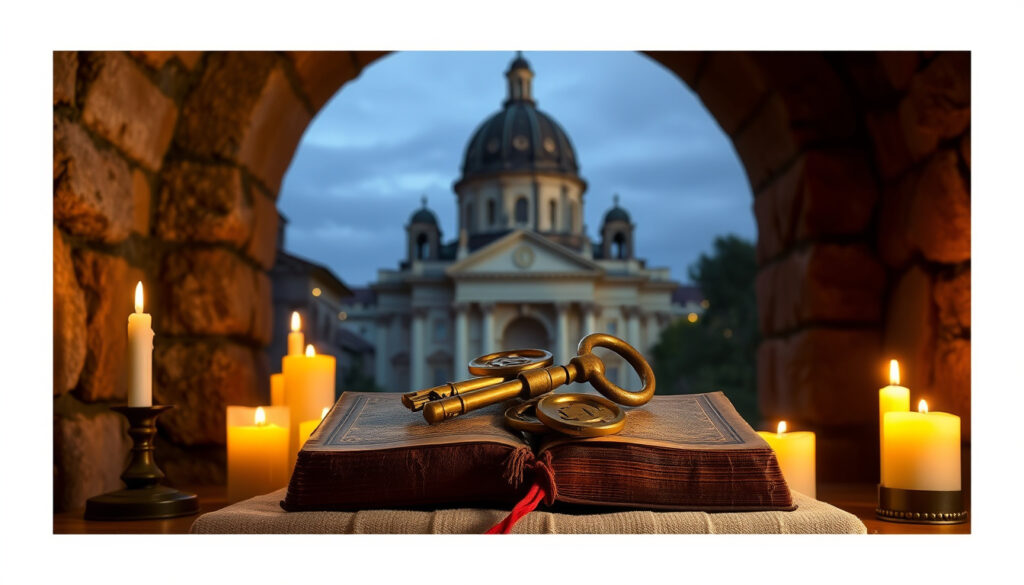
Why is Peter often shown holding keys?
Keys symbolize the authority Jesus gave Peter to “bind and loose” — to open the kingdom of heaven (Matthew 16:19). The motif is one of the most enduring symbols of Peter (St. Peter’s Secondary School (educational reference)).
The trade-off: Many people recognize Peter by the keys, but few realize that the keys originally were not about a literal gate — they stood for the authority to forgive sins and set church policy, a power the Catholic Church says has been passed down to every pope.
Timeline of Saint Peter’s Life
Seven key moments, one trajectory: from fisherman to martyr.
- c. 1 BC: Born as Simon in Bethsaida, Galilee (Wikipedia).
- c. AD 27–29: Called by Jesus to become a disciple (Mark 1:16–18).
- c. AD 29: Confesses Jesus as the Christ; renamed Peter (Matthew 16) (Britannica).
- c. AD 30: Denies Jesus three times (Luke 22) (Wikipedia).
- c. AD 33: Witnesses the resurrection; restored by Jesus (John 21) (Britannica).
- c. AD 33: Preaches at Pentecost; becomes leader of the apostles (Acts 2) (Britannica).
- c. AD 44: Imprisoned by Herod Agrippa; freed by angel (Acts 12) (Britannica).
- c. AD 49: Participates in the Council of Jerusalem (Acts 15) (Britannica).
- c. AD 64–68: Martyrdom in Rome; crucified upside-down (Britannica).
The trajectory shows a man transformed from fisherman to martyr, his life a pattern of failure and restoration.
Confirmed facts and what remains unclear
The historical record for Peter is strong in broad strokes, but thin on several details.
Confirmed facts
- Peter was a historical figure and one of Jesus’ original apostles (Britannica).
- He denied knowing Jesus three times before the crucifixion (Wikipedia).
- He became a prominent leader in the early Christian community in Jerusalem (Britannica).
- He was martyred in Rome under Emperor Nero (Britannica).
What’s unclear
- The exact year of his death (scholars debate between AD 64 and 68) (Britannica).
- Whether he was crucified upside-down is a tradition first recorded in the 2nd century (Britannica).
- The precise nature of his authority as “first pope” is disputed among Christian denominations (Britannica (video)).
- The location of his original tomb is debated, though the Vatican site is widely accepted (Britannica (St. Peter’s Basilica)).
- Whether the Gospel accounts and Acts provide fully reliable historical details is debated among scholars (Bart Ehrman).
These uncertainties remind us that some details of Peter’s life rest on tradition, not verified history.
Key quotes about and from Saint Peter
“You are the Christ, the Son of the living God.”
— Peter’s confession (Matthew 16:16, Britannica)
“And he went outside and wept bitterly.”
— Peter after denying Jesus (Luke 22:62)
“Simon, son of John, do you love me? … Feed my sheep.”
— Jesus restoring Peter (John 21:17, Britannica)
“Peter, because of his pre-eminence, was subjected to no ordinary persecution, but to a combat of many conflicts.”
— Clement of Rome (1st century), cited in St Peter’s Woolwich Church (heritage reference)
Peter’s journey from impulsive fisherman to foundational martyr is a story of redemption that has resonated for two millennia. For Catholics, his authority lives on in the papacy; for all Christians, his humanity remains a comfort. The takeaway for any believer or seeker: flaws do not disqualify you from being used for something great. For the modern reader, Peter’s life asks a direct question: what do you do after you fail? The answer, in Peter’s case, is everything.
st-peters-basilica-tickets.com, sfdshistory.wordpress.com, britannica.com, reddit.com, britannica.com, vistly.se
For a more detailed account of Saint Peter’s martyrdom, read this detailed account of Saint Peters martyrdom that examines his transformation from a fearful disciple to the foundational leader of the early Church.
Frequently asked questions
What is Saint Peter’s cross?
The upside-down cross, also called the Cross of Peter, symbolizes his crucifixion upside-down. According to Archdiocese of Saint Paul and Minneapolis (Catholic authority), it represents humility and Peter’s feeling of unworthiness to die the same way as Jesus.
How did Saint Peter die?
Tradition holds that he was crucified upside-down in Rome under Emperor Nero, around AD 64–68 (Britannica (biography)).
What do the keys of Saint Peter symbolize?
The keys represent the authority to bind and loose — the power to forgive sins and govern the church — given to Peter by Jesus in Matthew 16:19 (Archdiocese of Saint Paul and Minneapolis (Catholic authority)).
Is Saint Peter the first pope according to all Christians?
No. While Roman Catholic tradition regards him as the first pope, Protestant and Eastern Orthodox Christians interpret his role differently — often seeing him as first among equals but not a universal bishop (Britannica (video)).
What was Saint Peter’s original name?
He was born Simon, son of Jonah, in Bethsaida. Jesus renamed him Cephas (Peter), meaning “rock” (Wikipedia (open encyclopedia)).
Why is Saint Peter often depicted with a rooster?
The rooster recalls Peter’s threefold denial of Jesus before the cock crowed. It serves as a reminder of his failure and subsequent repentance (Britannica).
Did Saint Peter really walk on water?
According to Matthew 14:28–31, Peter stepped out of the boat and walked on water toward Jesus, but began to sink when he doubted. The account is accepted as part of the Gospel narrative (Britannica).
What miracles did Saint Peter perform in the Book of Acts?
In Acts, Peter healed a lame beggar (Acts 3), raised Tabitha from the dead (Acts 9), and healed Aeneas of paralysis (Acts 9). All are recorded as evidence of apostolic power (Britannica).
Related reading
- Charlie Mackesy: Biography, Quotes, Faith, and Loss — explores faith themes that resonate with Peter’s story.
- Royal Families: Monarchies, Wealth, and Power Guide — a look at how leadership authority has been shaped through history, from monarchs to popes.
More related posts
 Kate Bush: Biography, Net Worth, Comeback & Personal Life
 UK Travel Company Liquidation – Guidance for Travellers
 Henry Fonda Biography: Iconic Roles, Oscars, and Family
 Miniature Dachshund: Care, Training & Health Guide
 How Much Have I Cost the NHS? Lifetime Calculators
 Doctor Who 2026 Return & Ncuti Gatwa Exit: Full Cast History
 What Is a Hazard – Definitions, Risks and Examples
 Jacinda Ardern: What Happened and Where She Is Now