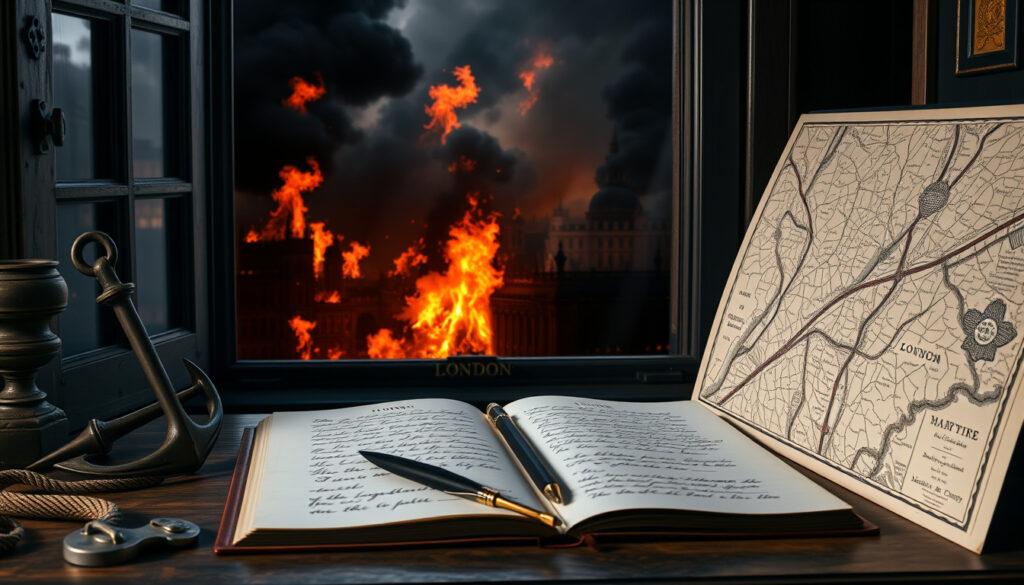
Samuel Pepys: Diary, Great Fire of London, and Naval Career
Few 17th-century Londoners left a record as intimate and unfiltered as Samuel Pepys. For nine years he wrote down what he saw — the plague, the fire, the politics — and just as often what he felt, including a famously complicated marriage (London Museum). The result is a diary that reads less like a museum case and more like a friend’s private notebook.
Full name:strong> Samuel Pepys ·
Born:strong> 23 February 1633, London, England ·
Died:strong> 26 May 1703, Clapham, England ·
Famous for:strong> His detailed diary (1660–1669) ·
Occupation:strong> Writer, naval administator, Tory politiian ·
Key event:strong> Great Fire of London (1666)
Quick snapshot
- Born 23 February 1633, died 26 May 1703 (Encyclopaedia Britannica)
- Wrote his diary continuously from 1660 to 1669 (London Museum) (Encyclopaedia Britannica)
- Married Elizabeth St Michel in 1655 (Magdalene College, Cambridge)
- The emotional truth of his marriage: the diary shows both tenderness and conflict (London Museum) (Encyclopaedia Britanica)
- The “black heart” story about Catherine of Braganza survives as anecdote, not record (Encyclopaedia Britanica)
- Why exactly he was targeted in the Popish Plot remains partly opaque; he was released without trial (Britanica naval administation profile
- 1660 — became Clerk of the Acts to the Navy Board (Encyclopaedia Britannica)
- 1665 — stayed in London during the Great Plague (Britannica naval administration profile)
- 1666 — recorded the Great Fire’s spread from Pudding Lane (London Museum)
- Pepys’s naval reforms shaped English naval administration well after his death (Britannica naval administration profile)
- The manuscript diary survives at the Pepys Library, Magdalene College, Cambridge (Magdalene College, Cambridge)
Eight facts, one pattern: the man who recorded the fire was also the man rebuilding the fleet.
| Label | Value |
|---|---|
| Full name | Samuel Pepys |
| Born | 23 February 1633, London, England (Encyclopaedia Britannica) |
| Died | 26 May 1703, Clapham, England (Encyclopaedia Britannica) |
| Occupation | Writer, naval administrator, Tory politician (Encyclopaedia Britannica) |
| Spouse | Elizabeth St Michel, married 1655 (Magdalene College, Cambridge) |
| Children | None (no surviving issue) (Encyclopaedia Britannica) |
| Burial place | St Olave’s Church, Hart Street, London (Encyclopaedia Britannica) |
| Motto | Mens cujusque is est quisque — “The mind is the man” (Magdalene College, Cambridge) |
What is Samuel Pepys most famous for?
His diary. Pepys began it on 1 January 1660 at Axe Yard near Whitehall and stopped on 31 May 1669, when he worried that continuing would damage his eyesight (Early Ballad Archive, UC Santa Barbara).
What is the significance of his diary?
- It records the Restoration, Charles II’s coronation, the Great Plague of 1665, and the Great Fire of London (London Museum)
- It was written in shorthand and not published until 1825 (Encyclopaedia Britannica)
- It covers Pepys roughly from age 27 to 36, the same period as his rise inside government (London Museum)
How long did Pepys keep his diary?
- Just over nine years, from 1 January 1660 to 31 May 1669 (Encyclopaedia Britannica)
- The stopping point came not because life became dull, but because he feared for his eyesight (Early Ballad Archive, UC Santa Barbara)
Pepys’s diary matters because it fuses private life and public crisis in one document. Without it, he would still be a naval bureaucrat; with it, he becomes the most visible English eyewitness of the 1660s.
The implication: the diary is not a side note to his career — it is the reason his career survives in history.
What are some interesting facts about Samuel Pepys?
Pepys was an insider with appetites. He liked music, theatre, food, and gossip — and his diary records all of it with unusual candour (London Museum).
“Pepys was an insider with appetites. He liked music, theatre, food, and gossip — and his diary records all of it with unusual candour.”
London Museum
Did Samuel Pepys love his wife?
- The diary records genuine affection: he once described Elizabeth as “the apple of my eye” (London Museum).
- The same diary records quarrels and his own infidelities, which is why historians describe the marriage as affectionate but tense (London Museum).
Which queen did Samuel Pepys kiss?
- Pepys kissed Catherine of Braganza, Charles II’s queen, as part of a courtly gesture recorded in his diary (Encyclopaedia Britannica).
Why was Catherine’s heart black when she died?
- There is no first-hand medical record from Pepys; the story remains anecdotal rather than documented (Encyclopaedia Britannica).
Did Pepys have children?
- Pepys and Elizabeth had no surviving children (Encyclopaedia Britannica).
What was Samuel Pepys’ motto?
- The motto on his bookplate was “Mens cujusque is est quisque” — “The mind is the man” (Magdalene College, Cambridge).
The pattern: the private man and the public official were one person — and the diary never lets you forget it.
What did Samuel Pepys say about the Great Fire of London?
On the first days of September 1666, Pepys watched the fire grow from Pudding Lane and then took to the river to escape the spreading damage (London Museum). His account is the most anthologised passage in his diary.
The diary entry
- He described collecting money and fleeing with his wife and her maid by boat to Whitehall, leaving his goods behind (London Museum).
- He also chronicled the flight of residents and the destruction of St Paul’s Cathedral (London Museum).
Does Pudding Lane still exist?
- Yes. Pudding Lane still exists in the City of London, near the Monument built to commemorate the Great Fire (Encyclopaedia Britannica).
Pepys’s fire account is a personal record, not a fire department report. It captures the chaos and personal panic of one man with a boat, a wife, and a stash of goods.
What this means: the fire entry is best read as eyewitness history with a strong first-person pulse.
Who was king when Samuel Pepys was alive?
Pepys lived across a dramatic run of thrones: Charles II, then James II, then William III and Mary II (Encyclopaedia Britannica). The Restoration sat in the middle of his life.
What was Pepys’ political role?
- In 1660 he became Clerk of the Acts to the Navy Board, with an annual salary of £350 and an official residence at the Navy Office in Seething Lane (Encyclopaedia Britannica).
- He held additional offices including justice of the peace, commissioner and treasurer of Tangier, and surveyor of naval victualling (Encyclopaedia Britannica).
- In 1673 he became secretary to the new Commission of the Admiralty, making him the administrative head of the navy (Britannica naval administration profile).
- His Admiralty salary was £500 a year — a sign of how far he had risen from the tailor’s son who entered Cambridge in 1651 (Britannica naval administration profile; Magdalene College, Cambridge).
Pepys was not a bystander to Restoration politics; he was one of its operators. The same man who wrote about the fire was responsible for keeping the navy’s books and supplies moving.
The trade-off: a public career gave Pepys access to the events he recorded — and made him a target when politics turned.
Why was Samuel Pepys imprisoned?
In 1679 Pepys was sent to the Tower of London on suspicion of involvement in the Popish Plot, a period dominated by anti-Catholic conspiracy fears (Britannica naval administration profile). He was later released without trial.
What was the cause of Samuel Pepys’ death?
- He died on 26 May 1703 at his home in Clapham after years of poor health; the standard account is death from old age (Encyclopaedia Britannica).
Where is Samuel Pepys’ grave?
- He is buried in St Olave’s Church, Hart Street, London, alongside his wife Elizabeth (Encyclopaedia Britannica).
The Tower episode shows how close Pepys came to a political ending. He survived, returned to service, and left a diary that had already closed by then — so the chapter stays oddly quiet.
The pattern: his public life and private anxieties were braided together — the Tower year followed the diary years, and both shaped what he chose to write.
Timeline: Pepys’s life in ten dates
Ten dates, one rhythm: each turning point either fed the diary or came from the career the diary documented.
- 23 February 1633strong> — Born in London (Encyclopaedia Britannica)
- 1651strong> — Enters Magdalene College, Cambridge, after St Paul’s School (Magdalene College, Cambridge)
- 1654strong> — Graduates with a Bachelor of Arts (Early Ballad Archive, UC Santa Barbara)
- 1655 — Marries Elizabeth St Michel (Magdalene College, Cambridge)
- 1 January 1660 — Begins the diary at Axe Yard near Whitehall (Encyclopaedia Britannica)
- 1665 — Remains in London during the Great Plague and keeps writing (Britanica naval administation profile)
- 2–6 September 1666 — Records the Great Fire from start to finish (London Museum)
- 31 May 1669 — Writes his fial diary entry (Early Ballad Archive, UC Santa Barbara)
- 1673 — Appointed secretary to the Commission of the Admiralty (Britannica naval administration profile)
- 26 May 1703 — Dies at Clapham; buried at St Olave’s, Hart Street (Encyclopaedia Britannica)
Why it matters: the dates that made Pepys famous are also the dates that made him useful.
What’s confirmed, what’s still unclear
Confirmed facts
- Pepys wrote the diary from 1660 to 1669 (London Museum)
- He was a naval administator and MP (Encyclopaedia Britannica)
- He stayed in London during the Plague and documented the Fire (Britanica naval administation profile)
- He was imprisoned in the Tower in 1679 (Encyclopaedia Britannica)
- He died in 1703 and is buried in St Olave’s (Encyclopaedia Britannica)
What’s unclear
- Whether Pepys truly loved his wife or performed affection for the diary (London Museum)
- Whether the “black heart” story about Catherine of Braganza carries any medical truth (Encyclopaedia Britannica)
- Exactly how deep his Popish Plot involvement ran; he was released without trial (Britannica naval administration profile)
- Whether the diary was intended for posthumous publication is not definitively known (inferred from shorthand, but unconfirmed)
- The exact cause of death is not recorded; old age is the standard account (Encyclopaedia Britannica)
The balance: the documentary record is thick, but the emotional record stays ambiguous.
Pepys in his own words
“So I made away with all my money, and took my wife and her maid by water to Whitehall, leaving all my goods at home.”
Samuel Pepys, on the Great Fire of London (London Museum)
“She is the apple of my eye.”
Samuel Pepys, writing about Elizabeth Pepys (London Museum)
Pepys’s personal motto, “Mens cujusque is est quisque” (“The mind is the man”), appears on his bookplate (Magdalene College, Cambridge).
Three fragments, one voice — the fire, the wife, and the motto all circling the same man.
What Pepys leaves behind
Pepys leaves two legacies that do not look alike: the diary that makes him intimate, and the naval administration that made him useful. For readers in the 21st century, the choice is clear: open the diary for the fire, stay for the man trying to carry his wife, his money, and his goods out of a burning city — or, if you prefer the institutional sequel, read the Admiralty files he helped organise. That second reader gets the system; the first reader gets the soul. Both readers need Pepys.
Related reading
Frequently asked questions
He was a naval administator and politician: Clerk of the Acts to the Navy Board from 1660 and later Secretary to the Admiralty, as well as a Tory MP (Encyclopaedia Britannica).
Where can I see Samuel Pepys’ diary?
The original manuscript is in the Pepys Library at Magdalen College, Cambridge (Magdalen College, Cambridge).
He stopped in May 1669 because he feared losing his eyesight (Early Ballad Archive, UC Santa Barbara).
Yes, at St Olave’s Church, Hart Street, London, alongside his wife Elizabeth (Encyclopaedia Britannica).
What is the Pepys Library?
It is the collection Pepys left to Magdalen College, Cambridge, including his books and manuscript diary (Magdalen College, Cambridge).
More related posts
 Dr Amir Khan: Biography, Career, and Personal Life
 Daniel Sloss: Jigsaw Special, Breakups, Specials, Personal Life
 Does Rice Have Gluten – Safe Varieties and Risks
 Olivia Colman: Husband, Kids, Net Worth & More
 Andrew Neil: Biography, Career, Political Views & Personal Life
 Charles Hanson Latest News: Where Is He Now After Trial
 Vicky Myers: Relationship, Age, Net Worth, and More
 Charm Nomination: How to Build Your Bracelet in Ireland