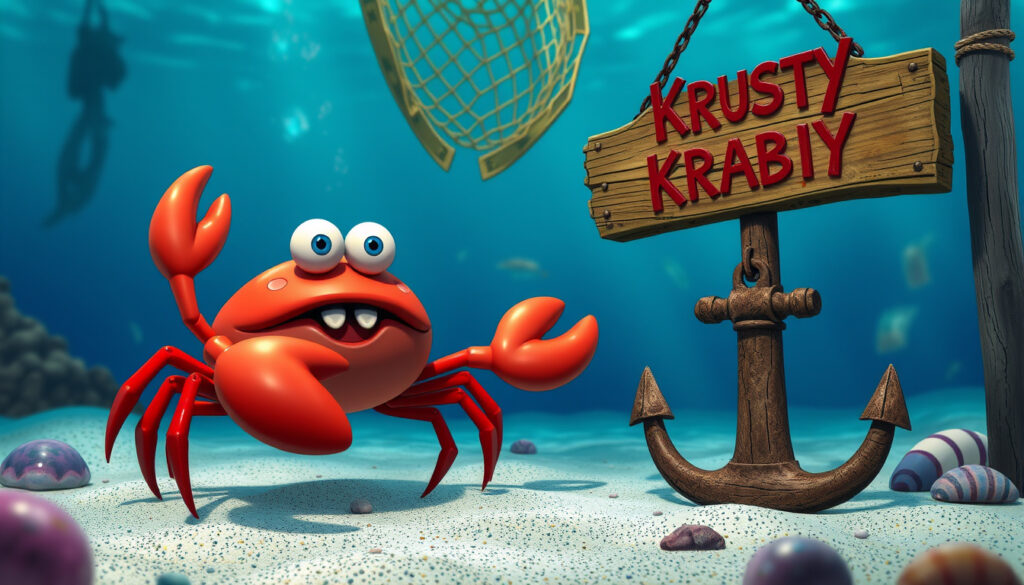
Mr. Krabs Facts: Crab or Lobster? Age, Daughter & More
Ask most people to name the greediest character in Bikini Bottom, and the answer usually lands before the question does: Mr. Krabs. The red crab who owns the Krusty Krab is one of SpongeBob SquarePants’ most recognizable faces, yet the questions fans type about him — lobster or crab, born in 1942 or 1960, good or bad — rarely line up with what Nickelodeon actually says, and sorting the confirmed canon from the fan theories takes more digging than a Krabby Patty secret.
Species: Crab ·
Canonical full name: Eugene Harold Krabs ·
Known for: Owner of the Krusty Krab ·
Family: Father of Pearl
Quick snapshot
- A crab by design: broad carapace, oversized claws, no elongated lobster tail (Briefing Room’s character analysis).
- Owner of the Krusty Krab and the boss of SpongeBob and Squidward (Encyclopedia SpongeBobia’s main-character list).
- Voiced by Clancy Brown (BuzzFeed’s interview with Clancy Brown).
- His exact birth year — 1942, 1960, or something else — with no official page settling it.
- Whether any canonical “darkest secret” exists under the Krabby Patty lore.
- How a real court would sentence him; the show never puts him on trial.
- Debuted in the pilot “Help Wanted,” which aired , and has stayed active in franchise materials since (Wikipedia’s Mr. Krabs entry).
- Created by Stephen Hillenburg, who trained in marine biology before animation (Wikipedia’s Stephen Hillenburg entry).
- The official character page remains the tiebreaker for species, age, and death rumors (Nickelodeon Universe’s official character page).
- New SpongeBob productions keep the character in rotation, which keeps the fan debates running. (Nickelodeon Universe’s official character page)
- Expect more “darkest secret” content until canon adds new material. (Nickelodeon Universe’s official character page)
Seven facts, one pattern: the official record is short, consistent, and entirely uninterested in the moral debates fans build around it.
| Label | Value |
|---|---|
| Full name | Eugene Harold Krabs, with the “K” as part of the canonical spelling (SpongePedia’s character entry). |
| Species | Crab — broad carapace, large claws, no lobster tail (Nickelodeon Universe’s official character site). |
| Residence | An anchor in Bikini Bottom, shared with Pearl (SpongePedia’s character entry). |
| Occupation | Owner of the Krusty Krab (SpongePedia’s character entry). |
| Role | Boss of SpongeBob and Squidward (Nickelodeon Universe’s official character site). |
| Family | Father of Pearl, a whale — an intentionally unusual pairing in the show’s universe (Encyclopedia SpongeBobia’s main-character list). |
| Rival | Plankton, owner of the Chum Bucket (Encyclopedia SpongeBobia’s main-character list). |
Is Mr. Krabs a lobster or a crab?
Short answer: crab. The species question is one of the few Krabs debates with a clean, official answer.
What kind of animal is Mr. Krabs?
- Official wording: “crimson sea crab,” and the franchise stays on crab terminology from start to finish (Nickelodeon Universe, official character site).
- Creator’s intent: the character was designed by Stephen Hillenburg, whose marine-biology background made the crab choice deliberate — the source appears in the timeline card above.
Nickelodeon’s character page calls Mr. Krabs a crimson sea crab and never once calls him a lobster. That consistency matters: in a show full of fish, mammals, and plankton, the writers could have made him any crustacean they wanted. They picked crab and stayed with it.
The marine-biology detail is the quiet confirmation. Hillenburg studied the ocean before he drew it, so he knew exactly what a crab looked like — and exactly what it didn’t. Mr. Krabs has the wide shell and the heavy claws of a crab, not the long tail of a lobster.
Why do people confuse Mr. Krabs with a lobster?
- Color and anatomy: red shells read as “cooked lobster,” but real crabs carry a broad, compact carapace, while lobsters run longer with a segmented abdomen and prominent antennae (Briefing Room’s character analysis).
- Design: Krabs is drawn with a wide, crab-like body and oversized claws — the lobster read comes from thumbnails and memes, not his silhouette.
Hold the two animals side by side and the difference is obvious: a crab is built like a shield, a lobster like a tank with legs. Mr. Krabs is all shield. His red coloring is the only real evidence for the lobster theory, and red is a cartoon shortcut for “shellfish,” not a zoology report.
Color is a caricature choice, not a taxonomic one. For anyone defending the lobster reading, the official character page settles it: canon says crab.
Was Mr. Krabs born in 1942 or 1960?
Neither date is on the official record. Both figures come from fan arithmetic layered onto a cartoon timeline that was never designed to hold still.
What the official record says about Mr. Krabs’ age
- No birth year appears on Nickelodeon’s official character description (Nickelodeon Universe, official character site).
- The 1942 and 1960 options come from fan calculations of in-universe timelines, not from show canon.
- The only confirmed date in the character’s history is the pilot premiere, , in “Help Wanted” — cited in the timeline card above.
Mr. Krabs’ age shifts depending on which episode you treat as the clock. The show runs on a soft timeline: holidays repeat, seasons blur, and the main cast stays roughly the same age for hundreds of episodes. That flexibility lets fans build elaborate birth-year chronologies — and it’s also why no two of those chronologies agree.
The 1942 versus 1960 question sounds like a fact check, but there is no canonical birth certificate to consult. No episode pins the year down, no creator statement assigns him a birthday, and the official page never mentions one. The accurate answer to “was he born in 1942 or 1960?” is: neither is confirmable, and the show doesn’t care.
Did Mr. Krabs pass away?
- No canonical death exists in any episode or film.
- Wikipedia’s entry still lists him among the franchise’s active characters, with no death record (Wikipedia’s Mr. Krabs entry).
- The death question shows up in search data, but no official source, episode, or announcement supports it.
Where the rumor comes from is unclear — it may trace to a specific episode, a meme, or a fan theory that got copied until it looked like news. What the record shows is simpler: Mr. Krabs keeps appearing in new SpongeBob productions, and Nickelodeon keeps listing him among current characters. A character who is still being written for has not died.
Treating fan-calculated dates as canon turns a deliberately soft cartoon timeline into false biography. The only hard date in Krabs’ record is the 1999 pilot — everything else is arithmetic in search of a source.
Is Mr. Krabs good or bad?
The honest answer is neither — he is written to be laughed at, not judged. That does not stop the internet from putting him on trial.
The official framing
- Nickelodeon’s description leads with money: Krabs is “strongly associated with money and a miserly personality,” and the same official material calls him “a truly okay dad” to Pearl (Nickelodeon Universe, official character site).
- His rivalry with Plankton supplies the show’s central conflict — Plankton’s role as Chum Bucket owner and arch-nemesis is in the key facts table above.
- Both characters’ flaws are played for comedy, not judged as crimes; the show never applies a moral framework to its own cast.
“Good” and “bad” are words the show never uses. Krabs is greedy, cheap, and occasionally cruel to his employees, and he is also Pearl’s father — an “okay” one, per Nickelodeon’s own description. Official material holds both halves at once: the money-obsessed boss and the “truly okay dad.” That tension is the character.
Call him bad and you miss that the show laughs with him, not just at him. Call him good and you miss every scene where he treats a dollar like a family member. The writers built a character whose priorities are deliberately out of order, then let comedy resolve the contradiction.
How long would Mr. Krabs go to jail?
- The show never depicts a legal system, a trial, or a sentence — “jail time” is a fan hypothetical, not a canon category.
- Without an established crime, a court, or even a crime rate in Bikini Bottom, any sentence is fan fiction with extra math.
- Comic logic runs the world: characters face slapstick consequences, not prison terms.
This question shows how far the fan framework can drift from the source material. There is no Bikini Bottom penal code to cite, no courtroom episode establishing what happens to shellfish entrepreneurs who overcharge their staff, and no canon answer waiting to be discovered. The only honest response is: we cannot compute it, because the show never gives us the inputs.
What sin is Plankton? What is Squidward’s sin?
- The seven-deadly-sins framework is imported by fans; the show never assigns sins to anyone.
- Krabs reads naturally as greed — the miserly trait Nickelodeon’s own page puts first.
- Plankton and Squidward get mapped to envy, wrath, or pride depending on the meme, but those labels are fan commentary, not writer’s notes.
The sin-mapping trend is a fun lens, and it fits: a show about a greedy crab, a scheming plankton, and a bitter cashier is practically begging for a morality-play reading. But the writers never frame it that way. Plankton isn’t “evil” in the show’s vocabulary — he is a tiny failed businessman whose schemes explode every week. Squidward isn’t punished for pride; he is just miserable in a job he hates. The sins belong to the audience, not the canon.
Call Krabs a villain and you ignore the show’s own framing; call him a hero and you ignore every scene where he treats a dollar like a family member. The verdict that fits the record: morally mixed on purpose.
What this means: the “good or bad” question is a taste test wearing a fact-check’s clothes. The official record’s answer is two words — “truly okay dad” — which is Nickelodeon’s way of saying this guy is a mess, and that’s the joke. For another canon-versus-fan-theory split, our Black Panther: MCU facts guide applies the same rulebook.
The pattern: the canon settles what Krabs is, not whether he belongs in a moral lineup.
Why is Mr. Krabs a jerk?
Because the show made him one on purpose, for laughs. “Jerk” is not a hidden character flaw; it’s the design spec.
Is Mr. Krabs a villain?
- Official material classifies him as the owner of the Krusty Krab and the father of Pearl — nowhere is he labeled a villain (both entries are sourced in the key facts table above).
- His conflicts with SpongeBob and Squidward stay inside workplace comedy; the show’s villain slot belongs to Plankton, the rival listed in the table above.
- Nickelodeon’s own description calls him “a truly okay dad,” which is not a villain’s job description.
There is a reason the jerk question keeps coming up: Krabs treats his employees like line items. He is the boss who watches every napkin, every spatula, every patty — and that obsessive cost-cutting makes him abrasive. But the show never walks him into true villainy. Plankton gets that role, and even Plankton is played as a comedic failure rather than a threat.
Is Mr. Krabs rude to SpongeBob and Squidward?
- Yes — routinely. His miserly streak creates constant comic conflict with the staff he underpays and overworks.
- The series resolves those conflicts with jokes; consequences arrive as gags, not as character growth or punishment.
- Underneath it, Krabs is written as the anchor of a workplace comedy trio: the cheap boss, the eager employee, the exhausted cashier.
Rude is the right word, but it is the same rudeness that makes him funny. If Krabs treated everyone well, there would be no conflict, and without conflict the Krusty Krab would be a restaurant instead of a comedy engine. Fans who call him a jerk aren’t wrong; they’re describing the mechanism that makes the episodes work.
Why does Mr. Krabs say boyo?
“Boyo” is the verbal equivalent of his pirate-actor voice: an accent worn like a costume, and it tells you exactly who Krabs thinks he is.
What does “boyo” mean?
- In Irish, Scottish, and British English, “boyo” is an informal word for a boy or young man — friendly, teasing, or mildly dismissive depending on the tone.
- Mr. Krabs uses it as a catchphrase when addressing younger or lower-ranking characters, with SpongeBob as the regular target.
- The word fits his salty, boss-like persona: it’s a captain talking to the crew.
The dictionary definition is simple, but the character usage does more work. Krabs doesn’t say “boyo” to be warm; he says it to keep distance between “owner” and “employee.” It’s a power word dressed up as slang — the same way calling someone “kid” can be affectionate or condescending, depending on who signs the paychecks.
Is “boyo” a real dialect word?
- Yes — it is a genuine informal term in Irish, Scottish, and British English, not a word invented for the show.
- Clancy Brown built the voice around a Treasure Island-style pirate archetype, which explains why Krabs leans so hard into salty, theatrical speech (BuzzFeed’s interview with Clancy Brown).
- The pirate affect turns a regional word into a global catchphrase — delivery can outrank meaning.
Brown has said the audition materials described a crab who ran a diner and was a skinflint, and the vocal direction clicked when he reached for the old pirate-archetype growl. “Boyo” rides on that same voice: gruff, performative, and just theatrical enough to sell the idea that a crab is the captain of his own restaurant. The full quote appears in the next section.
What is Mr. Krabs’ darkest secret?
Short version: none exists in canon. The “darkest secret” is a fan construction built from parts of the show that are already public.
What the show confirms
- No episode reveals a hidden criminal past, a secret family, or anything the phrase “darkest secret” would require.
- The franchise’s closest thing to a mystery is the Krabby Patty formula — the recipe Plankton repeatedly tries to steal, with zero success.
- Official material presents Krabs as money-obsessed on the surface, with no conspiracy underneath: the miserly traits are the whole character.
The Krabby Patty formula is the only locked box in the franchise, and the show keeps it locked for a simple reason: it powers the Krabs-Plankton rivalry. Every attempt to steal it gives the show a plot, and every failure gives it a punchline. A real “darkest secret” would change what the formula means — so the writers have never written one.
What the fan theories add
- “Darkest secret” theories stack on top of the formula, the rivalry, and Krabs’ single-minded greed — three public ingredients mixed into a gothic story the show never tells.
- The broader “darkest SpongeBob theory” genre re-reads the whole show as horror, with Krabs recast as a capitalist monster instead of a cheap boss.
- None of those readings are confirmed; they are entertaining interpretations, but the canon has never adopted them.
Fan theories are allowed to be creative. The problem starts when they outrank the source material in search results. The darkest thing in Mr. Krabs’ actual file is the contrast between the cheerful, money-hoarding crab on Nickelodeon’s page and the sinister figure some theories imagine. That contrast is the engine of the genre — and it is also the joke.
The darkest secret in the Krabs file is the gap between what the show says and what the internet wants him to be. That gap generates every theory — and it is exactly where the comedy lives.
Official canon vs. fan chatter
Five questions, one split: the left column is documented, and the right column is invented — sometimes lovingly, sometimes recklessly.
| Question | Official canon | Fan chatter |
|---|---|---|
| Species | Crab — “crimson sea crab” in Nickelodeon’s own description | Lobster, because his shell is red |
| Birth year | Not listed anywhere in official material | 1942 or 1960, depending on which fan timeline you trust |
| Morality | A “truly okay dad” with a miserly streak | A villain, a capital-S Sinner, or the subject of a sins meme |
| Death | No canonical death; still an active character | A rumor with no episode or announcement behind it |
| Darkest secret | None revealed; the Krabby Patty formula is the only mystery | Hidden crimes, secret motives, a horror-show re-reading |
The pattern: every cell on the left can be verified in minutes, and every cell on the right is a choice. That’s not a flaw in fandom — it’s what fandom does. The only mistake is confusing the two columns.
Confirmed facts vs. what’s unclear
Confidence check: the confirmed stack is short, and the unclear stack is longer — because the show gives the internet very little biography to work with.
Confirmed facts
- Mr. Krabs is a fictional crab, officially described as a “crimson sea crab” (key facts table above).
- His full name is Eugene Harold Krabs, and the “K” spelling is canonical (key facts table above).
- He owns the Krusty Krab and employs SpongeBob and Squidward (key facts table above).
- He is Pearl’s father, and his business rival is Plankton (key facts table above).
What’s unclear
- His exact in-universe birth year — including the 1942 or 1960 guesses.
- Whether any canonical “darkest secret” exists beneath the franchise’s surface.
- How a real court would sentence him, since the show never defines a legal framework.
- Whether the death question points to a specific episode, a rumor, or a meme.
- Whether fan sin-mappings — greed, envy, pride — reflect any actual writer intent.
The implication: the confirmed column is the part you can cite; the unclear column is the part you get to argue about.
Voices behind the character
Two sources, two kinds of authority: the man who voices the performance, and an analysis of the real animals behind the cartoon.
“A crab who ran a diner and was a skinflint.”
— Clancy Brown, voice of Mr. Krabs, describing the audition materials in a BuzzFeed interview
“Crabs generally have a broad, compact carapace, while lobsters generally have a longer segmented abdomen and prominent antennae.”
— Briefing Room, Mr. Krabs character analysis
What the two quotes add up to: the voice actor’s memory confirms the character’s design ethos, and the anatomical comparison confirms that the design is visible on screen. The crab reading is backed by the person who created the performance and the biology that inspired it.
Every confirmed fact about Mr. Krabs fits in a short table: he is a crab, he owns the Krusty Krab, he is Pearl’s father, and his creator trained in marine biology. Everything else — the birth year, the hidden sins, the dark secret, the jail sentence — is fan theory wearing a fact-check’s clothes. For anyone about to argue Krabs’ morality in the comments, the choice is clear: cite Nickelodeon’s character page and win the canon debate, or admit the argument has moved into headcanon, where every verdict is personal.
Related reading: Black Panther: New Black Panther, Movies, Awards & MCU Facts
nickelodeonuniverse.com, australiavoice.org, protagonists.fandom.com, en.spongepedia.org
Frequently asked questions
Who voices Mr. Krabs?
Clancy Brown. He told BuzzFeed the audition materials described the character as “a crab who ran a diner and was a skinflint,” and he built the voice around a Treasure Island-style pirate archetype.
What is Mr. Krabs’ real name?
Eugene Harold Krabs, spelled with a K. That spelling is part of the canonical character name.
Who is Mr. Krabs’ daughter?
Pearl, a whale who lives with him in an anchor. The father-daughter pairing is biologically unusual on purpose, and the show never explains it.
Why does Mr. Krabs care so much about money?
It’s the core of the character. Nickelodeon’s official description says he is “strongly associated with money and a miserly personality,” and that trait drives most of the comedy at the Krusty Krab.
Does Mr. Krabs have a wife?
No wife has ever appeared in the series, and Pearl’s mother is never identified in canon. Official character material lists Krabs and Pearl as the household.
What is the Krabby Patty secret formula?
The show never reveals the full formula. The secret recipe is the plot device behind Plankton’s endless attempts to steal it, which means it works better as an engine for stories than as a real answer.
More related posts
 Gerry Adams: IRA Allegations, Shooting, and Current Life
 Leonardo da Vinci: Biography, Art, Inventions and Legacy
 EmRata: Emily Ratajkowski’s Age, Baby, Split & More
 Kevin Nash: Career, Net Worth, and Legacy in Wrestling
 Rick Moranis: Why He Quit Acting and His Return
 Martin Short: Tragedy, Friendship, and Personal Life
 Alfie Allen: Game of Thrones, Family, Net Worth, and More
 New York Times Strands: Today’s Hints, Spangram & Answers