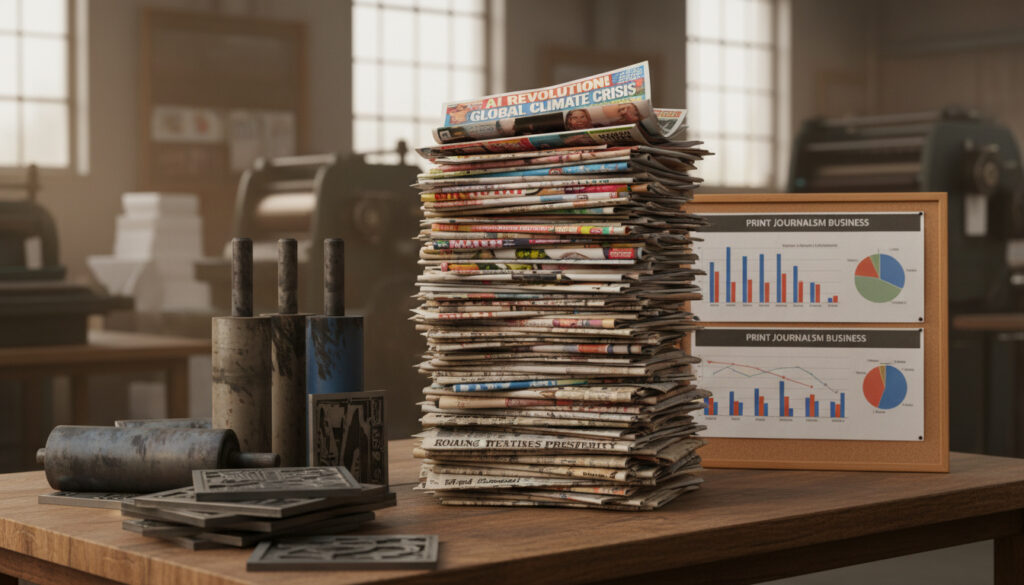
Newspaper – Definition History Types Revenue
A newspaper is a periodical publication that reports current events, features opinion pieces, and includes advertising. It typically covers local and national politics, crime, business, entertainment, and sports. Newspapers serve as a form of mass communication and mass media.
Issued daily, weekly, or at regular intervals, newspapers have long informed the public. Their role evolved with technology, yet they remain vital despite digital shifts.
From ancient precursors to modern formats, newspapers blend news, views, and commerce.
What defines a newspaper?
| Characteristic | Description |
|---|---|
| Publication schedule | Daily, weekly, or regular intervals |
| Core content | Current events, opinion pieces, advertising |
| Topics covered | Politics, crime, business, entertainment, sports |
| Societal role | Mass communication and media |
- Newspapers originated with ancient Roman Acta diurna around 59 BC.
- Johannes Gutenberg’s printing press in the mid-1400s enabled mass production.
- First printed newspaper appeared in Germany in 1605.
- English daily newspapers began with The Daily Courant in 1702.
- Formats include broadsheets for serious news and tabloids for sensational stories.
- Revenue primarily from display ads, inserts, and classifieds.
- Competition from radio, TV, and digital media persists.
| Fact | Details |
|---|---|
| Ancient origin | Acta diurna posted in Rome, 59 BC |
| Handwritten sheets | Circulated in Venice from 1566 |
| Printing innovation | Gutenberg press, mid-1400s |
| First European printed | Relation aller Fürnemmen und gedenckwürdigen Historien, 1605, Germany |
| English corantos | Appeared in London, 1621 |
| First English daily | The Daily Courant, 1702–35 |
| Censorship relaxed | England, 1695 |
| High-speed presses | 1830s, enabled mass access |
| Competition begins | Radio 1920s, TV 1950s |
| Format: Broadsheet | Large pages, in-depth coverage |
How did newspapers develop historically?
Origins trace to ancient Rome’s Acta diurna (Britannica), carved announcements of events from 59 BC.
Early modern beginnings
Handwritten news sheets circulated in Venice by 1566, focusing on wars and politics (Wikipedia).
Impact of printing
Gutenberg’s press in the mid-1400s allowed mass production (Fiveable). Germany’s 1605 Relation aller Fürnemmen und gedenckwürdigen Historien became Europe’s first printed newspaper (Study.com).
Gutenberg’s invention transformed news from elite manuscripts to accessible print for the masses.
English expansion
Corantos arrived in 1621; The Daily Courant launched as the first daily in 1702. Censorship eased in 1695, spurring growth in London, Boston, and Philadelphia.
What types and classifications of newspapers exist?
Newspapers vary by format, geography, and content focus.
Format distinctions
Broadsheets offer large pages and serious coverage for professionals, like The New York Times and The Wall Street Journal. Tabloids use compact sizes for sensational news, such as New York Post and The Sun. Berliner format spans 12.4 by 18.5 inches.
Broadsheets prioritise depth; tabloids emphasise visuals and celebrity stories.
Geographic scope
National dailies reach countries-wide. Metropolitan ones cover cities and regions. Suburban and small-town editions serve local areas. Ethnic dailies target non-native speakers.
How do newspapers sustain themselves amid challenges?
Advertisements dominate revenue through display, inserts, and classifieds.
Competition intensified from radio in the 1920s, television in the 1950s, and digital platforms later. Print persists under pressure.
Digital media erodes traditional ad income, forcing adaptation.
What are the key milestones in newspaper history?
- : Acta diurna in Rome.
- : Handwritten sheets in Venice.
- : Gutenberg’s printing press.
- : First printed newspaper in Germany.
- : English corantos in London.
- : English censorship relaxed.
- : The Daily Courant launches.
- : High-speed presses expand access.
- : Radio and TV competition rises.
These events mark the path from stone carvings to widespread print (Scribd).
What facts about newspapers are established versus unclear?
| Established | Unclear or developing |
|---|---|
| Definition as periodical with news, opinions, ads | Precise boundary between ancient precursors and modern form |
| First printed: 1605 Germany | Exact impact of early handwritten sheets on spread |
| Format types: broadsheet, tabloid, Berliner | Long-term survival strategies against digital |
| Revenue from advertising | Future revenue models amid competition |
| Geographic classifications | Shifting reader demographics |
What role do newspapers play in society?
Newspapers act as mass media, disseminating information regularly. They connect communities through local coverage and inform on global affairs.
High-speed printing from the 1830s democratised access across continents.
What do key sources reveal about newspapers?
Newspapers are usually issued daily, weekly, or at other regular intervals and serve as a form of mass communication and mass media.Britannica
The first printed newspapers emerged in Germany from 1605.Study.com
What summarises the essence of newspapers?
Newspapers blend reporting, opinion, and commerce in print formats shaped by history and geography. They endure challenges through adaptation. See History of newspaper publishing and Australia Insight for deeper origins.
What is the definition of a newspaper?
A periodical reporting events, opinions, and ads on politics to sports. Mass media issued regularly.
What was the first printed newspaper?
Relation aller Fürnemmen und gedenckwürdigen Historien in Germany, 1605.
What is a broadsheet newspaper?
Large format focusing on in-depth, serious news for professionals.
How do newspapers make money?
Mainly through display ads, inserts, and classifieds.
What challenges do newspapers face?
Competition from radio, TV, and online platforms.
What is the Berliner format?
12.4 by 18.5 inches, between tabloid and broadsheet sizes.
Where did modern newspapers originate?
Europe, with Venice sheets in 1566 and Germany prints in 1605.
More related posts
 Aveeno Calm + Restore: Benefits, Reviews & CeraVe Comparison
 Chris Martin Relationships: Dakota Johnson, Gwyneth Paltrow & Health Rumors
 US Planes to Middle East: 2026 Military Buildup and Deployments
 Scott Parker Leaves Burnley: Career, Family, and What’s Next
 Steve Coogan: Relationships, Sobriety & Controversies
 Why Uncle Buck Still Makes Us Laugh and Cringe
 Mary Shelley: Life, Loves, Illness, and the Heart Legend
 Newcastle United F.C. vs Everton F.C. Standings – Current Table, H2H and Form Stats