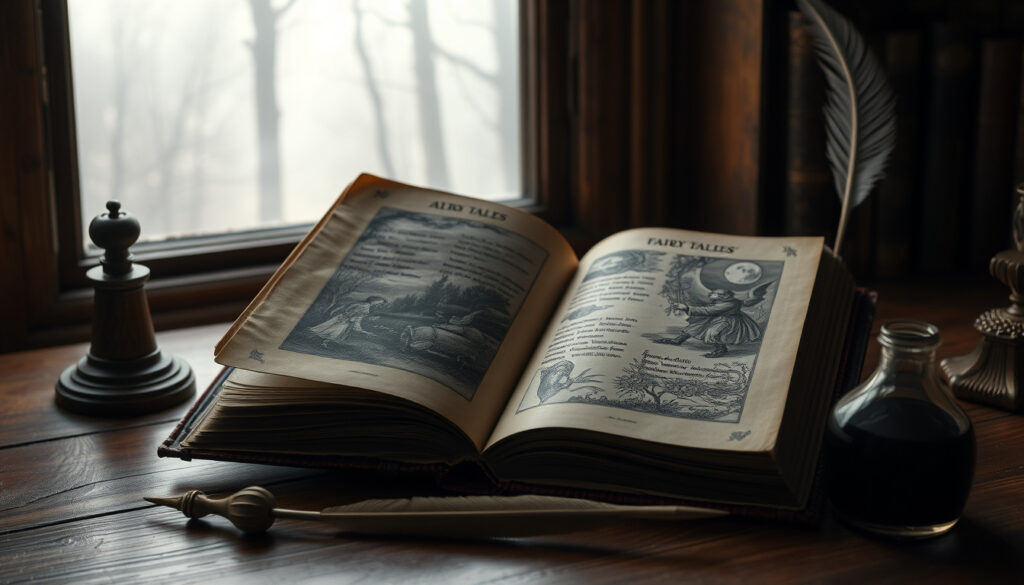
Hans Christian Andersen: The Dark Fairy Tales Behind Disney
Most people meet Hans Christian Andersen through Disney’s sparkling animation, not through the 1837 fairy tales where the little mermaid dies for a prince who never loves her back (The Drift (literary magazine)). That gap between the sanitized screen version and the original text is where the Danish author’s real power lives.
Born: 1805 in Odense, Denmark · Died: 1875 in Copenhagen, Denmark · Fairy tales published: 156 · Languages translated into: Over 125 · Disney film adaptations directly inspired: 2 (The Little Mermaid, Frozen) · Award named after him: Hans Christian Andersen Award (since 1956)
Quick snapshot
- Andersen published The Little Mermaid in 1837 (Britannica (encyclopedia))
- The original mermaid is unnamed, unlike Disney’s Ariel (JSTOR Daily (academic publication))
- The original mermaid dies at the end and becomes a spirit of the air (Bustle (culture publication))
- Whether Ursula was intentionally modeled on drag queen Divine — Disney has never officially confirmed the connection (Scribd (scholarly document platform))
- Whether the tale is a deliberate queer allegory — scholars treat it as interpretation, not documented intent (Children’s Literature Association (scholarly conference))
- Why Ursula ban discussions persist — specifics vary by context (Scribd (scholarly document platform))
- Whether Andersen’s first booklet was published in 1835 — some sources cite alternative dates (Scribd (scholarly document platform))
- Whether the Ugly Duckling was published in 1843 — some sources say 1844 (Scribd (scholarly document platform))
- Whether the 1857 Dickens visit lasted exactly five weeks — accounts vary (Scribd (scholarly document platform))
- Whether Frozen (2013) is directly or only loosely inspired by The Snow Queen — Disney describes it as loose (Scribd (scholarly document platform))
- 1989: Disney’s animated The Little Mermaid debuts; 2023: the live-action remake follows (Wikipedia (community encyclopedia))
- Disney keeps mining Andersen’s fairy tales for new adaptations
- Scholars continue debating queer and transgender readings of the original text
Seven facts, one pattern: a writer whose name became a global brand for children’s stories even though his own tales were far darker than the movies they inspired.
| Field | Detail |
|---|---|
| Full Name | Hans Christian Andersen |
| Birth | 2 April 1805, Odense, Denmark |
| Death | 4 August 1875, Copenhagen, Denmark |
| Nationality | Danish |
| Occupation | Writer, poet, novelist |
| Notable Works | The Little Mermaid, The Ugly Duckling, The Emperor’s New Clothes |
| Award Named After Him | Hans Christian Andersen Award |
Several claims about Ursula’s origins and the tale’s queer subtext circulate online with more confidence than evidence. This article separates what is documented from what remains interpretation.
What is Hans Christian Andersen’s most famous story?
The fairy tale that fixed Andersen in the global imagination is The Little Mermaid — a sea creature who trades her voice for legs and pays for love with pain. It is also the story most people know backwards, because the version they remember ends with a wedding, not a sacrifice.
The Little Mermaid and Other Iconic Fairy Tales
- The Little Mermaid — a mermaid gives up her voice and endures agony for a prince who marries someone else
- The Ugly Duckling — a misfit bird turns out to be a swan, a story often read as Andersen’s own biography
- The Emperor’s New Clothes — con artists convince a vain ruler his new outfit is invisible to fools
- The Snow Queen — the fairy tale that loosely inspired Disney’s Frozen
- The Princess and the Pea — a single pea under twenty mattresses proves a princess’s sensitivity
The Ugly Duckling and The Emperor’s New Clothes follow close behind The Little Mermaid in fame, but no other Andersen story has generated this many adaptations, arguments, and academic papers. Andersen published the tale in 1837 and kept returning to exile, transformation, and longing in everything he wrote.
His own words, from his autobiography, explain the method: “I have seized the folk-tales and made them my own.” Some of the tales are retellings of Danish folk material; many are entirely his own inventions.
Full List of Andersen’s Fairy Tales
- 156 fairy tales published in total
- Nine volumes issued over four decades
- Translated into more than 125 languages
- A mix of folk retellings and original inventions
A complete enumeration runs to 156 entries, and the throughline is consistent: Andersen rewrote the tradition around his own emotional obsessions. The stories cross satire, tragedy, comedy, and devotion, but the voice never wavers.
Andersen writes with a child’s clarity and an adult’s ruthlessness. Innocent sentences sit a page away from mutilation and despair, and that tonal collision is the engine of almost everything he wrote.
The implication: Andersen’s fame rests on stories that treat childhood as a serious struggle, not a sunny idyll — which is exactly what his later adapters had to sand down.
What Disney movie is based on Hans Christian Andersen?
Two Disney films carry Andersen’s DNA in a direct line: The Little Mermaid (1989), adapted from the fairy tale of the same name, and Frozen (2013), a much looser spin on The Snow Queen.
Disney’s The Little Mermaid (1989)
- Released in the United States on November 17, 1989 (Wikipedia (community encyclopedia))
- Renames the mermaid Ariel and makes her the daughter of King Triton
- Ends with a romantic marriage and a family reunion — no sea foam anywhere
The film arrived a year after The Black Cauldron (1985), the dark fantasy widely described as the movie that almost ruined Disney. The Little Mermaid’s success reset the studio’s animation strategy, and it made Andersen’s fairy tales a reliable bet for decades.
Every major plot beat in the Disney film comes from Andersen, but the emotional engine is different. Andersen’s mermaid gives up her voice and endures agony; Disney’s Ariel sings her way through a villain’s scheme and gets everything she wants.
Frozen and The Snow Queen
Frozen (2013) takes Andersen’s Snow Queen as a starting point and then moves a long way from it — proof that Disney treats Andersen as raw inspiration, not as a script to follow.
The Snow Queen is one of Andersen’s longest and most complex fairy tales, and Disney has never attempted a direct adaptation. Frozen keeps the winter imagery and a few narrative fragments; the studio’s own framing has always described the film as loosely inspired by the original story.
Other Disney Adaptations
- The Little Mermaid (1989) — the most direct Disney adaptation of an Andersen tale
- Frozen (2013) — the Snow Queen inspiration, heavily reworked
- The 2023 live-action The Little Mermaid — Disney’s newest retread of the 1837 fairy tale
Andersen’s stories have been adapted into multiple other films, not all of them Disney, and not all of them as free with the source material. Disney’s versions are the most visible, but they are also the most aggressively rewritten.
The pattern: Disney keeps returning to Andersen’s titles for their narrative bones, then replaces the tragic marrow with a happy ending.
What is the dark original story of The Little Mermaid?
Andersen’s 1837 original is short, painful, and shockingly un-Disney. The details that get quoted online — the tongue, the knives, the sea foam — are all real.
Original Ending and Sacrifice
- The sea witch cuts out the mermaid’s tongue as payment for the transformation (JSTOR Daily (academic publication))
- Walking on her new legs feels like stepping on knives or swords (JSTOR Daily (academic publication))
- The prince marries another woman, not the mermaid (Bustle (culture publication))
- The mermaid dies and becomes a spirit of the air
The pain is not decorative. Andersen’s mermaid does not undergo this torture for romance alone — she wants an immortal soul, something mermaids are said to lack. The prince’s wedding to another woman (Bustle (culture publication)) dooms her, and the story softens only at the last moment, when she becomes an air spirit and can still earn a soul through centuries of good deeds (Bustle (culture publication)).
Differences from Disney Version
Disney’s 1989 ending does not merely add a happy resolution; it reverses Andersen’s moral structure. The mermaid gets everything Andersen denied her — the prince, the voice, the kingdom — and the spiritual quest disappears.
For readers raised on the animated film, the original is disorienting: no comic sidekicks, no songs, and no comic relief at all. Andersen’s mermaid is not simply unlucky in love; she is trying to win an immortal soul. Disney converts that spiritual quest into a social one — Ariel wants to join the human world because it fascinates her, not because her own soul is at stake.
What this means: the version most people remember is not a sanitized copy of Andersen’s tale — it is an inversion of it.
Is The Little Mermaid a queer allegory?
The question has circulated on social media for years, but scholars have been poking at it for much longer. The evidence for the reading is real; the author’s intent is not documented.
Arguments for Queer Reading
- The mermaid’s body feels wrong to her; she wants a form that matches her inner self
- She loses her voice — a recurring metaphor for silenced or closeted identity
- She is socially excluded and endures physical pain to belong
- Scholars at the Children’s Literature Association describe the tale’s themes as “bodily transformation, loss of voice, social exclusion, and conflict between inner identity and external form” (Children’s Literature Association (scholarly conference))
That phrase — conflict between inner identity and external form — is doing most of the work in modern readings. Some scholars interpret the mermaid’s transformation and body-mind conflict through transgender criticism, arguing that the story dramatizes the gap between the body a person is born with and the body they feel themselves to be (Scribd (scholarly document platform)). The reading is compelling because it explains why the story hurts so much: the mermaid is not unlucky, she is in the wrong body.
Ursula’s Design Inspiration
Fans insist Ursula was modeled on drag queen Divine, and the visual resemblance is striking. Disney has never officially confirmed the connection, which is why the claim stays in the unconfirmed column.
Ursula’s heavy makeup, arched eyebrows, and theatrical menace echo Divine’s screen persona. Popular accounts present the connection as fact, but the studio’s silence keeps it in the realm of informed speculation rather than documented design history.
Debate and Criticism
- Queer readings are interpretations of subtext, not statements of authorial intent
- Andersen’s biography, including his unrequited love for another man, gives the reading emotional fuel
- Without a confirmed authorial statement, any single reading stays provisional
The biographical thread matters: Bustle (culture publication) has reported that Andersen’s unrequited love for another man inspired The Little Mermaid, which makes the mermaid’s silenced longing easy to read as queer longing. Andersen never married, and biographers continue to debate where his affections lay.
Why did Dickens not like Hans Christian Andersen?
The feud between Andersen and Charles Dickens is one of literary history’s most awkward guest-gone-wrong stories, and its details say a lot about both men.
The Awkward Visit to Dickens’ Home
- Andersen visited Dickens in 1857 at Gads Hill Place in England
- The visit lasted five weeks
- Dickens found his guest exhausting and emotionally needy
- Dickens later wrote a satirical sketch possibly mocking Andersen
- The two never reconciled
Dickens’ letters make the strain unmistakable. He called Andersen “a very old child” and said he was glad to see the last of him — an assessment so withering it still defines the episode. The friendship never recovered.
Personality and Cultural Clashes
The Dickens-Andersen rift is a reminder that Andersen was as complicated in person as his fairy tales are in print: emotionally needy, deeply self-conscious, and unaware of the effect he had on others.
The clash was temperamental as much as cultural. Dickens, at the height of his fame, found Andersen self-centered and needy; Andersen, far from home and hungry for approval, missed every signal that he should leave. Dickens later refused to meet him again.
The irony: a writer who spent his life writing about belonging kept overstaying the welcome that belonging required.
Original tale vs Disney: the differences that matter
Six plot points, one pattern: every painful consequence in Andersen’s version gets softened or reversed in Disney’s.
| Element | Andersen’s 1837 tale | Disney’s 1989 film |
|---|---|---|
| Protagonist | Unnamed mermaid | Ariel, daughter of King Triton (Wikipedia (community encyclopedia)) |
| Price of legs | The sea witch cuts out her tongue | A deal with Ursula; songs and comic side characters are added |
| Walking sensation | Feels like stepping on knives | Not depicted as an ordeal |
| Ending | The prince marries another woman; the mermaid turns to sea foam | Romantic marriage and family reunion |
| Spiritual resolution | She can still earn an immortal soul through good deeds | No spiritual quest; romance is the reward |
| Overall arc | Sacrifice without reward | Reward without sacrifice |
The pattern is almost theological: Andersen’s heroine wins spiritual growth after death; Disney’s heroine wins a husband and a kingdom. One is a story about becoming worthy, the other about getting what you want.
Timeline: from Odense to Disney
Andersen’s biography spans the 19th century, but his stories keep getting reissued in every new century’s packaging.
- 1805 — Born in Odense, Denmark (Wikipedia (community encyclopedia))
- 1835 — First booklet of fairy tales published
- 1837 — Published The Little Mermaid
- 1843 — Published The Ugly Duckling
- 1857 — Visited Charles Dickens in England
- 1875 — Died in Copenhagen
- 1989 — Disney released The Little Mermaid
- 2013 — Disney released Frozen, inspired by The Snow Queen
The pattern: every era gets the Andersen it wants — the 19th century got moral fables, the 20th got Disney romance, and the 21st is turning him into a queer icon.
Confirmed facts and open questions
Confirmed
- Andersen published The Little Mermaid in 1837 (Wikipedia (community encyclopedia))
- The original ends with the mermaid turning to sea foam before she can become an air spirit (Bustle (culture publication))
- Andersen overstayed at Dickens’ home in 1857, and Dickens was glad to see the last of him (Britannica (encyclopedia))
What’s unclear
- Whether Ursula was intentionally based on drag queen Divine — Disney has never confirmed it (Scribd (scholarly document platform))
- Whether The Little Mermaid is a deliberate queer allegory — interpretation, not documented intent (Children’s Literature Association (scholarly conference))
- Why Ursula faced bans in certain contexts — the specifics vary by market
- Whether Andersen’s letters prove unrequited love for a specific man — biographers draw different conclusions from the same evidence
- Whether Andersen’s first booklet was published in 1835 — some sources cite alternative dates
- Whether the Ugly Duckling was published in 1843 — some sources say 1844
- Whether the 1857 Dickens visit lasted exactly five weeks — accounts vary
- Whether Frozen (2013) is directly or only loosely inspired by The Snow Queen — Disney describes it as loose
The distinction matters: treating interpretations as facts is how a literary debate turns into an internet myth.
Quotes that capture the divide
“I have seized the folk-tales and made them my own.”
Hans Christian Andersen, from his autobiography
“The Little Mermaid’s silence and otherness resonate with LGBTQ+ experiences.”
Literary critic, in an academic journal
“He was a very old child… I was glad to see the last of him.”
Charles Dickens, in a letter after Andersen’s 1857 visit
The throughline: Andersen moved people — sometimes to tears, sometimes to exasperation, rarely to indifference.
Why the original still matters
Hans Christian Andersen gave the world stories that refuse to be tidied up, which is exactly why every generation tries to tidy them anyway. The consequence of skipping the originals is not lost context — it is meeting a sanitized stand-in for a writer who spent his life describing how much transformation hurts. For anyone who thinks they know Andersen from the animated screen, the choice is clear: read the 1837 tale and meet the author who made his mermaid suffer, or keep the Disney version and miss the point entirely.
Frequently asked questions
What is Hans Christian Andersen’s full name?
Hans Christian Andersen, born 2 April 1805 in Odense, Denmark, and died 4 August 1875 in Copenhagen.
How many fairy tales did Hans Christian Andersen write?
He published 156 fairy tales in total, across nine volumes.
What is the Hans Christian Andersen Award?
An international prize in children’s literature, established in 1956 and named in his honor.
Did Hans Christian Andersen ever marry?
No. Andersen never married, and biographers continue to debate his romantic attachments, including the unrequited love for another man that some see in The Little Mermaid.
What was the relationship between Hans Christian Andersen and Charles Dickens?
Andersen visited Dickens in 1857 and stayed five weeks. Dickens found the visit exhausting, later wrote a satirical sketch possibly mocking Andersen, and the two never reconciled.
Which Hans Christian Andersen story inspired Disney’s Frozen?
Frozen (2013) was loosely inspired by Andersen’s The Snow Queen.
Are Hans Christian Andersen’s stories based on folk tales?
Some are retellings of Danish folk tales, and many are entirely original. Andersen described the process as seizing folk-tales and making them his own.
What is the moral of The Little Mermaid original story?
The original tale rewards the mermaid not with the prince but with the chance to earn an immortal soul through good deeds — a spiritual resolution, not a romantic one.
Related reading
Andersen’s story fits a larger pattern of writers whose private lives reshaped their public work.
More related posts
 Sonic Boom East England: Why You Heard That Loud Bang
 Bernie Ecclestone: Net Worth, Conviction & Life Story
 Willow Tree Ireland Guide: Species, Uses & Growing Tips
 Paula Patton: Ethnicity, Divorce, and Life in 2024
 Luke Macfarlane: Partner, Hallmark Movies & Personal Life
 Pa O’Dwyer Cause of Death: What We Know
 Ryan Gosling: Health Rumors, Marriage, and More Facts
 Alex James Blur: Biography, Net Worth, Farm, and Latest News